

Enterprise hiring no longer suffers from a lack of tools.
There are plenty of them: ATS platforms, job boards, chatbots, video questionnaires, spreadsheets, messengers, plugins and standalone AI features. Many companies are already experimenting with AI in recruitment.
But the core problem often remains. A vacancy stays open for weeks. Candidates disappear between stages. Recruiters rebuild the same context again and again. Hiring managers do not get a clear choice, only fragments: "this one looks strong", "there are questions about that one", "let's talk to the third candidate again".
Adding one more HR tool does not fix that.
The real challenge is to turn hiring into a managed system: move candidates through the funnel faster, keep assessment quality high and give the final decision-maker a clear, evidence-based view.
That is what Neurohiring was built for.
Not as another simplified AI recruiter. Not as a first-touch chatbot. Not as a video questionnaire. Not as resume scoring in a separate window.
Neurohiring is an enterprise-grade AI hiring autopilot.
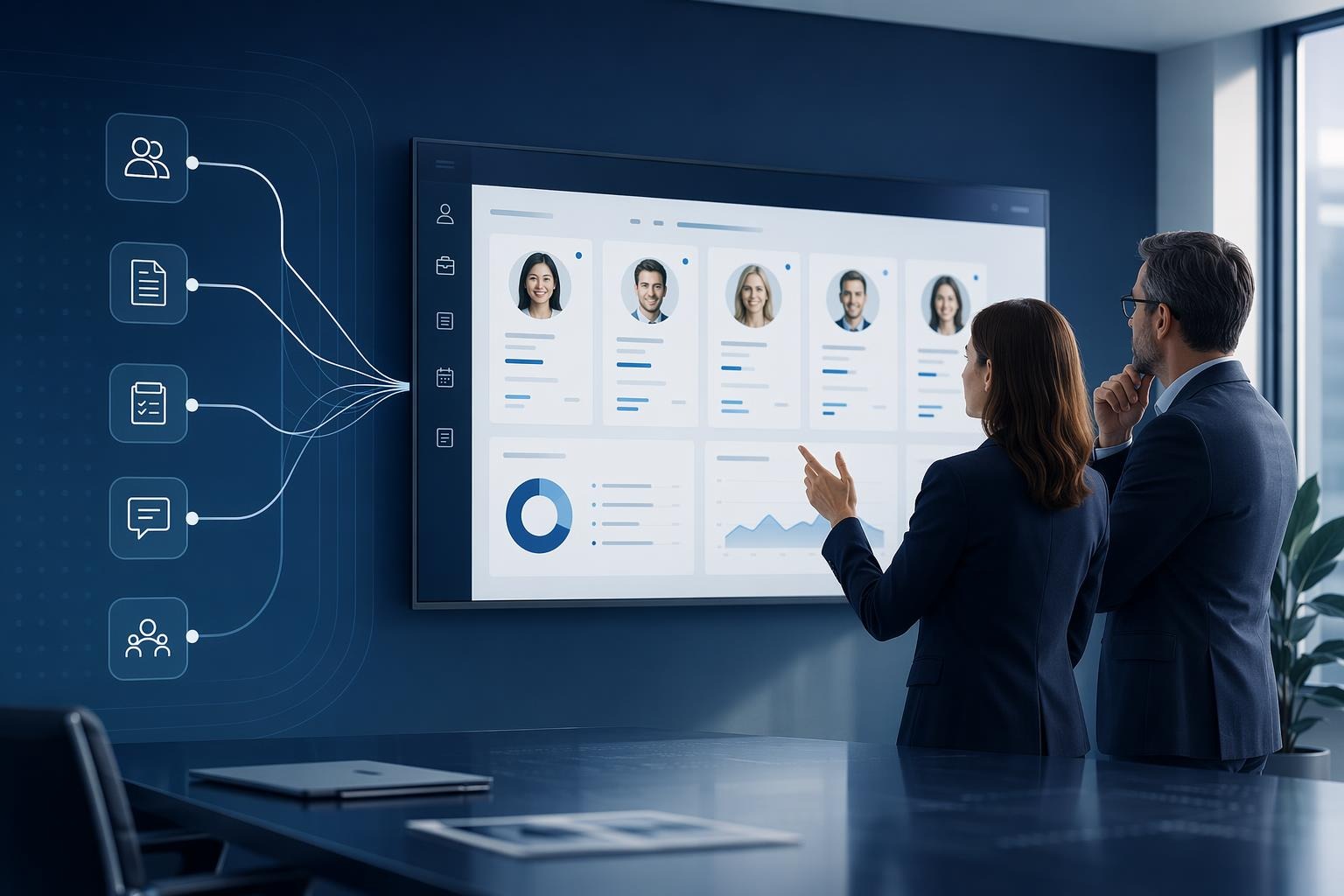
It connects the early hiring funnel into one AI-powered workflow: from application and pre-screening to adaptive chat screening, AI interviews, analytics and a finalist shortlist.
This is the new standard of hiring: less manual routine, less fragmentation, more speed, more evidence and clearer decisions.
Why "one more tool" is no longer enough
For years, enterprise recruitment evolved in a simple way: a new pain appeared, and companies added a new tool.
- An ATS to track vacancies and statuses.
- Job boards to generate applications.
- Chatbots to ask initial questions.
- Video questionnaires to record answers.
- Spreadsheets to compare candidates.
- Messengers to discuss candidates internally.
- AI plugins to speed up isolated tasks.
Each tool can be useful. But together, they often fail to become one coherent process.
The resume is in one place. The conversation is in another. Comments are somewhere else. Interview notes live in a document, a spreadsheet or someone's memory. The reasons for and against a candidate are scattered across people and systems.
So the company may use modern technology, but the same questions remain:
- Why is this vacancy still open?
- Which candidates are genuinely strong?
- How is one finalist better than another?
- How much time is the team spending?
- Why did a candidate receive this assessment?
- What evidence supports the final decision?
Point automation speeds up fragments. The business needs the result of the whole funnel.
This is where the difference appears between an AI feature and an AI hiring autopilot.
What an AI hiring autopilot actually means
An AI hiring autopilot is not a nicer name for automation.
It is an operating model where AI guides candidates through the early stages of hiring, keeps the context connected and prepares an evidence base for the human decision.
In Neurohiring, one workflow connects:
- application pre-screening;
- red-flag detection;
- resume screening;
- adaptive chat screening;
- AI interviews;
- analytical summaries;
- candidate comparison cards;
- finalist shortlists;
- recommendation rationale for hiring managers.
The key word is connected.
Resume screening is useful. Chat screening is useful. AI interviews are useful.
But the real value appears when these stages work in one information field. The system sees the candidate journey as a whole: application, experience, answers, motivation, risks, strengths and interview results.
This is when AI in recruitment stops being a tool for one action and becomes part of a managed hiring funnel.
How Neurohiring guides a candidate
A typical path can look like this:
- A candidate comes from a job board, sourcing channel, manual upload or another source.
- Neurohiring runs pre-screening and checks critical red flags.
- If there is a meaningful resume, the system evaluates experience, skills and fit against role requirements.
- In adaptive chat screening, AI clarifies important details: expectations, working conditions, motivation and role-specific requirements.
- When needed, the candidate goes through an AI interview.
- The system creates analytics and captures strengths, risks and supporting evidence.
- The hiring manager receives a finalist shortlist and comparison card.
- The final decision stays with a human.
The last point matters.
Neurohiring does not take the final decision away from people. It removes routine, early-stage uncertainty and data chaos.
Recruiters and hiring managers stay in the process. They simply work not with a raw stream of applications, but with a structured picture.
Three numbers that change the conversation
It is easy to describe AI in HR with generic words: "faster", "optimized", "more efficient".
We prefer to be more specific.
For Neurohiring, three operating metrics matter:
| Metric | What it means |
|---|---|
| 3-5 hours | from application to inviting a candidate to an AI interview |
| 1-2 days | to a finalist shortlist with detailed analytics |
| up to 1 hour | hiring manager involvement in the process |
For the business, these are not decorative numbers.
They mean fewer vacancies stuck in limbo, less manual load on recruiters, faster movement toward the final choice and more transparency for leadership.
The AI hiring autopilot works in parallel, 24/7 and by consistent rules. It does not forget to follow up with a candidate, postpone the first review until tomorrow or lose context between stages.
Speed should not break quality.
In one two-month enterprise pilot with a major telecom company, AI and recruiter assessments matched in 99.1% of cases within a ±1 point tolerance on a 10-point scale. In other pilots, candidates rated AI interviews at 4.8 out of 5 and 4.85 out of 5.
The new standard of hiring is not "faster at any cost". It is faster, more consistent and more evidence-based.
Candidates do not have to suffer because of AI
HR teams have a fair concern: candidates may react badly to AI in recruitment.
That happens when AI is turned into a cold, endless questionnaire. Every candidate gets the same questions. Their experience is ignored. They are asked to repeat what is already known. And the company calls it a "digital hiring process".
The problem is not AI. The problem is a bad process.
When the process is clear, questions are relevant, the interview can be completed at a convenient time and the candidate does not need to install extra apps, the reaction changes.
Across Neurohiring trials and pilots, about 7.1% of candidates declined an AI interview. Roughly 92.9% accepted the format.
That is an important signal: AI in candidate assessment does not have to damage candidate experience. It can make the process faster, clearer and more respectful of the candidate's time.
Especially when the system does not ask everyone the same set of questions, but uses context: resume, application, pre-screening results, chat answers and requirements of the specific role.
An AI interview is not a video questionnaire
"AI in hiring" can mean very different things. That is one reason for skepticism.
A video questionnaire is usually simple: the candidate receives predefined questions and records answers. The team then watches the recording or analyzes it.
That can be useful. But it is not a full interview.
Neurohiring's AI interview works differently. It is a dynamic conversation. The system:
- uses the resume and previous stages as context;
- asks structured blocks of questions;
- follows up on candidate answers;
- gets concrete details about projects, experience and decisions;
- captures strengths and risk areas;
- creates notes with timestamps and competency analytics.
For complex roles, the goal is not just to "ask questions". The goal is to understand how the candidate thinks, what they actually did, where they are strong and where risks may appear.
That is why strong AI in hiring starts not with the model, but with methodology: what to assess, in what sequence, by which criteria and how to explain the result to a human.
Why HR methodology matters
Neurohiring was not built as "AI from engineers for HR".
It sits at the intersection of engineering, HR methodology and real enterprise recruitment processes.
Behind the assessment logic, interview structure, chat-screening rules and finalist analytics are practical questions:
- how to define role requirements;
- which criteria really matter;
- which red flags cannot be missed;
- how to assess motivation;
- how to compare candidates;
- how to explain a recommendation to a hiring manager;
- where AI can act autonomously;
- where a human must decide.
For enterprise customers, this is critical.
It is not enough to "process applications quickly". The process must be repeatable, auditable, manageable and clear for HR, business stakeholders, security teams and leadership.
Why this is an enterprise product, not an AI widget
In hiring, an AI solution cannot be judged only by how well it asks questions.
Enterprise teams have other mandatory questions:
- Where is candidate data processed and stored?
- How is personal data handled?
- What security controls are in place?
- Can the vendor support compliance review?
- Can the product integrate with corporate systems?
- Who supports implementation?
- Can the workflow be adapted to internal hiring processes?
For the international Neurohiring track, the product is being developed with enterprise readiness in mind: a separate international infrastructure contour, a GDPR-compliant approach for relevant jurisdictions and a roadmap toward SOC 2 certification.
These are not decorative details. For enterprise hiring, they are conditions for trust.
What changes for the team
The new standard of hiring does not mean HR disappears from the process.
The team's role becomes more valuable.
For recruiters
Less routine, fewer repetitive first touches, fewer duplicated clarifications and less manual sorting.
More time for communication, finalist work and closing the role.
For HRDs and TA leaders
Hiring becomes easier to scale without expanding the team at the same rate.
The process becomes more manageable: less dependency on the speed of individual people, more visibility across stages and metrics.
For hiring managers
Instead of a sequence of early interviews "in the dark", the manager receives finalists, comparison cards and analytical summaries.
Their time is focused on the key stage: the final choice.
This is how an AI recruiter and an AI hiring autopilot should work in a mature enterprise workflow: not replacing human judgment, but preparing a stronger basis for it.
Why this series exists
This article opens our series on the new standard of hiring.
Next, we will look at:
- why point automation is no longer enough;
- how the path from application to finalist changes;
- why AI in hiring needs HR methodology;
- how pre-screening and red-flag detection work;
- how an AI interview differs from a video questionnaire;
- why candidate experience depends on process quality, not on AI itself;
- how to discuss GenAI with security and compliance teams;
- why ATS platforms and Neurohiring complement each other;
- how to evaluate an AI hiring autopilot through a demo, trial or pilot.
The goal of the series is not just to describe a product.
We want to show how enterprise hiring itself is changing: from a manual, fragmented and opaque funnel to one connected AI workflow where speed, quality and explainability work together.
The main point
If you are choosing AI for recruitment, the main question is not whether the system can read a resume faster or ask a candidate a few questions.
The real question is different: can it help manage the early hiring funnel as a whole and bring the company to a clear, evidence-based choice?
Neurohiring is not another tool for one hiring stage.
It is an enterprise-grade AI hiring autopilot. It connects candidate assessment, chat screening, AI interviews, analytics and finalist shortlists into one managed workflow.
Recruiters and hiring managers do not disappear from the process. They get a faster, clearer and stronger basis for decisions.
That is what we call the new standard of hiring.
If your team needs to speed up recruitment, reduce manual workload and get transparent finalist analytics, the next step is to see Neurohiring in a demo and discuss how the AI hiring autopilot can fit into your hiring workflow.