

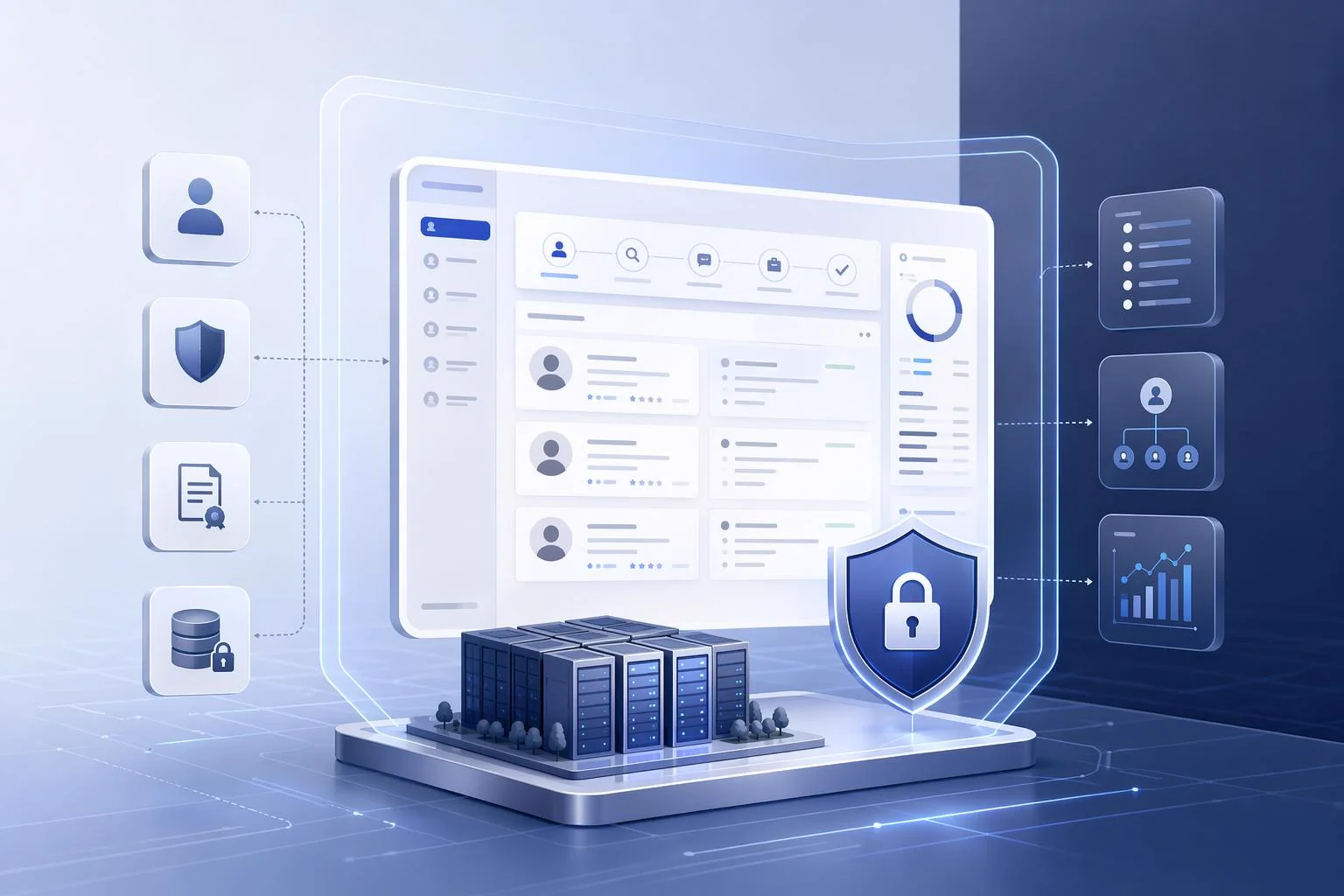
AI hiring is not something to "just try"
Interest in AI for HR usually starts with value. Teams want to close roles faster, reduce recruiter routine, accelerate shortlists, and lower the load on hiring managers.
That is why companies look for AI recruiting tools, AI recruiters, or AI hiring platforms.
But the closer a solution gets to the real hiring funnel, the earlier the conversation must include security.
AI in hiring does not work with abstract data. It sees resumes, contact details, communication history, interview results, assessments, analytics, conclusions, and comments. Some of this data is personal data. Some may be sensitive for compliance, employer brand, internal policy, or candidate trust.
Security cannot be left for later.
If a company launches an AI tool first and only then starts asking where data is stored and who receives it, the pilot may stop not because the product is weak, but because security and legal teams were not involved early enough.
A mature enterprise approach is different: personal data, architecture, and security are discussed before launch. AI in HR must be ready not only for a recruiter-facing demo, but also for a conversation with security, legal, compliance, and procurement.
Why HR, security, and legal should join early
An AI hiring solution touches several areas of responsibility at once.
- HR owns hiring efficiency, assessment quality, and candidate experience.
- Security reviews processing environments, access rights, external services, logging, leakage risks, and GenAI governance.
- Legal checks personal data, contractual structure, documents, consents, party roles, and regulatory requirements.
- Business looks at outcomes: speed, finalist quality, team workload, and process economics.
If these teams join one after another, the launch may stretch out. If they synchronize early, the pilot is usually faster and calmer.
The practical conclusion is simple: AI hiring should be evaluated not only as an HR tool, but as an enterprise system that processes candidate data.
This is especially true when the solution is not a point AI recruiter for one isolated action, but a platform that guides candidates through several stages of the funnel.
What to check before launch
Before launching an AI recruiting solution, companies should review several blocks.
1. Where candidate data is stored
The first question is where candidate data and processing results are physically stored.
For an international enterprise contour, this should be discussed in the context of applicable data protection laws, internal policies, customer geography, and cross-border data expectations.
For Neurohiring, the international version is intended to run in a separate international infrastructure contour, distinct from the local Russian product contour. The product approach is built around enterprise readiness, a GDPR-compliant implementation path for international use, and a roadmap toward SOC 2.
This matters because candidate data should not disappear into a set of unclear cloud services. A customer should understand the processing environment, responsibilities, and the level of control before the pilot starts.
2. What data goes to external AI models
If a product uses large language models, security teams will ask: what exactly is sent to them?
This is one of the central questions.
Neurohiring follows the principle of separating sensitive personal identifiers from professional context. In GenAI workflows, the goal is to use the professional part of the resume or dialogue where possible, without unnecessary identifiers such as name, contact details, or document data. Sensitive personal data should remain within the controlled product environment unless there is a clear, lawful, and documented reason to process it differently.
This reduces the risk that candidate identifiers travel outside the intended processing contour.
Deep technical details of the protective architecture, routing, prompts, and parameters are not normally disclosed publicly. But at the level of principles, the customer should understand which categories of data go where and which restrictions apply.
3. How regulatory compliance is addressed
There is no single global hiring-data rule that covers every customer equally. A mature AI hiring vendor should be able to discuss compliance in the context of the customer's jurisdiction, data flows, and internal policies.
What is worth checking:
- where data is stored;
- which party acts as controller, processor, or another relevant role in the contractual structure;
- what data is collected;
- on what basis it is processed;
- which documents, notices, or consents are needed;
- how access to data is controlled;
- how transfer to third-party services is limited;
- how vendor obligations are documented;
- how data is deleted, retained, or archived;
- how security and compliance review will be handled.
For the international contour, Neurohiring should be positioned as taking a GDPR-compliant approach for applicable jurisdictions, with enterprise security and compliance capabilities developed as part of the product path. This is not a marketing add-on. For enterprise customers, it is the basis for legal, security, and procurement review.
Why "we use AI" is not enough for security
For a security team, the phrase "we use AI" explains almost nothing.
Security teams care about different questions:
- what data is processed;
- which services requests pass through;
- where data is stored;
- how access is separated;
- whether logging is available;
- how GenAI calls are controlled;
- what happens when a security policy is triggered;
- whether a high-level architecture can be shared;
- who is responsible for operations;
- what is fixed in the contract.
A mature AI solution should do more than show a polished interface to the HR team. It should withstand a professional security conversation.
On request, Neurohiring can be discussed at the level of high-level architecture: components, processing contours, and key principles. This helps security teams and architects move faster at the start.
Guardrails: why protective mechanisms matter
AI hiring should not be an interface that accepts any input and returns any answer.
Enterprise GenAI needs protective mechanisms - guardrails.
At the level of principles, the important checks include:
- checks on user input;
- checks on model output;
- attempts at prompt injection or jailbreak;
- prohibited or unsafe content;
- protected or confidential material;
- correct routing of requests;
- separation of contexts between independent users.
Such mechanisms should be part of the solution logic. If a security policy is triggered, a request or response may be blocked and prevented from moving further through the processing chain.
Deep details - components, internal rules, thresholds, dictionaries, prompts, and routing - are usually not disclosed publicly. This is normal security practice: part of the protective architecture is confidential information and commercial know-how.
But the customer should be able to receive official confirmation of relevant control classes and document vendor obligations in a contract, security questionnaire, or compliance review.
Logging and access control
Another important question: can the company understand who did what in the system, and when?
For production use of AI in hiring, controlled mechanisms are needed:
- a centralized layer for GenAI requests;
- access control;
- binding of requests to an initiator at the platform level;
- request logging;
- recording of security-policy events;
- separation of user contexts;
- prevention of shared context leakage between independent users.
Without this, an AI tool may be convenient for a demo but weak for production operation.
HR may not notice this in the interface. For security, it is one of the central maturity criteria.
Why infrastructure matters for enterprise customers
Many AI products start as quick cloud solutions. That can be convenient at the beginning. For an enterprise customer, it may not be enough.
Enterprise customers need to understand:
- where the infrastructure is located;
- how availability is handled;
- whether there is redundancy;
- whether there is a single point of failure;
- who is responsible for operations;
- how access and administration are controlled;
- which third-party services are involved;
- how the solution fits internal security review;
- how data protection requirements are documented.
For Neurohiring's international track, the right public framing is a separate international infrastructure contour designed for enterprise adoption. The details may depend on the customer's geography, contractual setup, and deployment requirements, but the core point is the same: infrastructure is part of product maturity, not a secondary technical detail.
What to understand about external LLMs
A common question is: "Do you use your own model or an external one?"
By itself, this question does not always reveal the real risk.
In modern AI products, value is often created not by one model, but by architecture: orchestration, prompts, context, rules, checks, routing, quality evaluation, and engineering configuration.
Neurohiring should not be understood as "one LLM trained on our dataset". The value is a multi-component AI core where different parts support different tasks: screening, dialogue, analytics, and other stages of the hiring process.
From a security perspective, the more important questions are:
- what data is sent to the model;
- whether names and contact details are included;
- whether data is minimized, separated, or pseudonymized where appropriate;
- what data stays inside the controlled contour;
- which requests are logged;
- which security policies apply;
- whether sensitive scenarios can be restricted or handled differently;
- what the vendor is ready to confirm in documents.
For some sensitive tasks, local or separately controlled processing may be appropriate. The exact approach should be discussed through the lens of the use case, risk level, and customer requirements.
On-prem is not always the best first answer
When security teams ask about data, a fast conclusion sometimes appears: "Then we need on-prem."
On-prem deployment can be relevant for specific large contracts and highly sensitive environments. But it is not a universal answer.
On-prem has constraints:
- the customer may need expensive AI infrastructure;
- not every AI-stack component may have an on-prem version;
- implementation can become longer and more complex;
- the customer has to support an additional technical environment;
- the quality and speed of updates may depend on deployment architecture.
A mature conversation starts not with "only on-prem", but with a risk map:
- what data is processed;
- which data is sensitive;
- what can be separated or minimized;
- what must stay inside the controlled environment;
- what security requirements apply;
- which scenarios are actually tested in the pilot.
On-prem or dedicated deployment options can be discussed for large enterprise contracts, but they require a separate assessment.
Which documents and confirmations to request
Before launching an AI solution, the customer should request more than a presentation and a demo. Security and legal materials are part of the buying process.
A useful list includes:
- description of data processing contours;
- high-level architecture diagram;
- information about data storage;
- description of the personal data approach;
- description of GenAI controls at the principle level;
- answers to a standard security questionnaire;
- contractual obligations around data processing;
- confirmation of the applicable data protection approach;
- description of logging and access control;
- information about separation of user contexts;
- data deletion or retention approach if required by customer policies.
This prevents the pilot from turning into a long exchange of clarifications after launch.
Why previous security reviews matter
For a large customer, it is not enough to hear what a vendor says about security. It matters whether the vendor has handled comparable security and compliance reviews before.
Experience with enterprise reviews helps reduce uncertainty. The vendor understands the types of questions security teams ask, which documents are needed, where bottlenecks usually appear, and how to move through approval.
This does not remove the need for a new customer's own review. Every company has its own requirements, questionnaires, and internal procedures.
For the HR team, this also matters. The better the vendor is prepared for security review, the lower the risk that a promising AI project gets stuck in approval.
How HR teams should prepare for a security conversation
HR does not have to speak like system architects. But the HR team can frame the discussion correctly.
It helps to prepare:
- which business problems the AI solution solves;
- which hiring stages are automated;
- which candidate data is used;
- which communication channels are involved;
- which results the recruiter receives;
- who makes the final decision;
- whether the first step is a pilot, trial, or paid evaluation;
- whether ATS integration is needed in the first phase;
- which roles will enter the pilot;
- which metrics will be evaluated.
A Neurohiring pilot can often start without ATS integration. This reduces the complexity of the first step and helps the company test whether the system works as expected.
But even in that scenario, data, access, and approval questions should be discussed early.
What not to do when launching AI hiring
There are several common mistakes.
Mistake 1. Launch first, ask security later
This often leads to delays, re-approvals, and loss of internal trust in the project.
Mistake 2. Evaluate only the interface
A usable interface matters, but enterprise readiness is not defined by the interface alone. Data storage, access, logging, processing contours, and contractual obligations matter as much.
Mistake 3. Assume all AI solutions are the same
Some products are point widgets. Others are enterprise platforms. The difference appears in security, architecture, integrations, and operational readiness.
Mistake 4. Fail to separate professional context from sensitive identifiers
For GenAI workflows, the company should understand which data the model actually needs and which data should remain in the controlled environment.
Mistake 5. Expect the vendor to disclose trade secrets
Customers need confirmations, control classes, and contractual obligations. But deep details of prompts, routing, and protective architecture may remain confidential.
Why security should not slow innovation down
Security is often treated as a brake on AI adoption. In a mature enterprise approach, it works differently.
Good security does not block innovation. It makes innovation possible.
If a product has a clear processing architecture, a data protection approach, access control, logging, guardrails, and a path toward enterprise compliance, it becomes easier for the HR team to defend the pilot internally.
This is especially important for an AI Hiring Autopilot. It does not support one isolated action. It works with the core hiring funnel: from pre-screening and resume screening to chat screening, AI interviews, analytics, and finalist shortlists.
The deeper a product is embedded in the process, the more serious the security requirements should be.
The new standard: AI hiring should be secure by design
AI in hiring can no longer be treated as an experiment "somewhere on the side".
If technology guides candidates, analyzes resumes, conducts AI interviews, creates analytics, and prepares the foundation for a final decision, it becomes part of the corporate HR environment.
That means the requirements should be mature:
- personal data must be processed correctly;
- data should be stored in a clear environment;
- the data protection approach should be confirmable;
- access should be controlled;
- GenAI calls should be governed;
- sensitive identifiers should not go where they are not needed;
- security should understand the architecture at a sufficient level;
- legal should see the contractual basis;
- HR should understand how the technology improves the process without adding unnecessary risk.
Neurohiring is designed in this logic: as an Enterprise-Grade AI Hiring Autopilot that connects speed, HR methodology, analytics, and an enterprise approach to security.
The new standard of hiring is not simply "add AI to HR".
It is to implement AI in a way that HR, business, security, legal, and candidates can trust.
If a company chooses AI for recruiting, security should be one of the first evaluation criteria, not the final check after a successful demo.
What comes next in the series
In the next article, we continue the enterprise adoption topic and look more closely at how to discuss GenAI with security teams.
We will cover guardrails, logs, access, processing contours, and why a mature security conversation should be built not on promises, but on verifiable principles, documents, and architecture.