

GenAI in HR should be discussed in security language
HR usually looks at AI through hiring value: speed, conversion, assessment quality, recruiter workload, finalist shortlists, and candidate experience.
Security looks differently.
This is where the first AI recruiting conversation often breaks. HR sees a useful tool for screening, interviews, and analytics. Business sees a way to close vacancies faster. Security sees a new data processing contour: real candidates, personal information, and corporate processes.
If everyone accepts this early, the conversation becomes easier. The AI project does not get stuck between HR enthusiasm and security caution. It becomes a managed enterprise implementation: the teams understand what data is processed, what controls are in place, and why the solution can be trusted.
Security needs to understand:
- what data is processed;
- where it is stored;
- what data goes to external services;
- how access is separated;
- what is logged;
- whether there are controls at model input and output;
- how prompt injection and jailbreak attempts are handled;
- whether measures can be confirmed in writing;
- what obligations the vendor can document contractually;
- what happens when a security policy is triggered.
If HR only says "this will accelerate hiring" while security asks "where does the data go?", the conversation quickly reaches a dead end.
A mature conversation starts from a different frame: GenAI in hiring is not just a convenient interface or a smart chat on top of a vacancy. It is part of the corporate data processing environment.
Why security does not have to trust the demo
A demo shows how the product works for a user. It says very little about security.
In a demo, the team can see:
- a clean interface;
- candidate chat;
- AI interview;
- analytics;
- comparison cards;
- finalist shortlist.
But security needs different answers:
- where data is physically stored;
- which requests are sent to an LLM;
- how candidate identifiers are separated;
- whether logging exists;
- how blocking policies work;
- which contexts different users can see;
- which controls can be confirmed in writing;
- how the system behaves when someone tries to bypass rules.
So security is not "blocking innovation" when it asks uncomfortable questions. It is doing its job: checking whether the technology can be used in a corporate environment.
The vendor's job is not to be irritated by these questions. The vendor should have mature answers. For enterprise AI hiring, the ability to pass a security conversation is not an extra feature. It is a sign of operational readiness.
Start with the map of processing contours
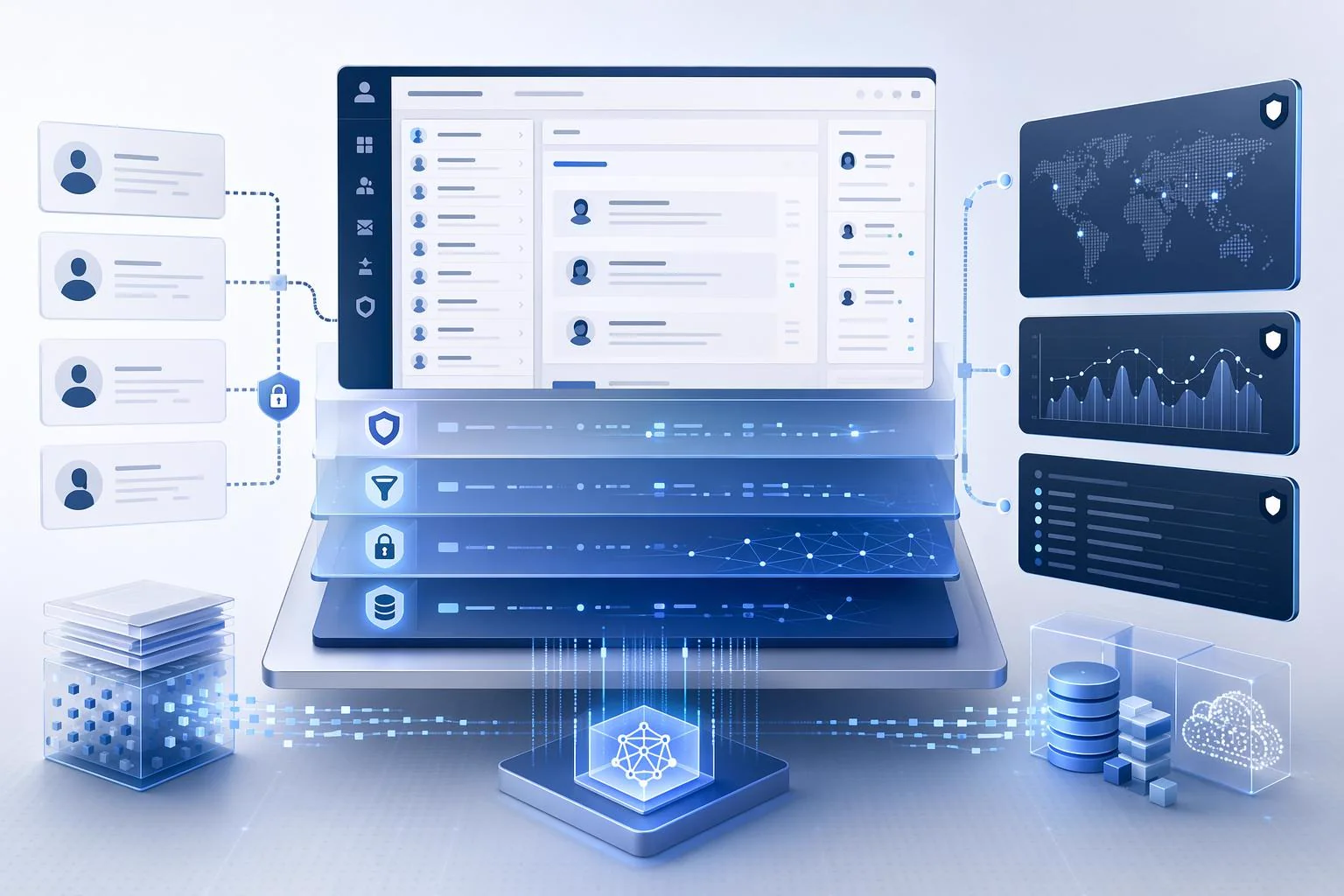
The first useful artifact for security is a high-level architecture diagram.
It does not have to disclose trade secrets, internal prompts, exact routing rules, or protective-system parameters. But it should show:
- where the platform runs;
- where data is stored;
- which components participate in processing;
- which external services may be used;
- what data passes through each contour;
- where sensitive personal data remains;
- how communication channels are organized;
- how user access is controlled.
On request, Neurohiring can be discussed through a high-level architecture view: components and processing contours at the principle level. This helps security teams and architects move faster at the start.
The right format is not "trust us". The right format is "here is the processing map, let us review the risk zones".
For the customer, this is an important difference between Neurohiring and experimental AI tools: the product can be discussed not only with HR, but also with security, architecture, legal, procurement, and compliance.
Personal data: what exactly goes to the AI model
One of security's main questions is whether candidate identifiers go to external AI models.
Hiring involves many such data points:
- full name;
- phone number;
- email;
- profile links;
- document or identity data if it appears in the process;
- uploaded files;
- communication history;
- interview records and results;
- candidate analytics.
For GenAI workflows, professional context should be separated from sensitive identifiers.
Neurohiring follows the principle of using the professional part of the resume or dialogue where possible, without unnecessary identifiers such as name, contact details, or document data. Sensitive personal data should remain within the controlled product environment unless there is a clear, lawful, and documented reason to process it differently.
For security, this answers a basic risk question: does the model truly need personal identifiers to assess professional experience? In most early-stage assessment scenarios, it does not.
For HR, this is also a useful argument. AI in HR can help assess experience, motivation, and fit without turning personal data into fuel for an external model.
Guardrails: what to check at input and output
In a corporate process, the system should not simply send a request to a model and show the answer to the user.
Protective mechanisms are needed.
In a mature contour, checks are needed at least at two points:
- input request - before it reaches the LLM;
- model response - before it returns to the user.
Why does this matter?
Input checks help prevent attempts to bypass rules, inject malicious instructions, force the model to disclose something it should not disclose, or perform an inappropriate action.
Output checks help prevent the model from returning prohibited content, protected material, sensitive information, or a result that violates system policy.
In Neurohiring, such classes of controls are part of the solution logic. When a policy is triggered, the request or response may be blocked and prevented from moving further through the processing chain.
This is why Neurohiring is not a separate AI recruiter freely "talking" to data. It is a managed AI hiring autopilot with protective frames around GenAI scenarios.
Jailbreak and prompt injection in an HR context
For HR teams, the terms jailbreak and prompt injection may sound too technical. The idea is simple.
Prompt injection is an attempt to insert an instruction into user input so that the model acts against system rules.
Jailbreak is an attempt to bypass model or system restrictions.
In HR, this may look like:
- a user asks the system to reveal hidden instructions;
- a candidate tries to make the system ignore job requirements;
- a resume or message includes text addressed to the model rather than the recruiter;
- someone tries to access another candidate's data;
- a user asks the system to answer outside its role;
- the model is pushed toward an inappropriate assessment or wording.
A mature GenAI contour should anticipate these risks.
This does not mean the vendor must publicly disclose all rules, dictionaries, thresholds, and internal prompts. Deep details of the protective contour are usually confidential.
But the vendor should confirm the relevant classes of controls and explain the principle of operation at an acceptable level.
Content safety matters even in hiring
Content safety is not only for public chatbots. It matters in recruiting too.
An AI system may work with:
- candidate messages;
- free text from resumes;
- comments;
- candidate questions;
- interview answers;
- internal recruiter requests;
- analytics about people.
Sensitive, inappropriate, or prohibited content can appear in this data.
That is why input and output checks are important. Relevant classes of controls may include hate, self-harm, sexual content, violence, and protected material, depending on the implementation and policy.
For HR, this is not excessive caution. It reduces the risk of inappropriate responses and uncontrolled AI behavior in a process that involves real people.
Logging: without logs, there is no control
For security, the principle is simple: if an action cannot be traced, it is hard to govern.
In a GenAI contour, logging is needed not only for incident investigation. It helps:
- confirm who initiated a request;
- see GenAI calls;
- record policy-trigger events;
- analyze abnormal behavior;
- answer audit questions;
- improve control mechanisms;
- reduce the risk of unauthorized use.
Neurohiring is designed with organizational and technical controls that include logging of requests and policy events.
For HR, this may be invisible in the interface. For enterprise adoption, it is one of the signs of maturity. These are the mechanisms that separate production AI recruiting from a demo tool that looks good in a presentation but is not ready for audit.
Access control: who can see what
AI in hiring works with candidate data. Therefore, not every user should see every context.
Access control should answer:
- who can view candidates;
- who can start processing;
- who can see analytics;
- who can share a shortlist;
- who can ask AI questions about a candidate;
- how the request is tied to the initiator;
- how user roles are separated;
- how access to independent contexts is limited.
Neurohiring is designed with access control and request attribution at the platform level.
This is especially important for large organizations where hiring runs across teams, regions, business units, and projects. Data from one process should not mix with data from another without control.
Context separation: why it is critical for GenAI
One specific GenAI risk is context.
If a system manages context incorrectly, it may use data that does not belong to the current user, vacancy, or candidate.
In corporate hiring, this is unacceptable.
For example:
- a recruiter working on one vacancy should not receive data from another independent vacancy without access;
- a question about one candidate should not pull information about another candidate;
- one customer's context should not intersect with another customer's context;
- internal service data should not appear in model responses.
So in a GenAI contour, models are not enough. Context policy matters.
Neurohiring is designed around separation of user contexts and prevention of cross-context leakage between independent users.
This is rarely visible in the interface, but it is critical for security trust.
LLM proxy: why a centralized layer matters
If different product components call GenAI directly without a shared control layer, security becomes harder to govern.
A centralized layer for GenAI requests helps:
- control what requests go to the model;
- apply security policies;
- log requests;
- tie actions to initiators;
- separate contexts;
- manage model providers;
- monitor usage;
- unify controls across scenarios.
Neurohiring uses a controlled GenAI access layer in this logic.
For security, this is an important signal: GenAI is not embedded as a chaotic set of model calls, but passes through a managed layer.
For business, it means a more predictable rollout. If AI recruiting scales across roles, teams, and scenarios, control should not depend on the manual discipline of every user.
Why not everything can be disclosed
Security teams have the right to ask deep questions. But there is a reasonable disclosure boundary.
A vendor should not publicly disclose:
- internal prompts;
- exact AI-agent routing rules;
- protective-system parameters and thresholds;
- internal dictionaries and lists;
- confidential technical details;
- trade secrets that could themselves become a risk factor.
Otherwise, the vendor does not improve security. It weakens it.
The better format is:
- confirm control classes;
- describe principles;
- provide a high-level architecture view;
- complete a security questionnaire;
- document obligations contractually;
- provide official written confirmations when needed.
For Neurohiring, this is the right enterprise format: if a customer needs to close a security questionnaire or audit point, the team can provide confirmation at the appropriate level, while keeping confidential implementation details protected.
How HR can turn security requirements into a plan
HR teams do not need to design GenAI security themselves. But they do need to organize the approval process.
A practical plan can look like this.
Step 1. Define the business scenario
First, describe what exactly will be launched:
- resume screening;
- chat screening;
- AI interviews;
- candidate analytics;
- finalist shortlist;
- ATS integration;
- quick pilot without integration;
- paid pilot on real candidate flow.
Without a scenario, security will assess an abstract risk.
Step 2. Describe the data
Define which data will be used:
- resumes;
- applications;
- contacts;
- correspondence;
- interview records or results;
- analytics;
- comments;
- candidate statuses.
Step 3. Request architecture materials
At this stage, useful materials include:
- high-level architecture view;
- description of processing contours;
- data storage description;
- answers to a security questionnaire;
- personal data approach;
- guardrails description at the principle level;
- information about logging and access.
Step 4. Agree pilot boundaries
If the first step is a quick pilot or trial, define in advance:
- which vacancies are included;
- which data is uploaded;
- whether ATS integration is required;
- who has access;
- how long data is stored;
- which results will be evaluated;
- which documents are needed before launch.
Step 5. Document obligations
If security requires confirmations, they should be fixed in writing: in a questionnaire, letter, contract appendix, or another agreed format.
Questions security may ask the vendor
Use this checklist to keep the conversation concrete.
| Security question | What the vendor should explain |
|---|---|
| Where is data stored? | Infrastructure approach, storage contour, geography if applicable |
| Which data goes to the LLM? | Separation of professional context and personal identifiers |
| Are names and contacts sent? | The approach to excluding unnecessary identifiers from GenAI workflows |
| Are there guardrails? | Input and output checks, control classes |
| What happens when a policy is triggered? | Blocking or another managed scenario |
| Is logging available? | Which requests and events are recorded |
| How does access control work? | Roles, initiators, and context separation |
| Is there a high-level architecture view? | Processing-contour diagram without disclosure of trade secrets |
| What compliance path is planned? | GDPR-compliant approach where applicable and a roadmap toward SOC 2 |
| Can measures be confirmed in writing? | Confirmation in a questionnaire, letter, or contract |
This helps move from a general fear of GenAI to a concrete risk assessment. For HR, it shows that the project is not about "playing with a neural network", but about mature AI adoption in HR.
Security-review experience as a trust factor
Enterprise customers want to know whether a vendor has handled comparable reviews before.
Prior experience with security questionnaires, compliance discussions, and enterprise approval processes reduces uncertainty. It means the vendor understands what security teams ask, which materials are usually needed, and where approval bottlenecks appear.
This does not mean a new review will be automatic. Every company has its own requirements, procedures, and criteria.
But for HR, vendor readiness lowers the risk that an AI project gets stuck after a successful demo.
Mature GenAI contour versus experimental AI tool
An experimental AI tool answers the question: "Can the model solve the task?"
An enterprise AI contour has to answer a different question: "Can this solution be used safely and controllably in a real process?"
The difference looks like this:
| Experimental AI tool | Mature enterprise GenAI contour |
|---|---|
| Focus on demo | Focus on production process |
| Data storage is unclear | Processing and storage contours are explainable |
| Model as a black box | Managed architecture and control principles |
| Weak personal-data approach | Sensitive data is separated and controlled |
| No logging | Requests and policy events are logged |
| No context separation | User and customer contexts are separated |
| No formal confirmation of measures | Ready for security questionnaires and documented obligations |
| Suitable for experiment | Suitable for enterprise adoption |
Neurohiring is designed as the second type of solution: an Enterprise-Grade AI Hiring Autopilot, not an experimental widget for one recruiting step.
Its value is not only that it can ask questions or analyze resumes. More importantly, these functions are assembled into a managed workflow that can go through security review and production use.
Why this matters specifically for an AI Hiring Autopilot
If an AI tool is used for one small task, risk is limited to that task.
Neurohiring works with the core hiring funnel:
- pre-screening;
- resume screening;
- chat screening;
- AI interviews;
- analytics;
- candidate comparison cards;
- finalist shortlist;
- foundation for the hiring manager's final decision.
The more stages are connected in one workflow, the more important data governance, access, logs, and protective mechanisms become.
For an AI Hiring Autopilot, security is not a secondary block. It is built into the product's ability to operate at enterprise level.
This is an important vendor-selection logic. If a company wants an AI recruiter as a quick bot, a point tool may be enough. If it needs AI recruiting for a real corporate process, security, access, logs, and processing contours become part of the business value.
The new standard for the security conversation
A conversation with security about GenAI should not be emotional.
A weak format sounds like this:
- "It is just AI, everyone uses it";
- "Let us try first and approve later";
- "There is nothing critical here";
- "We do not know where everything goes, but it works well";
- "Security is blocking innovation again".
A mature format sounds like this:
- "Here is the business scenario";
- "Here is the data involved";
- "Here is where it is stored";
- "Here is what goes to the LLM";
- "Here is how we separate personal identifiers";
- "Here are the guardrails";
- "Here is how requests are logged";
- "Here is how access is separated";
- "Here is what we can confirm in writing";
- "Here is what we do not disclose publicly because it is protective architecture and trade secret."
This approach helps HR, security, and business stop debating technology in the abstract and start evaluating a concrete solution.
GenAI in hiring should be not only smart, but governable
For enterprise AI in HR, model quality alone is not enough.
Even a very strong model does not solve questions of:
- personal data;
- access;
- logging;
- context;
- protective policies;
- data storage;
- contractual obligations;
- security review.
Neurohiring connects an AI core, HR methodology, and an enterprise approach to security. That is why the security conversation is not an external obstacle. It is a normal part of adopting an Enterprise-Grade AI Hiring Autopilot.
The new standard of hiring is not just closing vacancies faster with AI.
It is hiring faster, deeper, and better in a contour that HR, business, security, legal, and candidates can trust.
If you consider AI recruiting not as a one-off experiment but as part of future HR infrastructure, do not start evaluation with the demo alone. Ask how the solution works from the perspective of data, access, logging, and guardrails.
In a strong product, these questions do not hurt the sale. They prove maturity.
What comes next in the series
In the next article, we explain why an ATS and Neurohiring do not replace each other.
We will discuss the difference between a system of record and a system that guides the candidate through the funnel: from application and pre-screening to AI interview, analytics, and finalist shortlist.