

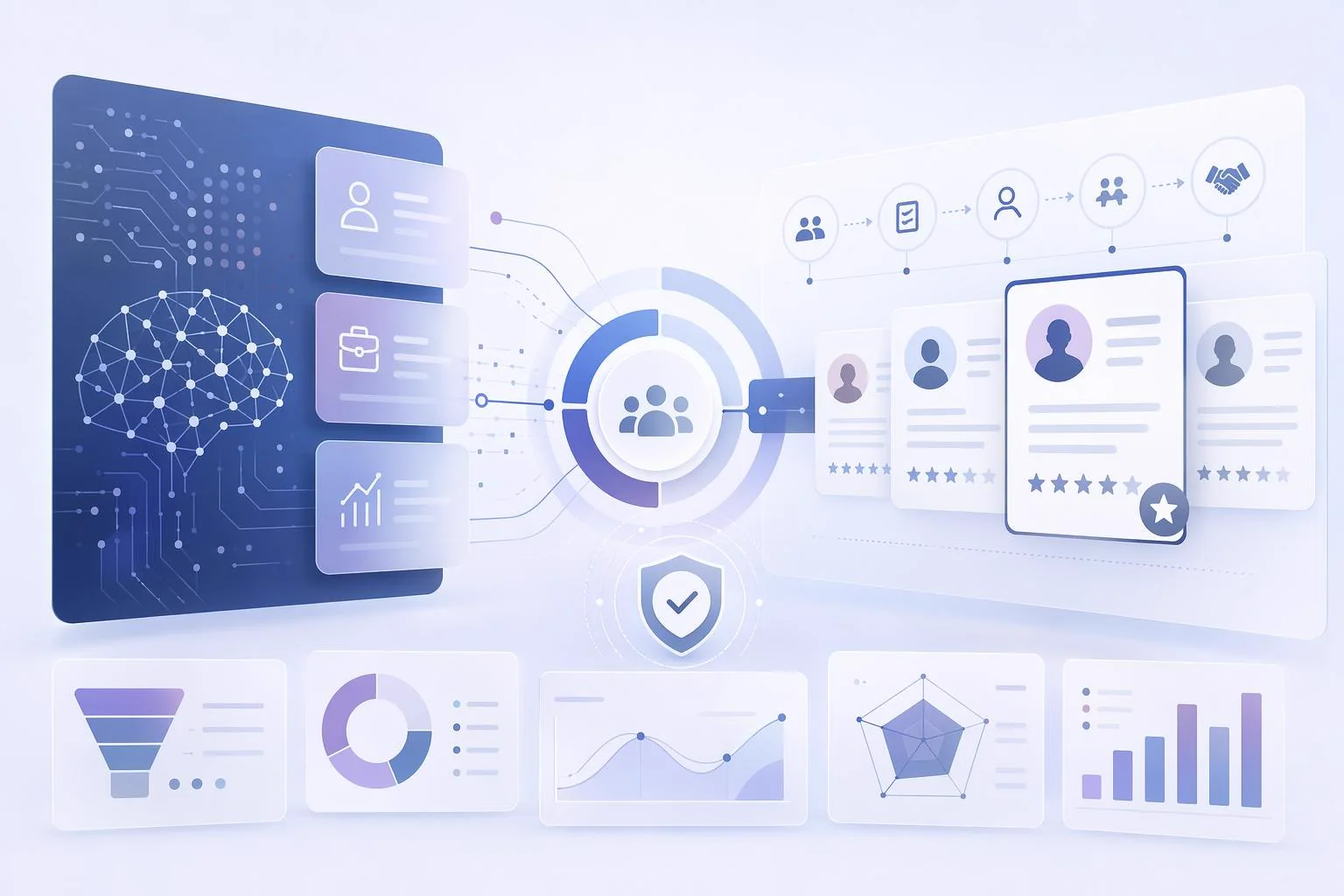
Why "just add AI" is not enough
Today, almost any HR Tech product can add an AI feature: resume scoring, question generation, candidate summaries, a clarification chatbot or automated outreach.
That is why phrases like AI in recruitment, artificial intelligence in HR and AI recruiter appear more and more often.
But for enterprise hiring, the AI label is not the point. The real question is different: is there a methodology behind the technology for assessing people, roles, risks and business context?
It is not enough to read a resume quickly. You need to understand whether the candidate's experience fits a specific role.
It is not enough to ask a few questions. You need to know what to clarify, when and why.
It is not enough to run an interview. You need analytics that a recruiter, HRD, hiring manager and business stakeholder can actually use.
It is not enough to give a score. You need to explain what the score is based on.
That is why AI in hiring should be more than data processing. It should be part of a methodologically designed process. Otherwise, artificial intelligence in HR remains a good-looking feature, but never becomes a tool for managed hiring.
Hiring does not assess resumes
A resume is an input signal. Nothing more.
It can show strong experience, but weak motivation. Good expertise, but wrong expectations. Relevant skills, but risks around stability, communication or working conditions.
Enterprise recruitment looks at several layers at once:
- experience and real relevance;
- professional competencies;
- motivation and expectations;
- readiness for role conditions;
- communication and ability to explain decisions;
- red flags;
- fit with business requirements;
- hiring and onboarding risks.
If AI sees only resume text, it can process information faster. But that is not enough for quality hiring.
You need logic: what matters for the role, which signals are critical, which questions to ask next, how to connect candidate answers with vacancy requirements and how to explain the conclusion to a human.
That is why AI in Neurohiring does not work in a vacuum. Behind assessment logic, chat screening, AI interviews and finalist analytics, there is HR methodology.
What methodology solves for the model
A large language model can understand text, formulate questions and summarize answers.
But by itself, it does not know how enterprise hiring should be structured.
The process must define in advance:
- What exactly is being assessed.
- Which criteria are mandatory and which are optional.
- Which mismatches count as red flags.
- Which answers require follow-up.
- Where premature conclusions are dangerous.
- How to distinguish a weak signal from a critical risk.
- How to make assessment repeatable.
- How to explain the result to the hiring manager.
Without methodology, AI easily becomes a "smart summarizer": it reads quickly, writes nicely and still does not help the team make a decision.
For the business, such an AI recruiter may look modern. But it does not solve the real pain: whom to trust, why the candidate fits and whether the conclusions are repeatable.
Neurohiring's task is different: not just to speed up resume reading or candidate dialogue, but to build one assessment workflow from first application to finalist shortlist.
How methodology is built into Neurohiring
Neurohiring is an Enterprise-Grade AI Hiring Autopilot. The platform connects several recruitment stages into one process:
- pre-screening;
- resume screening;
- adaptive chat screening;
- AI interview;
- analytical summary;
- comparison card;
- finalist shortlist;
- recommendation rationale for the human decision.
At every stage, automation is not enough. The assessment logic matters.
Pre-screening: red flags first
Pre-screening does not try to assess the whole candidate. Its job is to quickly check critical constraints.
For example: experience, schedule, location, readiness for working conditions or other mandatory role parameters.
This is especially important in high-volume flows, where some candidates do not meet basic requirements.
Pre-screening does not work only with classic resumes. If an application contains only a name, contact details and a few basic signals, Neurohiring can still analyze available information and build the next route using red flags.
Resume screening: consistent criteria instead of gut feeling
For skilled talent, white-collar roles and many office-operational positions, the resume remains an important source of data.
Here, methodology is needed so assessment does not depend on who opened the resume on Monday morning.
Neurohiring analyzes the candidate against vacancy requirements, assesses relevance and captures the reasoning behind the conclusion. This reduces subjectivity and makes early screening more repeatable.
In one two-month enterprise pilot with a major telecom company, AI and recruiter assessments matched in 99.1% of cases within a ±1 point tolerance on a 10-point scale. For us, this is not only a technology-quality signal, but also a signal that the methodology was configured correctly.
Chat screening: not a form, but clarification
A bad recruitment chatbot feels like a long form. It asks the same questions to every candidate, ignores what is already known and creates a mechanical experience.
Neurohiring's chat screening works differently. It adapts to context.
If there is a resume and screening output, the system asks more precise questions: about experience, motivation, working conditions, unclear points or mismatches.
If there is no resume and only minimal application data, the chat relies on pre-screening and red flags. It does not repeat what is already known unless there is a reason.
Methodology helps work with different role types:
| Role type | What matters | How methodology helps |
|---|---|---|
| Skilled talent and white-collar roles | Experience, motivation, competency depth | Ask questions that match the role and real experience |
| Office-operational and blue-collar roles | Basic experience, accuracy, responsibility | Check fit with working conditions and process requirements |
| Entry-level roles without resumes | Readiness for conditions, basic constraints, contactability | Work even with minimal input data |
This kind of chat screening does not try to imitate a human at any cost. Its job is to collect missing information correctly and respectfully, avoid overloading the candidate and prepare a basis for the decision.
AI interview: not a list of questions
An AI interview in Neurohiring is not a video questionnaire and not a fixed list of questions.
The system creates a personalized plan, uses the resume, chat-screening results and vacancy requirements, asks follow-up questions and collects competency analytics.
This matters for roles where the candidate should not only confirm experience, but explain how they made decisions, what challenges they faced, what role they played in projects and how they think professionally.
Here, HR methodology defines:
- which question blocks are needed;
- how to test depth of experience;
- how not to reduce assessment to formal answers;
- how to capture strengths and risks;
- how to prepare the output for the hiring manager.
This is how an AI interview becomes not a technology attraction, but a real assessment stage.
Good AI must explain its conclusions
One of the biggest problems in hiring automation is distrust of the black box.
If the system simply says "candidate fit: 8 out of 10" and does not explain why, that is not enough for an enterprise customer.
The recruiter needs to see candidate strengths. The HRD needs to know the process is repeatable. The hiring manager needs to make a decision quickly without reading the entire communication history. Security and compliance teams need to see that the process is controlled.
That is why assessment in Neurohiring does not end with a score. The platform creates:
- analytical summaries;
- candidate strengths;
- risk areas;
- mismatches between resume and answers;
- interview notes with timestamps;
- finalist comparison cards;
- recommendation rationale.
The final decision stays with a human. But the person receives not a raw resume or a stream of notes, but an evidence base for the choice.
Candidate experience is methodology too
Hiring automation is often judged from the employer side: faster, cheaper, more convenient.
But candidate experience directly affects conversion. If communication is cold, long, unclear or too robotic, strong candidates may simply never reach the next stage.
That is why HR methodology in Neurohiring includes not only assessment criteria, but also communication logic:
- how to start the dialogue;
- which questions to ask earlier or later;
- how not to overload the candidate;
- how to handle sensitive topics carefully;
- how to explain the next step;
- how to keep a respectful business tone.
Across trials and pilots, candidates rated Neurohiring AI interviews at 4.8 out of 5 and 4.85 out of 5 in separate enterprise pilots.
At the same time, about 7.1% of candidates declined an AI interview, while roughly 92.9% accepted the format.
The conclusion is simple: candidates are not against AI as a technology. They are against a bad, disrespectful and opaque experience.
Why this matters for enterprise
In a small business, hiring can sometimes stay informal: quickly review a resume, have a call, make a decision by feel.
Enterprise hiring does not work that way.
Large companies need:
- predictable processes;
- consistent assessment criteria;
- repeatable quality;
- data security;
- manageability;
- integrations;
- analytics;
- transparency for hiring managers;
- scaling without endless team growth.
That is why Neurohiring is developed as an enterprise platform, not an experimental AI widget.
For the international track, Neurohiring combines an AI core, HR methodology and enterprise product logic: security, support, integrations, implementation readiness and compliance-oriented development, including a GDPR-compliant approach and a roadmap toward SOC 2.
For the customer, this means AI is not limited to a demo scenario. It is built into an operating hiring workflow.
AI does not replace HR
In a mature model, AI does not take responsibility for the decision away from recruiters or hiring managers.
It frees them from routine and helps them focus where human expertise actually matters.
The recruiter does not need to manually process hundreds of similar applications and keep every communication detail in mind. They can work with finalists, complex cases, business stakeholders and process quality.
The hiring manager does not need to run many early-stage interviews in the dark. They receive a finalist shortlist with analytics, comparison and rationale.
Neurohiring's operating frame is: 3-5 hours from application to AI interview invitation, 1-2 days to a finalist shortlist and up to 1 hour of hiring manager involvement.
This is not about "hiring without people". It is about involving people where their decision truly matters.
Methodology turns AI into a workflow
If you see AI only as a feature, it speeds up separate actions: reads resumes, asks questions, writes summaries, gives a preliminary score.
But the new standard of hiring does not appear when one step becomes faster.
It appears when the early funnel becomes connected, manageable and evidence-based.
That is the role of HR methodology:
- define what exactly should be assessed;
- set the logic of candidate movement through stages;
- support different role types;
- reduce subjectivity;
- make assessment explainable;
- preserve respectful candidate experience;
- help humans make final decisions faster and with more confidence.
Neurohiring does not simply apply AI to recruitment. It builds an enterprise-grade AI hiring autopilot, where technology, HR methodology and enterprise product logic work as one workflow.
If a company is choosing AI for recruitment, it should look beyond the interface and feature list. The real question is whether the system helps standardize assessment, guide candidates respectfully and give the business an explainable basis for decisions.
In the future of hiring, the main question is not "which model is used".
The main question is: what methodology stands behind the way that model assesses people, runs dialogue and helps the business make decisions?
What comes next in the series
In the next articles, we will look at individual stages of the Neurohiring autopilot: pre-screening, resume screening, chat screening, AI interviews, analytics and finalist shortlists.
Because the new standard of hiring is not one AI module. It is a connected system where each stage strengthens the next, and the final decision stays with a human.