

When companies look for AI in recruitment, they usually do not need "AI for the sake of AI". They need a simple business result: move faster from application to strong finalist without losing assessment quality.
In traditional enterprise hiring, this path often becomes a chain of waiting.
A candidate applies. A recruiter sees the application. Then the resume waits for review. Then someone needs to clarify details. Then the next stage must be approved. Then the team looks for a time slot. Then the interview happens. Then impressions are collected. Then candidates are compared. Then someone needs to explain to the hiring manager why these people reached the final stage.
Each step makes sense. But the whole chain is slow because it depends on manual coordination, people's calendars and context being passed between tools.
Neurohiring rebuilds this model.
It is not an "AI recruiter" that asks a candidate a few questions. And it is not an AI feature attached to an old process.
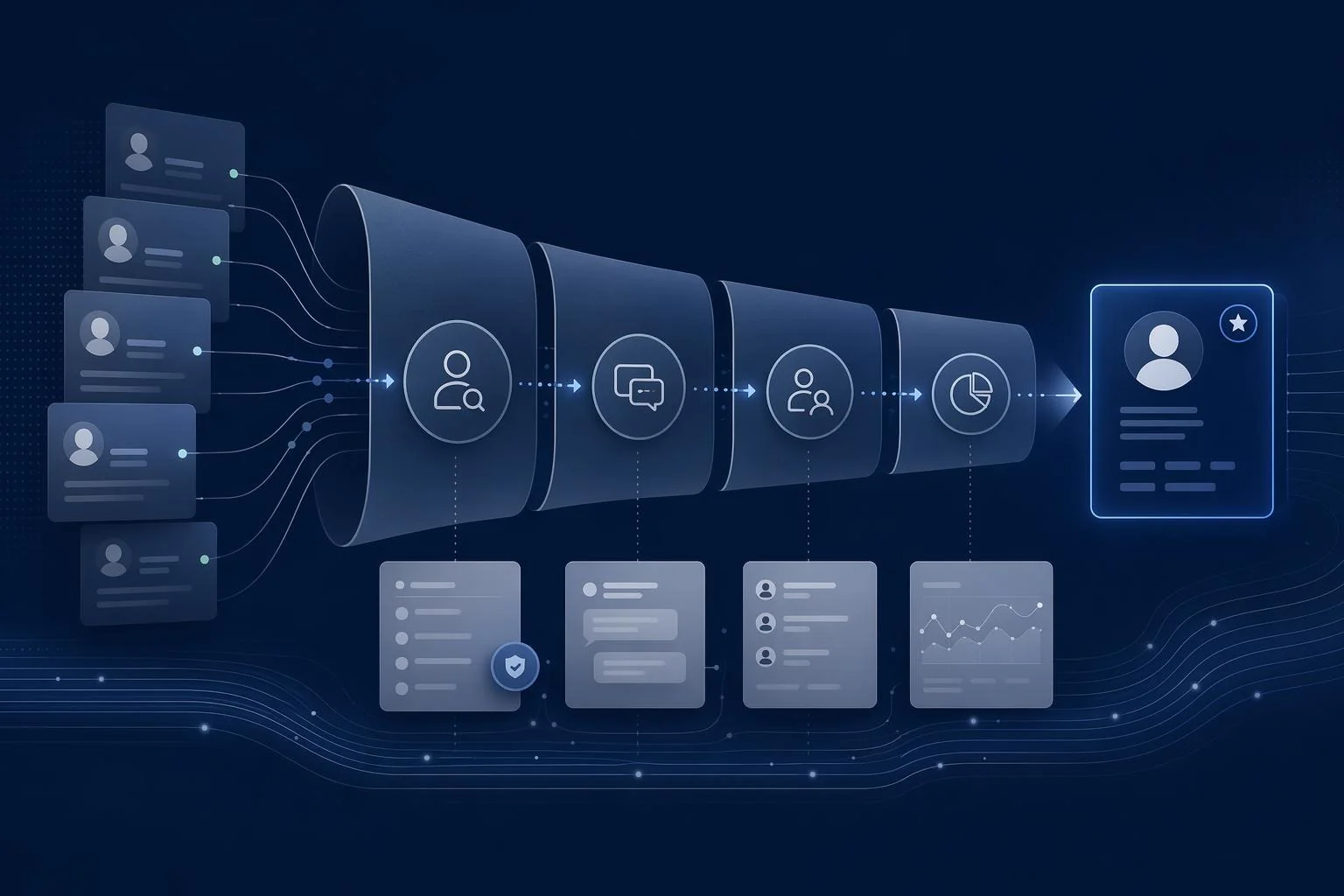
It is an Enterprise-Grade AI Hiring Autopilot. It connects the early hiring funnel into one route: application, pre-screening, resume screening, adaptive chat screening, AI interview, analytics and finalist shortlist.
It is not only about speed
Everyone wants hiring to be faster. That is understandable: the business needs roles filled, HR teams need less manual routine, and candidates need a clear process without long waiting.
But speed alone does not solve the problem.
If a candidate is rejected quickly without a clear reason, quality has not improved.
If the candidate receives a fast message, but the meaning of their answers is lost, the funnel has not become manageable.
If video answers are collected quickly, but finalists are not compared by consistent criteria, the hiring manager still makes the decision almost manually.
A modern hiring funnel must be more than fast. It must be:
- repeatable;
- explainable;
- scalable;
- convenient for candidates;
- useful for recruiters;
- clear for hiring managers;
- ready for enterprise requirements.
The value of Neurohiring is not that the product "uses artificial intelligence in HR". The value is that AI becomes an operating workflow for real enterprise recruitment.
What a funnel on autopilot looks like
In Neurohiring, stages do not live separately. Each stage passes context to the next one.
| Stage | What Neurohiring does | What the team gets |
|---|---|---|
| Application or sourcing | Accepts candidates from different sources | One entry point into the funnel |
| Pre-screening | Checks red flags and basic relevance | Fast filtering of clearly irrelevant candidates |
| Resume screening | Analyzes experience, skills and requirements | Initial assessment by consistent criteria |
| Chat screening | Clarifies details using context | Data without manual back-and-forth |
| AI interview | Runs dynamic assessment | Deeper candidate evaluation |
| Analytics | Connects data across stages | Strengths, risks and mismatches |
| Finalist shortlist | Compares candidates | Evidence for the decision |
The key is connection.
The resume influences chat-screening questions. Chat screening influences the AI interview plan. The AI interview influences analytics. Analytics influences the comparison card. The comparison card supports the final decision.
That is how a set of touchpoints becomes one workflow.
Stage 1. The candidate enters one funnel
Real candidates come from different sources:
- job board applications;
- sourcing channels;
- manual resume uploads;
- PDF imports;
- channels where candidate data is minimal.
Sometimes there is a detailed resume. Sometimes there is a short application. Sometimes there is only a name, contact details and a few basic signals. Sometimes the candidate applies for an operational role and does not fully understand the role details yet.
In a manual funnel, the recruiter handles this case by case: whom to clarify, whom to reject, whom to message, whom to move forward.
Neurohiring makes the entry point manageable. The candidate enters the system, and the route is built based on available data, role type and defined criteria.
Stage 2. Pre-screening checks red flags
Pre-screening should not "assess everything". Its job is to quickly check critical constraints.
For example:
- required education;
- minimum relevant experience;
- work authorization or age-related constraints, where relevant and legally applicable;
- readiness for schedule, relocation, shift work or other conditions;
- clear mismatches with role requirements.
This helps avoid spending resources on candidates who clearly do not fit critical requirements.
For roles with detailed resumes, pre-screening can be the first step before deeper analysis. For roles without resumes, it can immediately move the candidate into adaptive chat screening.
This matters for office-operational, industrial and entry-level roles, where applications often contain very little data.
Stage 3. Resume screening works where there is something to analyze
For skilled roles and many office-operational positions, the resume still matters.
Neurohiring analyzes:
- candidate experience;
- education;
- skills;
- fit against requirements;
- relevance of previous roles;
- risk areas;
- strengths relative to the vacancy.
The assessment is built around consistent criteria. This matters not only for speed, but also for repeatability.
In a manual process, different recruiters may read the same resume differently. One focuses on industry. Another focuses on employer names. A third looks for formal keyword matches.
The AI workflow stabilizes early assessment. It does not cancel professional HR judgment, but it makes the first stage more consistent and explainable.
Stage 4. Chat screening clarifies only what matters
Chat screening in Neurohiring does not work like the same questionnaire for everyone.
It can use:
- role requirements;
- pre-screening results;
- resume data, when available;
- application information;
- detected red flags;
- candidate answers in the dialogue.
If the information is already known, the system should not ask for it again without a reason.
If data is limited, the chat asks basic clarifying questions. If there is more context, the questions become deeper.
Candidates feel the difference between a relevant conversation and a long generic questionnaire.
Across trials and pilots, about 7.1% of candidates declined an AI interview, while roughly 92.9% accepted the format. This shows that candidates are ready to interact with AI when the process is clear, convenient and respectful of their time.
Stage 5. AI interviews reveal more depth
After resume screening and chat screening, the system already has context. That allows the AI interview to be a dynamic assessment, not a list of generic questions.
Neurohiring can:
- create a personalized interview plan;
- ask structured blocks of questions;
- follow up on answers;
- get concrete details about experience;
- check motivation;
- capture strengths and risk areas;
- create notes with timestamps;
- collect competency analytics.
For complex roles, this is especially valuable. A resume may say that the candidate led a project or was responsible for results. In conversation, the real questions are different: how deeply they were involved, which decisions they made themselves and how they explain their experience.
The AI interview does not replace the final management decision. It prepares the evidence base that makes the human decision easier.
Stage 6. Analytics turns data into a picture
A weak point of traditional hiring is the loss of meaning between stages.
A recruiter noticed something after a call. A candidate said something important in an interview. Notes stayed somewhere. Later, all of this must be retold to the hiring manager, often quickly and from memory.
Neurohiring turns scattered data into an analytical picture:
- strengths;
- risk areas;
- mismatches between the resume and answers;
- interview notes with timestamps;
- results across stages;
- reasons for comparison with other candidates.
The discussion becomes specific. Not "the candidate seems good", but "here is what was confirmed, here are the doubts, here is where this candidate is stronger or weaker than others".
Stage 7. The finalist shortlist becomes the result of assessment
In a manual process, a finalist shortlist often looks like a list of candidates the recruiter considers suitable. The work may be high quality, but it is not always easy to verify or explain.
In Neurohiring, the finalist shortlist is formed from data collected across the entire funnel.
The hiring manager receives:
- finalists;
- a comparison table;
- analytical summaries;
- fit assessment;
- strengths;
- risks;
- recommendation rationale.
The final decision stays with a human. But the person makes that decision based on a structured picture, not scattered impressions.
What changes for the HR team
When the funnel works as one AI workflow, the role of the HR team changes.
Recruiters spend less time on:
- initial application review;
- repetitive clarification messages;
- manual candidate comparison;
- moving information between tools;
- preparing materials for the manager.
And more time on:
- vacancy quality;
- criteria setup;
- communication with strong candidates;
- finalist work;
- collaboration with the business;
- improving the hiring process.
This is not "hiring without HR". It is hiring where HR stops being the bottleneck for manual operations and becomes the owner of process quality.
What changes for the hiring manager
For the hiring manager, the main change is fewer early-stage interviews in the dark and more clarity at the final stage.
Instead of a stream of resumes and repeated basic clarification, the manager receives finalists with reasoning.
One of Neurohiring's key operating metrics is up to 1 hour of hiring manager involvement.
This does not mean the manager loses influence over hiring. On the contrary, their time is used where it matters most: choosing between strong finalists and making the final decision.
What changes for the business
The business needs more than speed. It needs predictability.
When the process depends on a manual chain of actions, timelines are hard to control. A vacancy can get stuck because a recruiter is overloaded, slots are unavailable, the candidate reacts late or the team cannot compare finalists quickly.
The AI hiring autopilot changes this through parallel work and 24/7 availability.
Neurohiring's operating frame is:
- 3-5 hours from application to AI interview invitation;
- 1-2 days to a finalist shortlist with detailed analytics;
- up to 1 hour of hiring manager involvement.
In selected enterprise cases, the hiring cycle accelerated by 4-5 times compared with a manual process. One of the best recorded cases moved from application to all stages completed and a candidate selected in 3 hours 57 minutes.
Results like this do not come from one "fast action". They come from rebuilding the logic of the funnel.
Why shared context matters more than separate reports
A candidate report is useful. But if it is not connected with previous and next stages, its value is limited.
In Neurohiring, context accumulates.
Resume, application, chat screening, AI interview, analytics, timestamps, strengths, risks and comparison with other candidates live in one workflow.
This matters for three reasons.
1. Candidates are assessed more consistently
The system does not start every stage from zero. It uses what is already known.
2. The team sees cause and effect
It becomes possible to understand why a candidate received a particular assessment, which answers influenced conclusions and where doubts appeared.
3. The final decision becomes explainable
The hiring manager sees not just a score, but a picture: how the candidate fits, where the risks are and why they reached the shortlist.
Why the model works for different roles
One AI workflow does not mean the same scenario for everyone.
For skilled talent, experience, motivation and competency depth matter. Resume screening, deeper questions and AI interviews are especially valuable here.
For office-operational roles, basic experience, accuracy, responsibility and readiness for working conditions may matter more. Here, it is often more important to quickly check key requirements and clarify details correctly.
For entry-level roles without resumes, there may be very little input data. The process can still work: Neurohiring can move from pre-screening and red flags directly into adaptive chat screening.
The point is not to force every role into one template. The workflow should adapt to the role, available data and required assessment depth.
Where humans stay in control
The new standard of hiring does not mean AI fully replaces people.
In Neurohiring, people remain responsible for key decisions:
- the HR team defines requirements, criteria and red flags;
- the recruiter manages the process and funnel quality;
- the hiring manager makes the final decision;
- the business defines priorities and role expectations.
AI takes on what should be fast, scalable and repeatable:
- initial review;
- communication through standard and adaptive scenarios;
- data structuring;
- AI interviews;
- analytics preparation;
- finalist shortlist creation.
This is not a replacement for HR. It is operational support for HR and the business.
When to consider an AI hiring autopilot
A company should look beyond separate tools and consider an AI hiring autopilot if:
- vacancies often stay open longer than planned;
- recruiters are overloaded with first touches and application review;
- hiring managers spend time on weak or poorly prepared candidates;
- early-stage assessment quality differs across recruiters;
- candidates drop out because of delays;
- data is scattered across systems, chats and spreadsheets;
- scaling hiring constantly requires expanding the team.
If these signs are present, the problem is not only speed. The problem is process architecture.
The main point
Neurohiring rebuilds the hiring funnel not by adding AI to one stage, but by changing how the stages work together.
From application to finalist, the candidate moves through one route: pre-screening, resume screening, chat screening, AI interview, analytics and comparison with other candidates.
The recruiter gets less routine and more control over quality.
The hiring manager gets finalists and an evidence base for the decision.
The business gets speed, predictability and scalability.
This is the new standard of hiring: not a separate tool, but one enterprise-grade AI hiring autopilot.
If you are evaluating AI for recruitment, Neurohiring should be assessed across the full route: from application to finalist, with analytics, comparison and explainable decision support.
In the next article, we will look at why hiring technology needs to understand not only data, but people, and why HR methodology is as important to Neurohiring as AI itself.