

Why resume screening remains a fragile stage
Resume screening looks simple: open an application, review the experience, compare it with the requirements, and decide whether the candidate should move forward.
That is why many companies start exploring AI in recruiting with automated resume analysis. It sounds logical: if AI can quickly read a large flow of applications, the early selection problem must be solved.
In practice, it is more complicated.
The point is not just to read a resume. The point is to assess the candidate with the right logic.
At high volume, recruiters review dozens or hundreds of profiles. Decisions happen under pressure, with different resume formats, different levels of detail, fatigue, and limited context.
The same candidate can receive a different assessment depending on who reviews the profile and when.
The problem is not that recruiters work poorly. The problem is that manual screening does not scale well.
For an enterprise customer, this creates risks:
- strong candidates get lost in the flow;
- borderline profiles are assessed inconsistently;
- criteria for the same role are interpreted differently;
- hiring managers receive candidates without a clear evidence base;
- recruiters spend too much time on early-stage routine;
- early selection quality depends on team workload.
That is why AI resume screening should solve more than the speed problem. Its main value is repeatable assessment against unified criteria that can be explained to the recruiter, HR leader, and hiring manager.
Reading fast is not the same as assessing well
Many AI tools that call themselves an "AI recruiter" promise fast resume analysis.
That can be useful. But it is not enough.
A resume can be summarized quickly. A system can extract experience, education, skills, employers, and keywords. It can assign a preliminary score.
But high-quality screening does not start with summarizing text. It starts with matching the candidate to a specific role.
The system needs to understand:
- Which experience is truly relevant to the role.
- Which requirements are mandatory.
- Which skills are advantages but not blockers.
- Whether there are red flags.
- How the depth of experience matches the level of the position.
- Whether expertise is supported by details in the resume.
- What should be clarified next.
- Why the candidate receives this assessment.
If AI only searches for word matches, it may be fast, but it remains shallow.
If AI works inside a methodologically designed workflow, it becomes part of high-quality selection.
How this works in Neurohiring
Neurohiring is an Enterprise-Grade AI Hiring Autopilot.
Resume screening in Neurohiring is not a separate feature. It is one stage of a connected funnel: from pre-screening and red flags to adaptive chat screening, AI interviews, analytics, and the finalist shortlist.
At the resume screening stage, Neurohiring analyzes:
- candidate experience;
- education;
- professional skills;
- relevance to the role requirements;
- possible mismatches;
- reasons for follow-up questions.
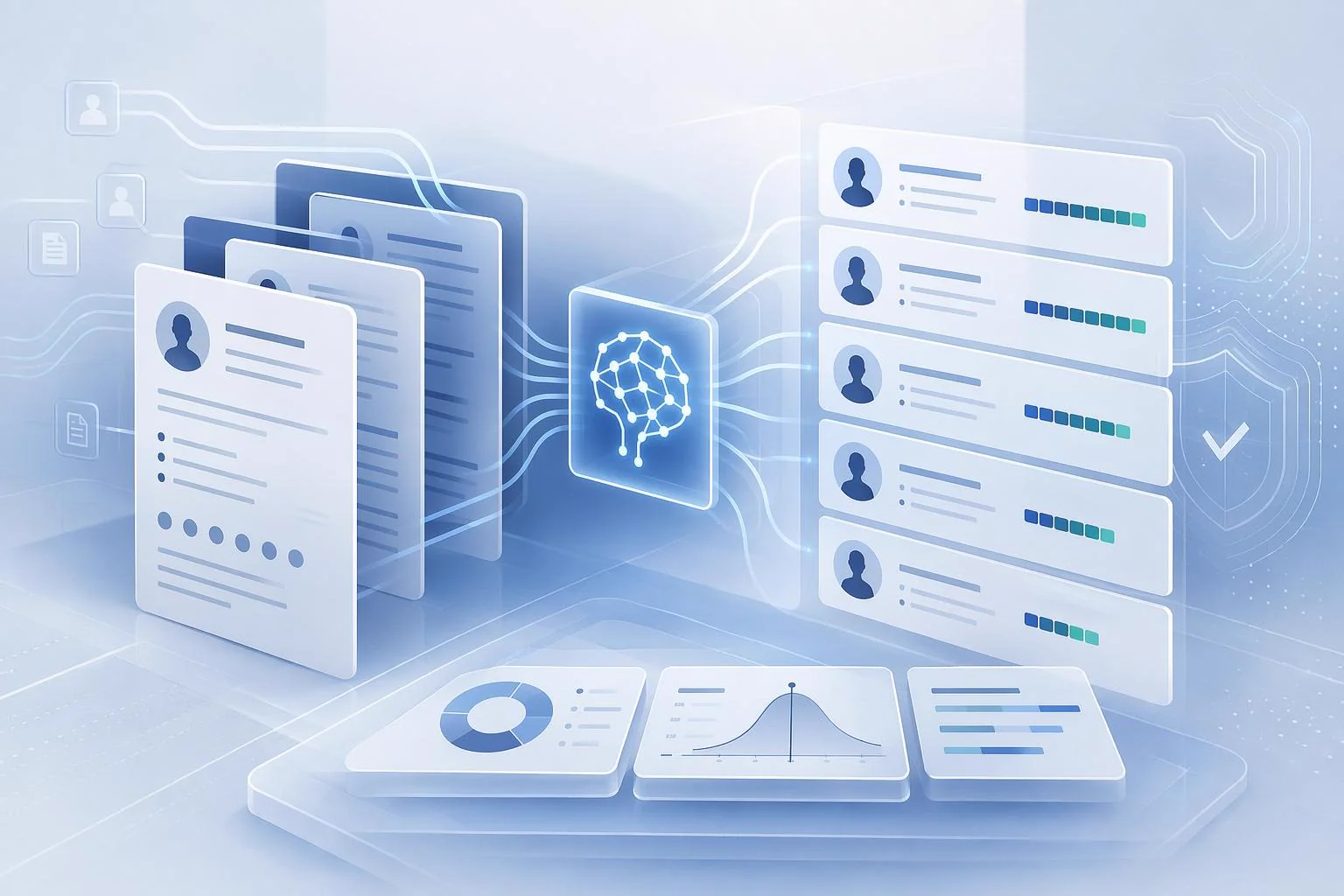
The system assesses relevance on a 10-point scale based on the role requirements and can automatically stop candidates below a configured minimum threshold.
This stage is especially important for highly skilled professionals, white-collar roles, and office-operational roles where the resume contains meaningful information and the company needs to assess experience, competencies, and motivation.
Unified criteria matter more than impressions
In a manual process, one recruiter may focus on the reputation of a candidate's previous employer. Another may focus on tenure. A third may focus on one specific skill. A fourth may react to the overall style of the resume.
All these signals can matter. But without a shared logic, they become impressions.
In Neurohiring, assessment starts from the role requirements.
First, the company defines what matters for the role: responsibilities, requirements, preferences, red flags, reference information, and context. Then the resume is analyzed against that frame.
This moves the discussion from "do we like this resume?" to more precise questions:
- does the experience meet the mandatory requirements;
- is there evidence of the required competencies;
- how deeply has the candidate worked with similar tasks;
- what strengthens the profile;
- what requires clarification;
- what risks should be checked next.
For enterprise hiring, this repeatability is critical. If a company hires across different teams, locations, or business units, early assessment should not depend only on the personal style of one recruiter.
Why a 10-point assessment helps
A score is not the final decision. Its value is that it structures the flow.
A 10-point relevance assessment helps teams:
- identify strong profiles quickly;
- separate clearly weak applications;
- avoid losing borderline candidates;
- set a minimum passing threshold;
- compare candidates using the same logic;
- explain why one profile moves forward and another does not.
The score should not be a "magic number". Recruiters and hiring managers need to understand which factors affected it.
That is why Neurohiring does not stop at a number. Resume screening becomes an input for the next stages: adaptive chat screening, AI interviews, comprehensive reassessment, and the finalist comparison card.
Why screening must be connected to the funnel
The weakness of point automation is that every tool works in its own fragment.
A separate resume scoring tool assigns a score. A separate chatbot asks questions. A separate video questionnaire collects answers.
But if the stages do not share context, the company receives fragments of information instead of a coherent assessment.
In Neurohiring, resume screening does not end with itself. Its results are used further.
If the resume shows strong experience but motivation remains unclear, adaptive chat screening can clarify it.
If the resume mentions an interesting project but the candidate's exact role is unclear, this can become a topic for the AI interview.
If the resume and later answers contradict each other, the system records that in analytics.
This creates one connected workflow:
| Stage | What it adds to the assessment |
|---|---|
| Pre-screening | Checks red flags and critical constraints |
| Resume screening | Analyzes experience, education, skills, and relevance |
| Adaptive chat screening | Clarifies motivation, expectations, conditions, and borderline points |
| AI interview | Checks depth of experience and professional reasoning |
| Analytics | Summarizes strengths, risks, and mismatches |
| Finalist shortlist | Gives people an evidence base for the decision |
The connection between stages turns resume screening from a separate function into part of the AI hiring autopilot.
Which roles need this most
Resume screening is especially valuable when the profile contains meaningful information and the decision cannot be made from basic signals alone.
Highly skilled professionals and white-collar roles
Here, experience, motivation, depth of competence, and the ability to explain decisions matter.
Examples include:
- accountants;
- marketers;
- software engineers;
- engineers;
- B2B sales managers.
A resume may contain important signals: projects, task scale, industries, tools, achievements, and career logic.
AI screening helps compare this information with the role requirements quickly and consistently.
Office-operational and blue-collar roles
For office-operational and production roles, the company often needs to understand basic experience, accuracy, responsibility, process discipline, and readiness for the required working conditions.
Examples include:
- operations specialists;
- dispatchers;
- machine operators;
- production operators.
If there is a meaningful resume or application, screening helps understand whether the required experience exists and what should be clarified next.
Roles with minimum input data
For no-resume or low-resume roles, deep resume screening may be unnecessary or impossible.
In these cases, Neurohiring can start with pre-screening and route the candidate to adaptive chat screening. The chat asks questions based on the available data and role-specific red flags.
This is an important part of the autopilot logic: the system does not force every role through the same heavy process. It chooses the right route.
How AI screening reduces subjectivity
Subjectivity in hiring does not always look like obvious bias.
More often, it appears in smaller ways:
- one recruiter trusts well-known employers more;
- another focuses on tenure;
- a third pays attention to wording style;
- a fourth filters out non-standard career paths too quickly;
- a fifth interprets the same requirement differently.
A unified AI assessment reduces these differences because every candidate goes through the same analysis logic relative to the role requirements.
In a two-month enterprise pilot with a major telecom company, AI and recruiter assessments matched in 99.1% of cases within a tolerance of ±1 point on a 10-point scale.
For us, this is an important signal: with the right methodology, AI screening can be not only fast, but also comparable to expert recruiter assessment.
The recruiter should not become a scoring operator
Good AI screening does not turn the recruiter into someone who simply accepts or rejects machine scores.
The task of Neurohiring is to remove repetitive early-stage processing and give recruiters more time for meaningful work:
- reviewing strong and borderline candidates;
- communicating with the business stakeholder;
- configuring criteria;
- improving the role description and funnel;
- working with finalists;
- closing the role.
The recruiter remains the owner of the process, but receives a more structured and evidence-based foundation.
For an enterprise workflow, this is especially important. The goal is not only to hire faster, but to run a manageable process that is clear to HR leaders, TA leads, hiring managers, and security or compliance stakeholders.
What happens after screening
Resume screening is not the final step. It helps decide what should happen next.
After analysis, a candidate may:
- stop if they do not pass the minimum threshold;
- move to adaptive chat screening to clarify expectations, motivation, or conditions;
- move to an AI interview;
- enter further analytics and comparison with other candidates.
Screening results remain in the shared candidate context. The next stage does not start from a blank page.
Adaptive chat screening uses the strengths and risks already found. The AI interview goes deeper into the important topics. Analytics compares the resume with the candidate's answers.
This gives the company a consistent assessment history, not a set of disconnected notes.
Why this accelerates hiring
AI resume screening accelerates hiring not only because it analyzes resumes faster than a human.
It accelerates the funnel through three effects.
First, it quickly separates irrelevant profiles from candidates worth reviewing further.
Second, it helps recruiters and hiring managers see the structure of the flow: who is strong, who is borderline, where risks exist, and which questions should be clarified.
Third, it prepares data for the next stages, so adaptive chat screening and AI interviews work with real candidate context instead of a generic script.
As a result, Neurohiring can run early stages 24/7 and move candidates to the next step faster than a manual process.
The key product benchmarks are 3-5 hours from application to an AI interview invitation and 1-2 days to a finalist shortlist with detailed analytics.
The market mistake: treating screening as a standalone product
Many solutions automate only resume evaluation.
That can be useful. But for enterprise hiring, it is usually not enough.
A resume does not answer every question.
It does not always reveal motivation. It does not always show the depth of a candidate's role in projects. It does not always explain why the candidate wants to change jobs. It does not always help assess communication, expectations, and real risks.
That is why resume screening should be part of a broader process.
It should not only assign a score. It should prepare the next step.
This is the difference in Neurohiring: resume screening is embedded in one AI hiring autopilot, where each stage strengthens the next one.
For the company, this means AI screening does not remain a separate report. It becomes a working input for further selection.
How to evaluate AI screening quality
If a company tests AI resume screening, it should not look only at processing speed.
Better questions are:
- Did the system understand the role requirements correctly?
- Does it distinguish mandatory and preferred criteria?
- Does it separate red flags from clarifying questions?
- Does it explain the reasons behind the assessment?
- Do the assessments match the logic of recruiters and hiring managers?
- Does it help avoid losing strong candidates?
- Does it prepare data for the next stages?
- Does it reduce manual workload without losing quality?
- Can the result be used in an enterprise workflow?
- Is the conclusion clear to the people who make the final decision?
Otherwise, the company may get a tool that is fast, but hard to manage.
The main point
AI resume screening is not about replacing the recruiter with an algorithm.
It is about moving from subjective review to unified criteria, explainable conclusions, and a connected funnel.
In Neurohiring, this stage works as part of an enterprise-grade AI hiring autopilot:
- first, red flags and basic constraints are taken into account;
- then the resume is assessed against the role requirements;
- results are used in adaptive chat screening and AI interviews;
- analytics collects strengths, risks, and mismatches;
- the finalist shortlist gives the hiring manager an evidence base for the decision.
This turns resume screening from manual routine into a manageable stage of enterprise hiring.
If you are choosing AI for recruiting, do not look only at resume parsing speed. It is more important to understand whether the system helps build unified criteria, explain conclusions, and move the candidate through the funnel without losing context.
What comes next in the series
In the next article, we will look at adaptive chat screening: why it should not feel like a bot, how tone affects candidate conversion, and why an adaptive dialogue works better than a long identical questionnaire.