

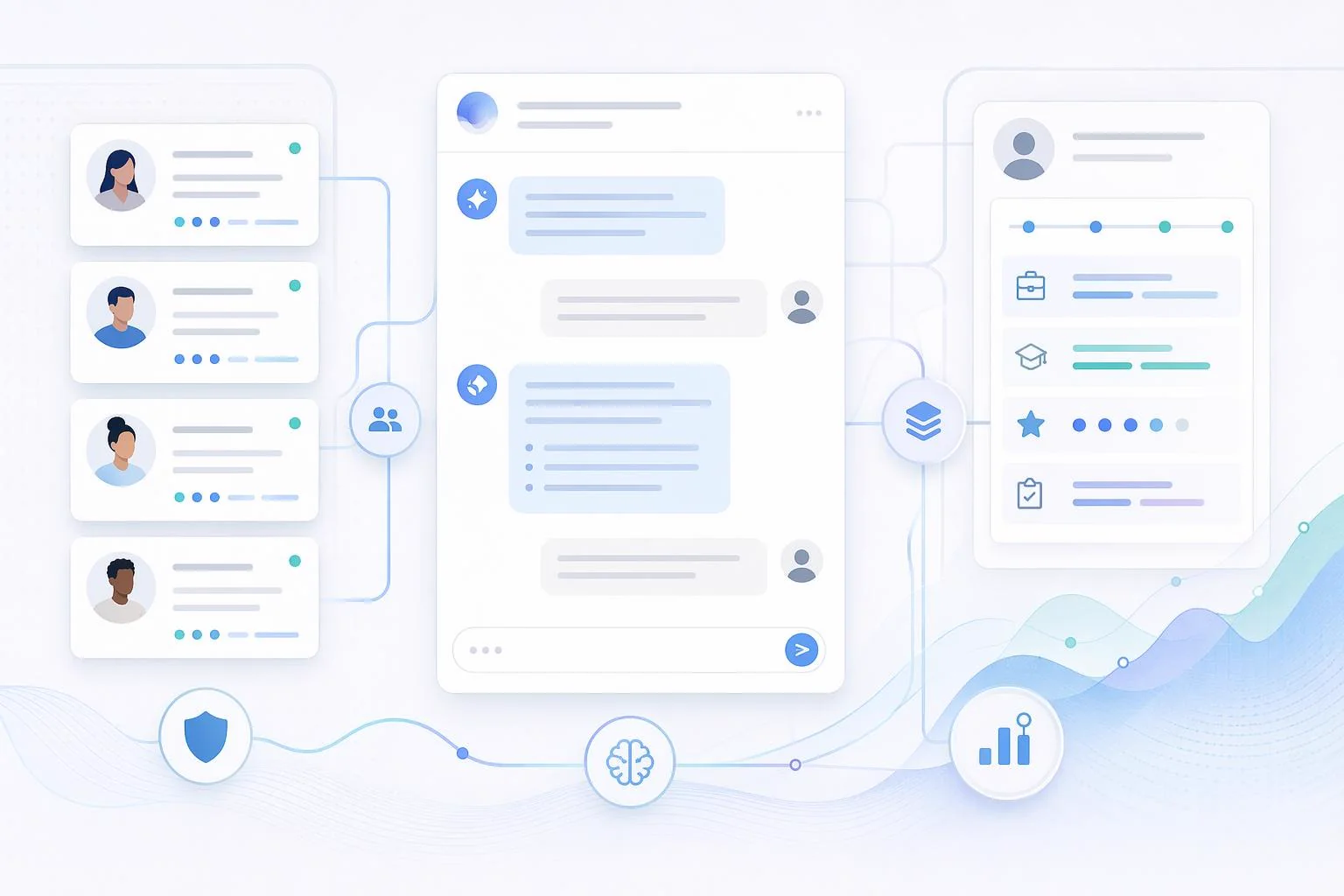
Where chat screening breaks the funnel
Chat screening looks like a simple stage. Ask the candidate a few questions: compensation expectations, schedule, work format, and readiness for the next step.
That is why many products that call themselves an "AI recruiter" start with a chatbot.
But automated messaging does not solve much on its own. If a candidate applies and then receives a long questionnaire in a messenger, that is not speed. It is another barrier.
Bad chat screening is easy to recognize:
- it asks for information that is already in the resume;
- it asks everyone the same questions;
- it does not react to the candidate's answers;
- it sounds dry and mechanical;
- it breaks when the candidate replies in a non-standard way;
- it makes people spend time without a clear reason.
For the employer, this may be called "automated early communication". For the candidate, it feels different: "nobody read my application".
In hiring, that is dangerous. A strong candidate does not have to tolerate a poor process. They may not reply, choose another role, or simply lose interest.
That is why chat screening should not only be fast. It should be relevant, adaptive, and respectful. Otherwise, AI in recruiting does not help the funnel. It helps candidates drop out.
Chat screening is not a form inside a messenger
The main mistake is to move a standard questionnaire into WhatsApp, Telegram, email, or another communication channel and call it AI.
From the outside, it may look modern: the candidate does not fill in a form, but "talks to a bot". Inside, however, if there is only a rigid list of questions, the value is limited.
A form does not understand context. A dialogue should.
Real chat screening takes into account:
- what is already known from the application;
- what is written in the resume;
- which red flags were found during pre-screening;
- which requirements matter for this specific role;
- what the candidate has already answered in the chat;
- which next stage is needed.
This is how chat screening works in Neurohiring. It is not a separate bot for collecting answers. It is part of the AI Hiring Autopilot. Every question is connected to the role, previous data, and further candidate assessment.
This is where AI in HR stops being a "questionnaire with buttons" and becomes a real selection stage.
How this works in Neurohiring
Neurohiring is an Enterprise-Grade AI Hiring Autopilot. Chat screening in Neurohiring does not live separately from the process. It is connected with pre-screening, resume screening, AI interviews, analytics, and the finalist shortlist.
At this stage, the system can start a dialogue with the candidate through available channels such as messengers, email, or job-platform communication flows, depending on the implementation.
The task is to clarify, quickly and carefully, what is needed to move through the funnel:
- compensation expectations;
- readiness for relocation or a required work format;
- schedule and work format;
- specific skills;
- conditions that matter for the role;
- motivation and interest in the vacancy;
- unclear points after resume screening or pre-screening.
The key is not the fact that there is a chat. The key is adaptability.
If the data is already available, Neurohiring does not ask for it again. If the data is limited, it asks basic clarifying questions. If the resume has already been analyzed in detail, the questions become more precise: experience, skills, motivation, and constraints.
Context is stronger than a script
A classic bot moves on rails:
- Question.
- Question.
- Question.
- Question.
- Final message.
That is convenient to configure. It is poor for real hiring.
Candidates are different. Roles are different. Input data is different. One candidate needs a compensation clarification. Another needs a work-format clarification. A third needs to explain a career change. A fourth needs to clarify a skill that was described too generally in the resume.
If the chat does not use context, it creates noise. If it does, it helps assessment.
In Neurohiring, context is collected from several sources:
| Source | How it helps chat screening |
|---|---|
| Candidate application | Shows basic data and initial interest |
| Pre-screening | Highlights red flags and critical constraints |
| Resume | Helps ask more precise questions about experience and skills |
| Role requirements | Remove irrelevant questions and set priorities |
| Chat answers | Change the next clarifying questions |
This turns chat screening from an impersonal questionnaire into a connected part of the funnel.
Tone affects conversion
In hiring, the question itself is not the only thing that matters. The way it is asked matters too.
The same question can make a candidate feel pressured. Or it can sound calm, businesslike, and clear.
This is especially important when the topic is sensitive:
- compensation expectations;
- readiness to relocate or work in a specific format;
- reasons for looking for a new role;
- schedule constraints;
- mismatch with part of the requirements;
- unclear points in the candidate's experience;
- conditions that may be inconvenient for the candidate.
A good AI recruiter does not pressure the candidate and does not pretend to be human. It asks questions at the right time, briefly, clearly, and to the point.
Neurohiring chat screening is built with HR methodology in mind. The goal is not only to get a fact, but also to preserve the relationship. A difficult question is better asked when the candidate already understands the role context and sees a normal business dialogue.
Candidate experience is not decoration. It is a conversion factor.
Candidates are not against AI. They are against bad experience
Companies sometimes worry: "Candidates will not want to talk to AI."
Usually, the problem is not AI. The problem is a bad process.
Candidates are ready to interact with AI when everything is clear, fast, and respectful. They are not ready to complete long forms, answer repeated questions, and read cold template messages.
In Neurohiring trials and pilots, candidates rated the AI interview format highly: 4.8 out of 5 in one enterprise pilot and 4.85 out of 5 in another enterprise pilot. At the same time, only about 7.1% of candidates refused the AI interview, while around 92.9% accepted the format.
These numbers refer to AI interviews, but they show an important principle: when AI communication is designed well, candidates work with it.
Chat screening is the first moment where this principle is tested in practice.
Different roles need different dialogue
The same chat for everyone is almost always weak. It is either too shallow or too heavy.
For highly skilled professionals and white-collar roles, experience, motivation, professional logic, and the ability to explain decisions matter. Here, chat clarifies details after the resume: interest in the role, expectations, specific skills, unclear transitions, and conditions.
For office-operational and blue-collar roles, basic experience, accuracy, responsibility, readiness for conditions, and process discipline are often more important. Here, the dialogue should be simpler, more practical, and closer to the vacancy.
For no-resume or low-resume roles, the input may be minimal: contact details, a short comment, basic availability, or brief experience. In this case, the chat relies on pre-screening, red flags, and carefully collects missing role-relevant information.
Different roles require different depth. That is why chat screening must be an adaptive stage, not a universal list of questions.
What the recruiter gets
Good chat screening does not replace the recruiter. It removes routine and prepares useful information for the decision.
The recruiter does not need to manually write the same clarifying messages, check basic conditions, send reminders, collect answers from different channels, and move everything into notes.
Neurohiring helps automate this part:
- starts the dialogue with the candidate;
- clarifies important parameters;
- takes resume screening and pre-screening into account;
- supports different communication channels;
- handles cases where the candidate does not respond or declines;
- supports richer communication formats where available;
- collects communication in one shared candidate context.
As a result, the recruiter receives not just "answers to questions", but a candidate picture: what is known, what is confirmed, where the risk is, and what should be checked next.
Why a separate chatbot is not enough
There are many tools that automate candidate messaging. For reminders, simple questions, and routing, they can be useful.
But for enterprise hiring, a chatbot alone is not enough.
If the chat is not connected to resume screening, it does not know which questions already appeared. If it is not connected to pre-screening, it repeats obvious points. If it is not connected to the AI interview, its answers do not support deeper assessment. If it is not connected to analytics, the recruiter has to manually assemble fragments again.
In Neurohiring, chat screening works inside one AI hiring autopilot:
- pre-screening identifies red flags;
- resume screening analyzes experience and skills;
- chat screening clarifies what is missing;
- the AI interview checks depth of competence;
- analytics records strengths, risks, and mismatches;
- the finalist shortlist helps people make the decision.
That is why Neurohiring is different from a simple AI recruiter or chatbot. It does not just ask questions. It connects answers with pre-screening, interviews, analytics, and the final shortlist.
How to make AI dialogue feel human
A good AI dialogue does not need to pretend to be human. It only needs to be clear, relevant, and attentive to context.
High-quality chat screening:
- Does not ask unnecessary questions.
- Uses information that is already known.
- Explains the next step.
- Avoids long overloaded messages.
- Handles sensitive topics carefully.
- Clarifies incomplete answers.
- Keeps a natural business tone.
- Does not break when the candidate replies in an unusual way.
- Does not make the candidate repeat the same thing.
- Helps the candidate move to the next stage faster.
This is what separates adaptive chat screening from a mechanical script.
Tone is part of the employer brand
The first contact after an application affects the candidate's impression of the company.
If communication is fast, clear, and respectful, the employer looks organized and modern. If the candidate receives a dry questionnaire that ignores their resume, the effect is the opposite.
This matters both for strong professionals and for high-volume hiring.
A strong professional should not be lost at a boring first step. A high-volume candidate should not be overloaded with unnecessary actions. Office-operational and production roles need clear conditions. Candidates without a resume need a simple entry point without complex logic.
Chat screening in Neurohiring helps keep this balance: automation removes routine, while the dialogue remains connected to the role and context.
How to evaluate chat screening
If a company tests an AI chat for recruiting, it should not only check whether the chat sends messages.
Look deeper:
- does the chat use resume screening and pre-screening context;
- does it ask only necessary questions;
- can it work with limited data;
- does it handle non-standard answers correctly;
- does it avoid repeating what is already known;
- does it keep a respectful business tone;
- does it help improve conversion to the next stage;
- does it reduce recruiter workload;
- does it save results in one candidate profile;
- does it support the AI interview and final analytics.
If the chat simply follows a list of questions, it is form automation. If it uses context and moves the candidate through the funnel, it is part of an AI hiring autopilot.
The new standard: dialogue that helps hiring
Chat screening should solve two tasks.
The first is to quickly collect missing information, check conditions, and prepare the candidate for the next stage.
The second is to preserve a healthy candidate experience: do not overload, do not irritate, do not ask for obvious information again, and do not turn the dialogue into a mechanical form.
In Neurohiring, this stage is embedded in an enterprise-grade AI hiring autopilot. It uses pre-screening, resume screening, role requirements, red flags, and candidate answers. That is why chat screening becomes part of a managed funnel from application to finalist.
Automation becomes not only faster, but smarter.
If a company chooses AI for recruiting, chat screening quality should not be evaluated by the number of messages sent. The more important question is whether it helps keep the candidate engaged, collect relevant data, and move the candidate through the funnel without unnecessary friction.
What comes next in the series
In the next article, we will look at AI interviews: why they are not video questionnaires, how a dynamic interview differs from a set of template questions, and how Neurohiring helps assess the depth of candidate experience.