

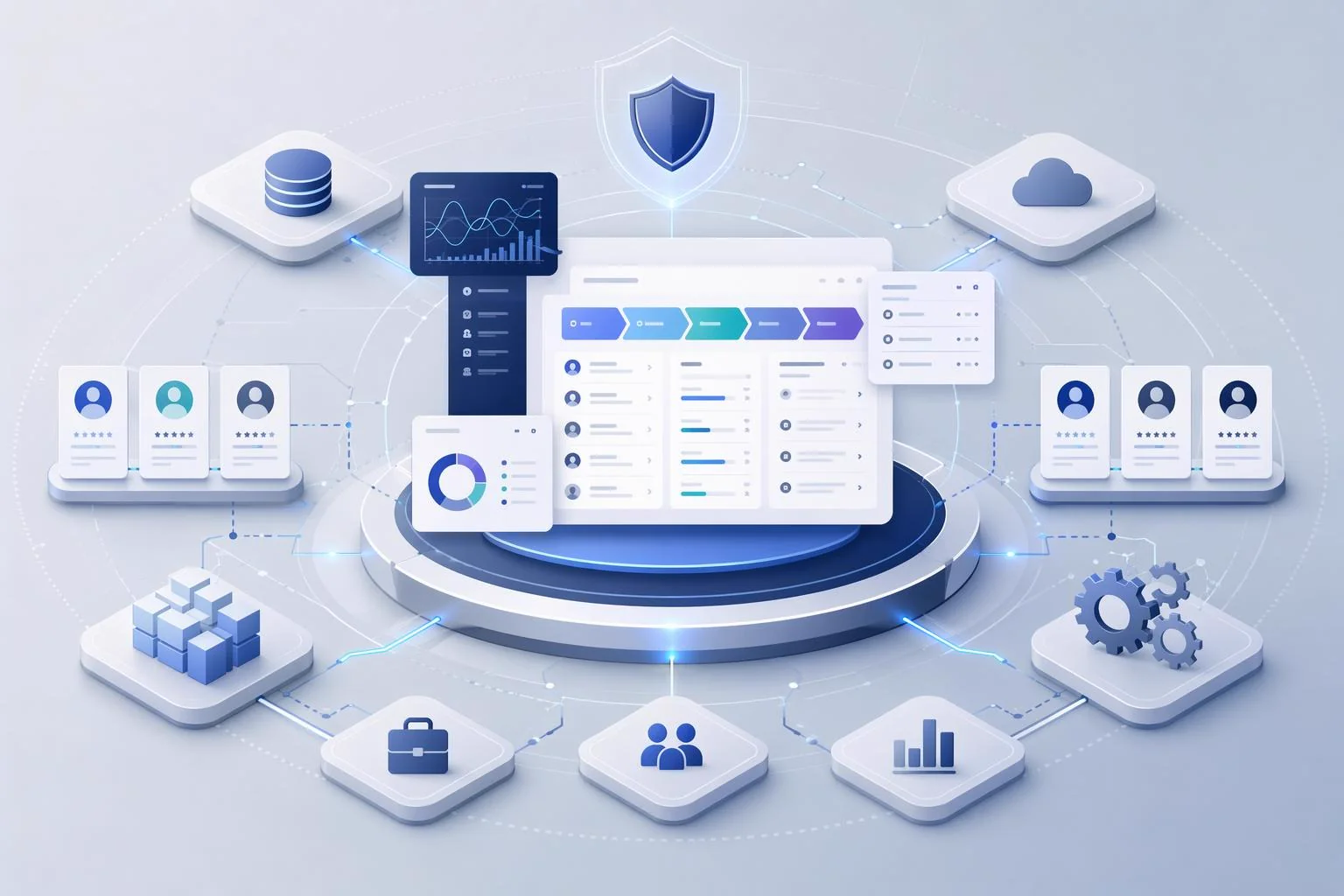
In AI recruiting, the model is not the only thing that wins
When the market discusses AI in hiring, attention often goes to the visible layer: the interface, AI recruiter responses, follow-up questions, and the speed of the report.
All of this matters. But for a large company, it is not enough.
Searches for AI recruiting, artificial intelligence in HR, or AI recruiters often start with curiosity about the model. In the enterprise segment, another point becomes clear quickly: the quality of an AI answer is only the first layer.
Behind it, there must be architecture, security, operations, integrations, and a product team that knows how to work with enterprise requirements.
An enterprise customer does not need only "AI that answers well". It needs a system that can operate in a real corporate environment:
- with candidate data;
- with security requirements;
- with integrations;
- with access roles;
- with logging;
- with support;
- with reliability;
- with clear operations.
This is where the line is drawn between an experimental AI widget and an enterprise product.
Neurohiring is designed as an Enterprise-Grade AI Hiring Autopilot. Its value is not only the AI core or HR methodology, but also the product engineering maturity required to bring AI into a real hiring process.
This maturity did not appear by accident. The team behind Neurohiring brings 15+ years of experience in custom development of complex enterprise systems with high requirements for reliability, security, integration, and support.
For the customer, this is not a reputation add-on. It reduces implementation risk: the product should not only look good in a demo, but also reach production use.
Why a polished demo is not enough
A demo can be impressive. But after the demo, enterprise customers ask different questions:
- where data is stored;
- how applicable data protection requirements are addressed;
- who has access to candidate data;
- whether user roles can be separated;
- how actions are logged;
- how the system handles failures;
- whether it can integrate with an ATS or HRIS;
- how it will work not on one test vacancy, but in a regular process;
- what happens to personal data when GenAI is used;
- how the vendor responds to security, legal, architecture, procurement, and business requirements.
These are not objections for the sake of objections. This is the normal path of enterprise adoption.
Hiring works with sensitive information: resumes, contact details, career history, candidate answers, assessments, comments, and internal employer decisions. That is why an AI hiring solution should be ready not only for a conversation with HR, but also for security, IT, compliance, legal, procurement, and business.
A simple AI recruiter is often not enough here. It may run a good dialogue. But an enterprise customer needs governance, predictable operation, and the ability to fit into a corporate contour.
Neurohiring is AI, HR methodology, and enterprise engineering
Neurohiring is not a separate tool for one hiring stage.
It is one AI hiring autopilot that connects:
- pre-screening;
- resume screening;
- adaptive chat screening;
- AI interview;
- analytics;
- comparison card;
- finalist shortlist;
- recommendation reasoning;
- unified candidate profile;
- foundation for the hiring manager's final decision.
For this workflow to work reliably, a strong model is not enough. Three layers are needed.
| Layer | What it is responsible for |
|---|---|
| AI core | Analyzes data, runs dialogue, asks follow-up questions, creates conclusions and recommendations |
| HR methodology | Defines what to assess, which red flags matter, how to structure communication, and how to explain the result |
| Enterprise product engineering | Makes the product secure, reliable, integrable, and suitable for corporate operation |
If one layer is missing, the product becomes weaker.
AI without HR methodology may ask formally correct but not always useful questions. HR methodology without engineering remains a consulting framework. Engineering without AI and methodology becomes another system of record.
The strength of Neurohiring is the combination.
That is why the product should not be evaluated only by the question "how smart is the model?" The more important question is whether the whole workflow helps the company move candidates to the final decision faster, safer, and with more evidence.
What enterprise experience adds to Neurohiring
The team behind Neurohiring has 15+ years of experience building complex custom enterprise systems.
For AI recruiting, this matters directly.
A corporate AI hiring autopilot cannot be assembled only from prompts, a clean interface, and a strong demo. It has to be designed as a production system:
- with architecture;
- with reliable data handling;
- with access control;
- with integrations;
- with support;
- with customization options;
- with different corporate environments in mind;
- with readiness for security, IT, legal, and compliance review.
This background shapes how Neurohiring approaches HR Tech: not as a quick AI experiment, but as enterprise SaaS that must work under real operating conditions.
That is an important distinction in the AI recruiting market. Neurohiring is not built around one impressive AI feature. It is built around a corporate hiring process that has to be stable, explainable, secure, and usable by several stakeholder groups at once.
An enterprise product should integrate, not break the contour
Large companies rarely start from a blank slate. They already have an ATS, HRIS, enterprise systems, policies, roles, approval processes, communication channels, security requirements, and user habits.
A corporate AI product should not break this contour. It should fit into it carefully.
Neurohiring is positioned as an AI layer that can work alongside existing systems of record and, where needed, integrate with the customer's HR technology landscape. The exact integration scope depends on the customer's systems, data flows, security review, and target operating model.
The principle is simple: Neurohiring does not replace an ATS where the ATS already tracks records well. The ATS can remain the system for vacancies, statuses, and process history. Neurohiring solves a different task: it guides candidates through early stages and prepares a finalist shortlist with analytics and reasoning.
In other words:
- ATS tracks the process.
- Neurohiring guides the candidate.
For companies that have already invested in an HR Tech landscape, this is essential. AI adoption in recruiting should not become a painful replacement of the entire stack. It should strengthen the parts where a tracking system alone does not move candidates through the funnel.
Security is part of the product, not an appendix
In AI recruiting, security cannot be prepared "after development". In the enterprise segment, it has to be part of the product logic.
For Neurohiring, this means several principles.
First, the international product path should be discussed through a separate international infrastructure contour and a data protection approach suitable for global customers.
Second, enterprise adoption requires resilience and predictable operation: availability, monitoring, support, and a clear responsibility model.
Third, corporate AI workflows need governance and control: access separation, logging, context separation, and the ability to discuss dedicated requirements for a specific customer.
Fourth, when GenAI is used, sensitive personal identifiers should not freely flow into the model. Neurohiring follows the principle of separating professional context from unnecessary identifiers such as names, contact details, or document data where possible and appropriate.
For security teams, this is not an implementation detail. It is a launch condition.
For the business, it is also value. The earlier the product is ready for security and legal questions, the lower the risk that HR interest stops during internal approval.
Security review is part of maturity
Many AI tools look good in a demo but never reach production because of security, compliance, and architecture questions.
In large companies, this is especially visible. Even if HR is interested, the solution must pass internal filters: security, IT, legal, procurement, architecture, compliance, and owners of adjacent systems.
For an enterprise AI hiring vendor, readiness for these conversations is a maturity signal.
This does not mean every implementation is identical. Each customer has its own policies, questionnaire, legal structure, and approval path.
But the general expectation is the same: the vendor should be able to explain the processing contour, data approach, access model, logging, GenAI controls, and documented obligations.
In the AI in HR segment, this is especially important. Many products promise speed. Far fewer are ready for real reviews, contracts, access roles, and constraints of an enterprise environment.
Reliability matters in hiring too
Recruiting may not look like a banking process or an industrial system. But stability still affects the business.
If a candidate cannot pass a stage, does not receive a link, misses an invitation, cannot complete an AI interview, or loses contact with the company, this is not just a technical issue.
It is a lost candidate, a broken SLA, additional recruiter workload, and a worse candidate journey.
This matters even more when Neurohiring works 24/7 and covers early funnel stages: from application to AI interview invitation within 3-5 hours, and to a finalist shortlist with detailed analytics within 1-2 days.
This speed is possible only when the system works consistently and does not depend on the manual availability of individual people. Reliability, monitoring, support, and operations are not technical extras. They are part of product value.
Otherwise, AI in hiring quickly becomes an operational risk: it promises speed, but at a critical moment creates manual workarounds.
Customization without losing system logic
Enterprise customers rarely have identical processes. Roles, candidate requirements, application channels, approvals, communication rules, branding, and integration depth differ.
An AI hiring autopilot should adapt to the company without becoming a chaotic set of manual settings.
Neurohiring supports enterprise-level configuration such as:
- branded candidate-facing experience where appropriate;
- custom scenarios for different role types;
- integration with corporate systems when needed;
- support for non-standard processes;
- launch and operational support;
- alignment with customer data and security requirements.
This matters for large organizations where one product may be used across different hiring contours: highly skilled talent, office and operational roles, frontline positions, or vacancies with minimal candidate data at entry.
The Neurohiring logic remains consistent: do not force the customer to manually build a process around AI. Embed AI into a managed hiring workflow.
Engineering maturity affects candidates too
Enterprise product engineering is often discussed with IT and security. But in hiring, it also affects candidates.
Candidates need the process to be clear, fast, and stable. They should receive the correct invitation, complete chat screening without feeling trapped in a pointless questionnaire, join an AI interview without complex installation, and see professional communication from the employer.
In separate enterprise pilots, 92.9% of candidates accepted the AI interview format, while 7.1% refused it. In selected pilots, candidates rated the AI interview experience at 4.8 and 4.85 out of 5.
These numbers confirm more than the quality of an AI interview. They show that candidate experience depends on the whole system: communication, stability, scenario design, interface, speed, and process accuracy.
If an AI solution is technically unstable, trust breaks faster than automation creates value.
For the candidate, the quality of an AI recruiter is not only the question script. It is the entire platform: invitation, availability, clarity, speed, correct communication, and accurate analytics at the end.
An AI widget does not solve enterprise hiring
A point AI tool can be useful. It may accelerate resume analysis, help write a message, ask several candidate questions, or prepare a short meeting summary.
But enterprise hiring rarely suffers from only one bottleneck.
Usually, the problem is broader:
- applications are reviewed too slowly;
- candidates get lost between stages;
- recruiters are overloaded with manual communication;
- assessment depends too much on a specific person;
- business receives too little explainable analytics;
- data is scattered across systems and messages;
- final decisions are made on an incomplete picture.
That is why Neurohiring is not built as a widget for one action. It covers the connected chain of stages: from pre-screening and resume screening to chat screening, AI interviews, analytics, and finalist shortlist.
This connectedness makes an AI hiring autopilot a different class of solution.
If a company chooses AI recruiting for years, not for one experiment, it should look at the connection between stages: how much of the path from application to finalist is covered, not only whether one visible part looks impressive.
How enterprise experience helps pilots
An enterprise pilot is not just "give access and see what happens". Even a fast pilot requires alignment on scenario, roles, candidate sources, constraints, expectations, and success criteria.
For a large customer, it is important to:
- see a working scenario quickly;
- avoid months of integration before the first test if integration is not needed;
- discuss data constraints in advance;
- prepare answers for security and IT;
- agree on evaluation criteria;
- distinguish a quick pilot from a full paid pilot;
- avoid promising impact without a sufficient sample.
A quick Neurohiring pilot can often start without ATS integration. Its goal is to show that the system works as expected and reduce initial uncertainty.
A paid pilot is better suited for evaluating effect on a meaningful sample: conversion, cost of hire, team workload, and readiness to scale.
The strategy is pragmatic: first the customer sees the AI hiring autopilot in real work, then decides on deeper integration and scaling.
Enterprise product development is not only code
Enterprise product development is broader than engineering alone.
An enterprise product needs operational maturity:
- ability to work with customer requirements;
- readiness for reviews and questionnaires;
- understanding of corporate processes;
- support for custom scenarios;
- careful integration work;
- post-launch support;
- operational responsibility;
- ability to speak to different stakeholders in their language.
The HR leader needs to understand how the product reduces workload and accelerates hiring. Security needs to understand how data is protected. IT needs to understand how the system fits into the landscape. Business needs metrics. The hiring manager needs to know why the shortlist can be trusted.
A mature AI product should answer all these audiences.
That is why enterprise product development is not only writing code. It is bringing the product through the full cycle of corporate adoption: from the first scenario and pilot design to security review, integration planning, launch, support, and scaling.
The new standard: an AI autopilot should be enterprise-ready
AI in hiring can no longer be evaluated only by how impressive it looks in a demo. For corporate use, the more important question is whether the product can operate in a real hiring process in a stable, secure, and reproducible way.
Neurohiring is built in this logic.
It connects:
- AI core;
- HR methodology;
- international infrastructure approach;
- security and data protection;
- integrations;
- analytics;
- support;
- enterprise product maturity.
That is why Neurohiring is not an experimental AI widget for a separate stage. It is an enterprise-grade AI hiring autopilot that helps companies move candidates to the final decision faster, reduce manual workload, and make early assessment more reproducible.
Routine work stays with AI. The final decision stays with people.
But those people should not stand behind a fragmented chain of tools. They should stand behind a reliable corporate workflow.
If you evaluate AI recruiting for a large company, do not look only at the beauty of the demo. Ask how the product will live in your environment, how it will pass security review, how it will integrate with existing systems, how it will be supported, and who is responsible for operation.
These are the questions that separate an experimental AI widget from an enterprise-ready AI hiring autopilot.
What comes next in the series
In the next article, we turn to hiring economics: why counting only the price of a resume, application, or one interview is a mistake.
We will show what the real cost of closing a role consists of, why recruiter and hiring manager time matters, where candidates are lost, and how the Neurohiring AI autopilot changes not only hiring speed, but also hiring economics.