

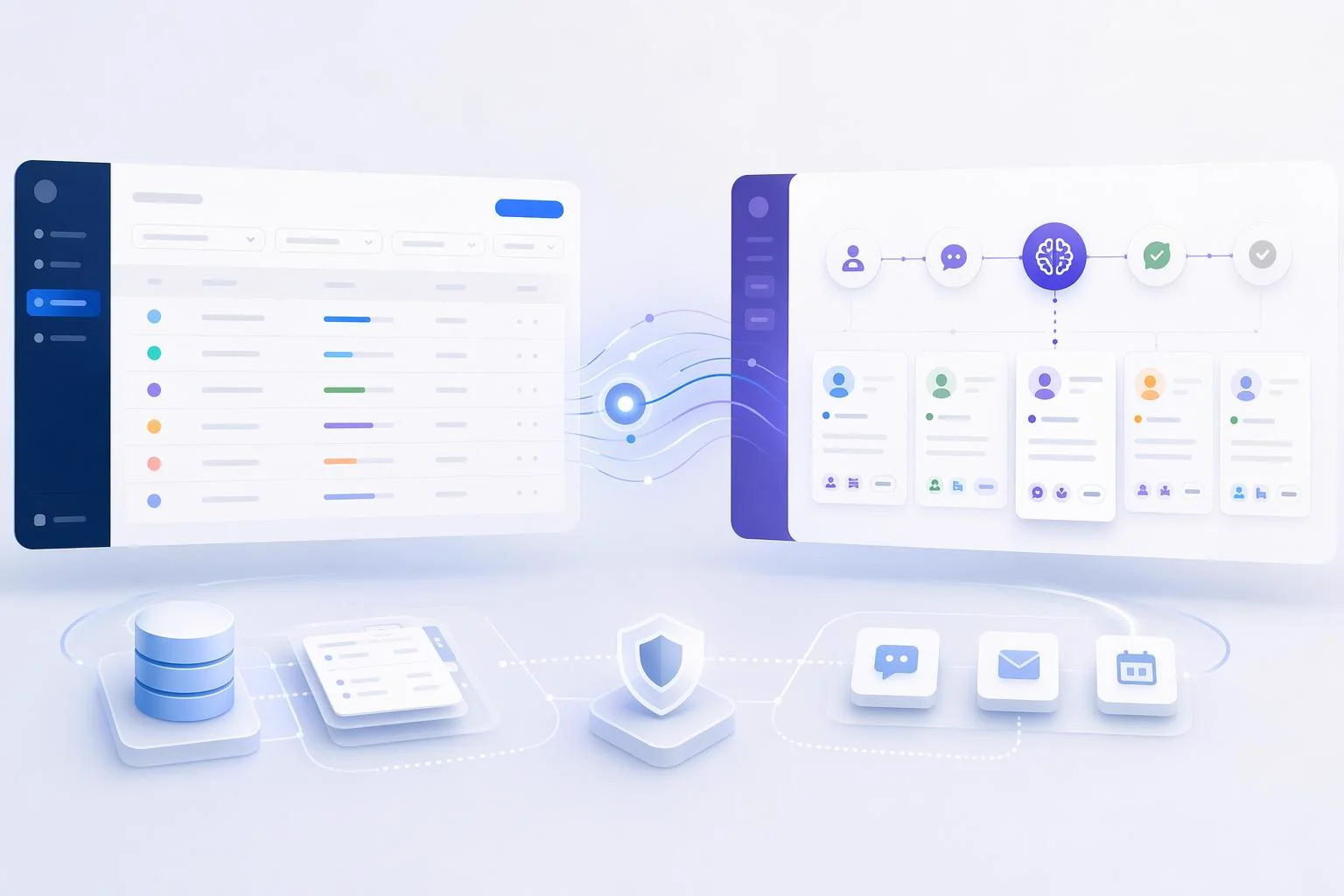
ATS and AI Hiring Autopilot solve different problems
In corporate hiring, an ATS has long been a basic part of the HR technology landscape.
An ATS helps manage vacancies, store candidates, track statuses, collect communication history, organize approvals, and produce reports.
This is important. But tracking the process and actively guiding the candidate are different tasks.
So the question "why do we need Neurohiring if we already have an ATS?" is logical, but not quite precise.
An ATS is responsible for order. Neurohiring is responsible for movement in the early funnel: the candidate passes pre-screening, answers questions, reaches an AI interview, and the hiring manager receives not just a set of statuses, but an evidence-based picture.
When companies search for AI recruiting, AI recruiters, or artificial intelligence in HR, they usually do not need another candidate directory. They need a layer that takes over the work between application and final decision.
An ATS answers questions such as:
- which vacancies are open;
- who applied;
- which stage the candidate is in;
- who owns the vacancy;
- which statuses were assigned;
- which comments were added;
- which actions have already been completed;
- where the hiring history is stored.
Neurohiring answers different questions:
- who should be rejected because of red flags;
- how relevant the resume is to the role;
- which questions should be clarified in chat screening;
- how to run the AI interview;
- which strengths and risks the candidate has;
- who should enter the shortlist;
- why these candidates should be considered further;
- what evidence base the hiring manager receives.
In short:
- ATS tracks the process.
- Neurohiring guides the candidate.
Why a system of record is not enough for the new standard of hiring
Historically, hiring has relied on manual work: the recruiter reviews applications, asks questions, schedules interviews, takes notes, moves candidates through stages, and updates statuses.
In this logic, an ATS solves its problem well: it helps the company avoid losing the process.
But an ATS by itself usually does not remove the main routine from the early stages.
It can store an application, but it does not necessarily assess it deeply.
It can record a status, but it does not necessarily move the candidate forward.
It can contain a candidate card, but it does not necessarily run chat screening.
It can store an interview recording or outcome, but it does not necessarily create detailed notes with timestamps and analytics.
It can be a source of data, but it does not always become an active participant in the funnel.
For the new standard of hiring, this is not enough. Companies need more than a record of what happened. They need a workflow that helps the process move faster, deeper, and more consistently.
This is the practical value of AI recruiting: not adding a smart button to a database, but removing the manual work that has lived for years between ATS statuses.
What Neurohiring adds on top of tracking logic
Neurohiring covers the core hiring funnel as an Enterprise-Grade AI Hiring Autopilot.
It works with candidates stage by stage:
- accepts applications from job boards and other sources;
- takes into account role requirements, responsibilities, preferences, and red flags;
- runs pre-screening;
- analyzes the resume when a resume exists and matters for the role;
- runs adaptive chat screening;
- conducts an AI interview;
- creates analytics;
- prepares a comparison card and finalist shortlist;
- gives the hiring manager a foundation for the final decision.
This is not just "one more stage" inside an ATS. It is a different logic: active candidate guidance through the funnel.
If an ATS records the state of the process, Neurohiring helps move the candidate through it.
This is especially important in high-volume and enterprise hiring. A delay in the early stages quickly turns into lost candidates, overloaded recruiters, and a weak shortlist for the business.
Example: what happens after an application
Imagine a common situation: a candidate applies for a role.
In an ATS, the application appears in the system. Then the recruiter has to review the resume, assess relevance, check red flags, decide whether to contact the candidate, ask questions, wait for answers, schedule the next step, and record the result.
Neurohiring follows another logic.
The system can accept the application, check red flags, run pre-screening, assess the resume when needed, start chat screening, clarify expectations or role-specific skills, invite the candidate to an AI interview, and generate analytics.
For the recruiter, this is not simply "the candidate card became richer". It means the early funnel starts moving without constant manual work.
This is how Neurohiring differs from a simple AI recruiter in chatbot form. It does not only chat with the candidate. It connects pre-screening, resume analysis, dialogue, AI interview, and analytics into one trajectory.
Why integration matters more than replacement
Many large companies already have an ATS. It is embedded into processes, reports, roles, access models, policies, and historical data.
So the right question is not "what should we replace?" The right question is "how should we connect the contours?"
In most enterprise scenarios, an ATS and Neurohiring should complement each other.
The ATS can remain the system of record and hiring process backbone.
Neurohiring can serve as the AI workflow that takes over active candidate work:
- pre-screening;
- resume screening;
- chat screening;
- AI interview;
- analytics;
- finalist comparison;
- recommendations and reasoning.
This approach reduces organizational resistance. The company does not need to rebuild the entire HR landscape on day one. It can start with a specific scenario, test the effect, and then expand integration.
For an enterprise customer, this is a practical adoption path: the existing ATS is not devalued. It receives an AI layer that helps turn inbound candidate flow into a meaningful shortlist faster.
Where the boundary lies between an ATS and Neurohiring
The boundary is easiest to see by task type.
| Task | Typical ATS role | Neurohiring role |
|---|---|---|
| Vacancy storage | Maintains structure and statuses | Uses requirements for assessment and communication |
| Candidate card | Stores data and history | Enriches the card with analytics and stage results |
| Statuses | Records process movement | Helps move the candidate through stages |
| Resume screening | May store the resume | Assesses relevance against requirements |
| Communication | May record touchpoints | Runs adaptive chat screening |
| Interview | May store a recording or result | Conducts AI interview and creates notes |
| Candidate comparison | May store comments | Creates comparison tables and shortlist |
| Hiring decision | Records the outcome | Prepares evidence for the decision |
An ATS supports process governance. Neurohiring supports intelligent candidate guidance inside the process.
Why plugins and point add-ons do not solve the core problem
There are many tools that add one AI function to an existing process: resume scoring, message generation, a separate chat, a browser extension, or an interview assistant.
These tools can be useful. But they often do not create shared context.
Problems appear at the seams:
- resume scoring is not connected to chat screening;
- chat does not use previous-stage results;
- the interview does not rely on the dialogue;
- analytics does not become a comparison card;
- the hiring manager receives fragments, not a full picture;
- data has to be moved manually;
- the process depends on user discipline.
Neurohiring is designed as one workflow from the start. Resume, pre-screening, chat, AI interview, analytics, and shortlist are connected.
This is the difference between point automation and an AI hiring autopilot. Many market terms may sound similar: AI recruiting, AI recruiter, artificial intelligence in HR. For the business, the important question is not the label. The important question is whether AI is connected to the real funnel or only decorates one fragment of it.
Why an ATS should not become a candidate graveyard
Many companies have a large candidate database in their ATS. But a database does not create value by itself if nobody works with it.
Candidates become outdated, contact details lose relevance, statuses stop reflecting reality, strong people stay in the archive, and recruiters go searching for new applications again.
Neurohiring can be useful not only for new inbound flow, but also for selected scenarios involving an existing candidate base: re-engagement, data refresh, interest validation, market mapping, or segment-based candidate pooling.
These scenarios require configuration and approval. But the logic matters: a candidate database creates value not when it is simply stored, but when it can be used in a controlled way.
Here, the AI layer has a clear benefit. The company has already spent money attracting and storing candidates. Neurohiring helps turn the database from an archive into a working recruiting resource.
How Neurohiring helps the hiring manager
For the hiring manager, the difference between an ATS and Neurohiring is especially visible.
In an ATS, the manager often sees statuses, resumes, comments, and at best a brief summary of the discussion.
In Neurohiring, the manager receives:
- finalist shortlist;
- comparison table;
- strengths of each candidate;
- risk areas;
- reasoning behind recommendations;
- AI interview notes with timestamps;
- the ability to ask AI a question about a candidate;
- a link to a candidate profile or finalist comparison.
This changes the hiring manager's role.
The manager joins not to reprocess the whole flow, but to make the final decision based on prepared analytics.
That is why one of Neurohiring's key metrics is up to 1 hour of hiring manager involvement.
For the business, this is stronger than "we have an AI feature": the manager spends less time sorting the flow and more time choosing from prepared finalists.
How Neurohiring helps the recruiter
For the recruiter, the ATS remains an important workspace. But often it does not remove the heaviest workload: initial review, communication, clarifications, repeated questions, waiting for replies, and preparation of materials for the hiring manager.
Neurohiring takes over routine early-stage work.
The recruiter gets:
- less manual application sorting;
- fewer blind first screens;
- fewer repeated questions;
- more structured data;
- more time for finalists and complex communication;
- clearer reasoning for the business;
- one candidate context.
This does not replace the recruiter. It changes the focus of work: from mechanical flow processing to managing hiring quality.
So the right framing is not "AI recruiter instead of a person". It is "AI autopilot that strengthens the recruiter and makes the early funnel manageable".
Why ATS integration should be pragmatic
In an ideal world, all systems are immediately connected through two-way integrations, data syncs in real time, statuses update automatically, and users work in a seamless environment.
In reality, enterprise integrations take time.
Companies have different ATS platforms, processes, mandatory fields, dictionaries, access models, and security requirements.
That is why Neurohiring supports a pragmatic launch approach.
At the first stage, a quick pilot or trial can often run without ATS integration. This helps the company test quality, confirm that the system works as expected, and reduce initial uncertainty quickly.
Then, if the company sees value, it can discuss integration with the existing ATS, HRIS, or enterprise systems. The integration scope should depend on customer requirements, data flows, security review, and the target operating model.
The right sequence is simple: prove value first, then make the contour more complex.
This path is convenient for companies that want to try AI recruiting without a long integration project at the start: first the quality of result, then the architecture for scale.
When a deeper ATS module may be needed
Some enterprise customers want not only an AI autopilot, but a broader environment around it: vacancy management, documents, talent pool, role model, organization structure, and other ATS-like functions.
This is a logical request.
If the AI autopilot becomes the core of hiring, a broader operational layer may be needed around it. But Neurohiring's strategic focus remains the AI autopilot and deep analytics. ATS-like functionality in this logic is an additional layer around the autopilot core, not an attempt to replace every historical ATS in every scenario.
Neurohiring may develop toward a broader contour, but its key value is not becoming another ATS.
The key value is guiding the candidate and preparing evidence for the decision.
That is why comparing Neurohiring with an ATS by a list of fields is the wrong lens. It should be evaluated by how much it accelerates the candidate path, improves assessment quality, and reduces manual workload for HR and business.
Why this matters for architects and HR Tech teams
For HR Tech and architecture teams, it is important to define Neurohiring's place in the landscape correctly.
If it is treated as "another ATS", the product can be misread.
It is better to view Neurohiring as an AI layer for active candidate guidance that can integrate with existing systems of record.
This layer solves tasks that a classic ATS usually does not fully cover:
- early-funnel automation;
- adaptive communication;
- AI interviews 24/7;
- unified assessment criteria;
- candidate analytics;
- finalist comparison;
- lower hiring manager workload;
- faster path from application to decision.
Architecturally, this means the company does not need to break the existing stack. It can strengthen it with the layer it lacks.
Why "we already have an ATS" does not close the question
The phrase "we already have an ATS" is understandable. But it does not answer the main question.
The company should clarify: which task is already solved?
If the task is to store vacancies and statuses, the ATS may be enough.
If the task is to automatically guide a candidate from application to finalist shortlist, run chat screening, conduct AI interviews, create analytics, and reduce hiring manager involvement to up to 1 hour, an ATS alone is usually not enough.
So the question is not: "ATS or Neurohiring?"
The better question is: "How do we connect the system of record and the AI autopilot so hiring becomes faster, better, and more manageable?"
This moves the conversation away from system competition and toward business outcomes: less manual routine, faster communication, clearer analytics, and a stronger shortlist.
How to evaluate ATS and Neurohiring together
If a company is considering Neurohiring while already using an ATS, it helps to define the scenario early.
First stage
You can test:
- one or several vacancies;
- inbound candidate flow;
- pre-screening quality;
- resume screening quality;
- chat screening;
- AI interviews;
- analytics;
- shortlist usability;
- hiring manager involvement.
At this stage, ATS integration may not be mandatory if the goal is to validate value quickly.
Second stage
You can evaluate:
- which statuses should sync;
- which data should return to the ATS;
- where the primary candidate card will live;
- who works in which system;
- which roles and access rights are needed;
- whether two-way integration is required;
- which fields are mandatory for the corporate process;
- which reports should be produced.
Scaling stage
It is important to discuss:
- unified operating contour;
- SLA and support;
- security and legal requirements;
- work with historical candidate base;
- re-engagement scenarios;
- organization structure and role model;
- API or integration mechanisms;
- long-term HR Tech architecture.
This approach prevents the team from mixing the pilot, integration, and strategic architecture into one overloaded project.
The new standard: tracking plus active guidance
Corporate hiring can no longer rely only on storing the process.
The system should help the process move.
An ATS remains an important part of the HR Tech landscape: it provides records, statuses, history, structure, processes, and governance.
Neurohiring adds another layer: an AI autopilot that guides the candidate, assesses relevance, communicates, conducts AI interviews, creates analytics, and prepares a finalist shortlist.
These systems do not conflict in meaning. They complement each other.
An ATS answers: "Where is the candidate in the process?"
Neurohiring answers: "What should happen with the candidate next, and why?"
Together, they give companies what corporate hiring often lacks: a manageable, fast, and evidence-based process where data is not just stored, but works for the decision.
If a company already has an ATS, this is not an argument against Neurohiring. It is a good foundation. The system of record remains in place, while the AI autopilot adds active candidate guidance, analytics, and speed where a classic tracking system usually cannot handle the job alone.
What comes next in the series
In the next article, we discuss why enterprise product development matters in AI recruiting as much as model quality.
We will talk about reliability, infrastructure, security, integrations, support, and why large companies need more than an experimental AI widget. They need a mature enterprise platform.