

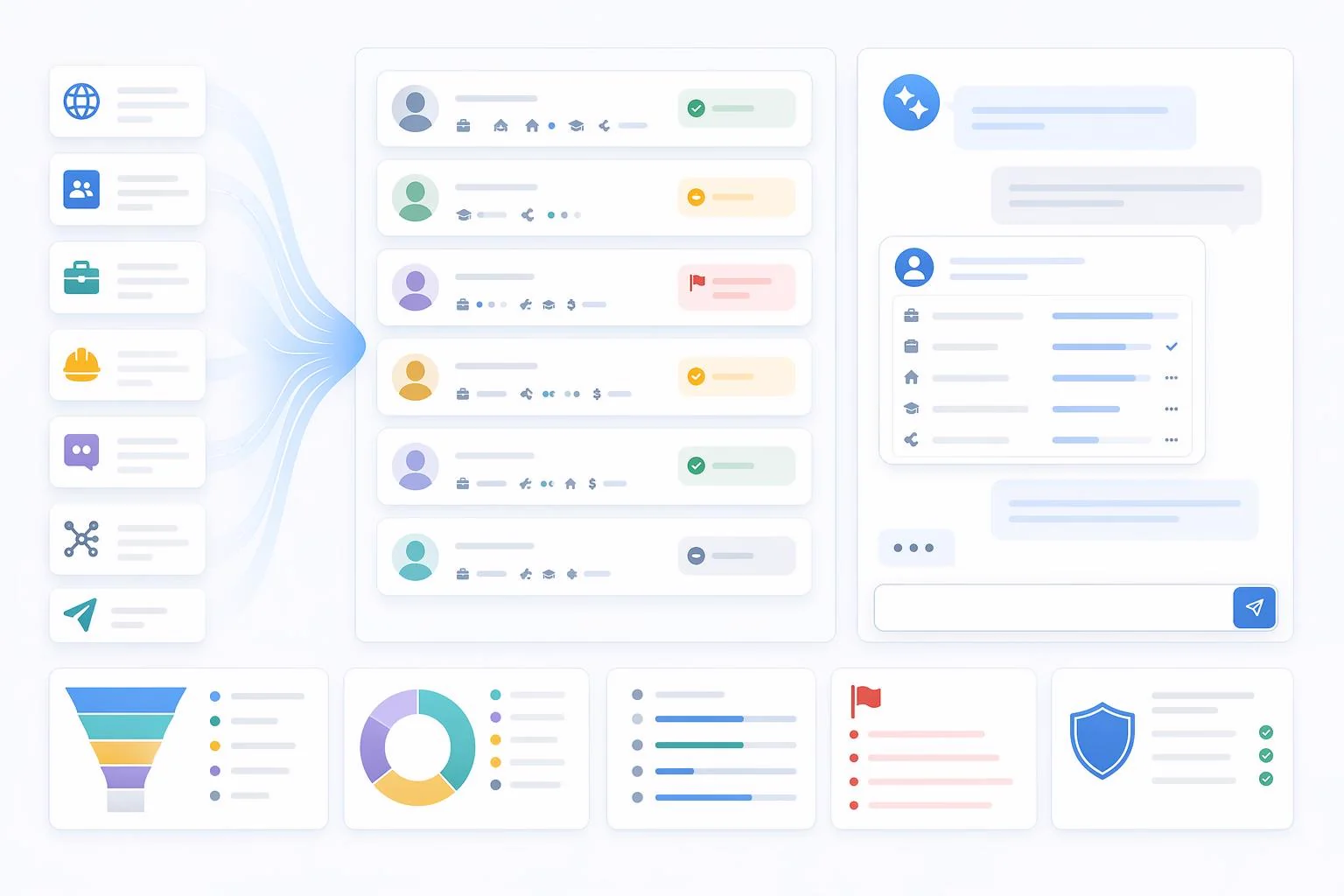
Not every candidate has a resume
Enterprise hiring often focuses on complex roles: engineers, software developers, finance specialists, marketers, and B2B sales managers. For those roles, resumes, competencies, and AI interviews are indeed important.
But AI in recruiting is not needed only for complex expert roles.
In high-volume, office-operational, and frontline hiring, AI in HR can create just as much impact. There are many repeated early-stage actions, and speed often matters as much as assessment depth.
Some candidates apply without a resume or with very little data. Sometimes there are only contact details. Sometimes there is a short comment, basic availability, or a few words about experience. Sometimes the person does not fully understand the role they applied for, which is common in high-volume hiring and quick-apply flows.
This is not an exception. It is normal reality for office-operational and low-resume hiring.
These roles may include:
- operations specialists;
- dispatchers;
- machine operators;
- production operators;
- general workers;
- assemblers;
- warehouse workers;
- cleaning staff.
For these positions, a long resume and career history are often less important than basic but critical parameters: experience, accuracy, responsibility, schedule, conditions, location, physical workload, required documents, and employer rules.
That is why the task of an AI Hiring Autopilot is different here: not to "deeply analyze a resume", but to collect missing context quickly, correctly, and at scale.
This is not a simplified AI recruiter following a script. It is an adaptive workflow that works even when there is almost no input data.
Why the same script does not work
When data is limited, a simple scenario may look tempting: ask everyone the same questions and filter out unsuitable candidates.
It sounds rational. In practice, it quickly breaks the funnel.
| Problem | What happens |
|---|---|
| The system asks for information already known | The candidate gets irritated |
| Everyone follows one route | The process becomes longer than needed |
| Red flags are not used | Recruiters receive more irrelevant candidates |
| Questions do not depend on the role | Data is collected, but does not support the decision |
| There is no shared context | Information is lost between stages |
| The chat feels bureaucratic | Conversion to the next step drops |
For high-volume and operational hiring, this is especially sensitive. If the process is inconvenient, the candidate stops replying. If the process is slow, they move to another employer. If basic mismatches are not filtered, recruiters drown in manual routine again.
That is why Neurohiring uses adaptive chat screening, not the same script for everyone. AI for recruiting does not just "survey the flow". It helps identify faster who is actually worth moving forward.
How Neurohiring works when data is almost absent
The Neurohiring approach is built on a simple idea: even minimal data can be used intelligently.
If a candidate does not have a full resume, that does not mean the system knows nothing. An application may include contact details, brief experience, a comment, the application source, and the vacancy itself.
The company also has role data:
- mandatory requirements;
- working conditions;
- schedule;
- location;
- document requirements, where relevant;
- critical constraints;
- red flags;
- acceptable and unacceptable parameters;
- information that must be clarified before the next stage.
Neurohiring starts with pre-screening: the first stage that checks the application against critical red flags. It works not only for classic resumes, but also for no-resume or minimum-data applications from job platforms and quick-apply channels.
If the candidate clearly does not fit a critical factor, the company can stop the process before spending resources on deeper stages. If there are no critical blockers, the candidate moves forward, most often to adaptive chat screening.
Pre-screening protects the team from unnecessary routine
In high-volume hiring, the flow can be large and the share of irrelevant applications can be high. That makes pre-screening especially important.
At this stage, Neurohiring checks red flags: factors that the company defines in advance as critical for a specific role. Parameters depend on the vacancy and industry.
Pre-screening does not replace the whole hiring process. Its task is to quickly remove clearly unsuitable applications and understand how to route the candidate next.
For the company, this means:
- less manual review of obviously irrelevant applications;
- fewer resources spent on deeper stages;
- less recruiter overload;
- a cleaner input for chat screening;
- unified criteria across teams.
For the candidate, this can also be useful. If the role is not a fit, the process does not drag on. If it is a fit, the system moves them to the next step faster.
Adaptive chat: questions depend on context
After pre-screening, Neurohiring moves to chat screening. The key word is "adaptive".
The chat does not ask everyone the same questions just because that is easier to configure. It uses the available context.
If some information is already known, there is no need to ask it again. If data is limited, the chat carefully collects basic information. If there are risk signals, it clarifies those exact points. If the role requires a specific condition, the question appears at the right moment.
The system can clarify:
- readiness for the schedule;
- experience with similar tasks;
- compensation expectations;
- location and commute readiness;
- required documents, where relevant;
- readiness for physical workload;
- understanding of working conditions;
- specific skills;
- constraints that may become red flags.
This is not a form for the sake of a form. It is controlled data collection for the next decision.
Minimum data should not mean minimum quality
In high-volume hiring, there is a risk: if the candidate has no resume, the process becomes crude. Same questions, simple filters, gut-feel decisions.
But the absence of a detailed resume does not mean assessment should be chaotic.
On the contrary, this is where several things matter even more:
- unified criteria;
- predefined red flags;
- correct routing;
- clear questions;
- preserved context;
- careful communication;
- fast movement to the next stage.
Neurohiring helps make early selection repeatable even with limited input data.
If only pre-screening happened before chat screening, the chat asks basic clarifying questions about the role and conditions. If the candidate has additional information or a short resume, the system uses it. If the role requires deeper resume analysis, the candidate can be routed to the relevant stage.
The process does not become identical for everyone. It remains adaptive.
Office-operational roles: process discipline and responsibility
Office-operational roles often sit between classic white-collar hiring and high-volume hiring.
The candidate may have a resume and clear experience. But the company needs to understand not only formal skills, but reliability in regular processes.
For operations specialists, dispatchers, and similar roles, it is important to understand:
- whether the candidate has worked with procedures;
- how attentive they are to details;
- whether they are ready for shift work, if applicable;
- whether they can handle repetitive tasks;
- how they think about responsibility;
- whether they understand communication with customers, internal teams, or production;
- whether there are constraints around working conditions.
Here, Neurohiring can use a combination of pre-screening, resume screening when meaningful data exists, adaptive chat screening, and additional stages when needed.
The value is that the candidate goes through one connected process, while the recruiter receives a structured picture instead of scattered answers.
Blue-collar roles: basic experience and conditions
For worker and production roles, such as machine operators or production operators, the resume may be short. But specific parameters can be critical.
Important points may include:
- relevant experience;
- qualification level, where applicable;
- readiness for the schedule;
- understanding of working conditions;
- accuracy and responsibility;
- safety discipline;
- readiness for the location;
- documents and constraints, if they are material for the role.
Adaptive chat screening helps quickly clarify what actually affects the candidate's next step.
If the candidate matches the basic parameters, they can move faster to the recruiter or the next stage. If not, the company does not spend resources on unnecessary communication.
Important: Neurohiring does not reduce a person to one signal. The system works with a set of criteria for the specific vacancy and records the basis for the next decision.
Low-resume roles: speed matters especially
Low-resume hiring has its own dynamics.
A candidate may apply quickly and not study the vacancy in detail. They may be considering several options at once. They may not be ready for long formal communication. They may simply stop replying if the process looks complicated or slow.
Here, several things are especially important:
- fast first contact;
- clear tone;
- short and relevant questions;
- minimum unnecessary actions;
- convenient communication channel;
- 24/7 availability;
- capture of key conditions;
- no repetition.
Neurohiring can start communication through familiar communication channels, depending on the implementation. The chat uses pre-screening results and does not ask unnecessary identical questions if some information is already known.
In high-volume hiring, this creates practical impact: the flow does not need to be manually processed from scratch, and candidates pass the first check faster.
Shared context is needed even for simple roles
There is a misconception that for simple or high-volume roles, it is enough to "call and check the basics".
In practice, lack of context creates extra workload:
- the candidate already answered, but the recruiter asks again;
- a red flag was visible in the application, but noticed too late;
- different recruiters interpret the same answer differently;
- the candidate came from one channel, continued in another, and the history was lost;
- the manager does not understand why the candidate moved forward;
- some candidate questions remained unanswered.
Neurohiring collects candidate communication and data in one workflow. This matters not only for complex roles, but also for office-operational and high-volume hiring.
Shared context prevents every stage from starting over.
How adaptability affects conversion
In high-volume hiring, conversion often depends on small details.
A candidate may fail to move forward not because they are a poor fit, but because:
- the company contacted them too late;
- too many questions were asked;
- they were asked to repeat known information;
- a question was unclear;
- the channel was inconvenient;
- nobody answered their clarifying question;
- the process took more time than they were ready to spend.
Adaptive chat screening reduces unnecessary actions.
It can:
- start the dialogue automatically;
- take the candidate's communication style into account;
- ask sensitive questions carefully and in the right sequence;
- answer questions using the role knowledge base;
- support richer communication formats where available;
- handle situations where the candidate does not respond, declines the role, or appears as a duplicate;
- finish the conversation early when needed.
This is not just convenience. It is operational funnel efficiency.
Scaling without proportional team growth
One of the key problems in enterprise hiring is the difficulty of scaling hiring without growing the team at the same rate.
In high-volume and operational hiring, this is especially visible. When there are many vacancies, recruiters quickly end up in manual routine:
- reviewing applications;
- first clarifications;
- repeated questions;
- checking basic conditions;
- recording answers;
- moving data between systems;
- reminding candidates;
- handling refusals and duplicates.
Neurohiring takes over early stages and guides candidates 24/7. Recruiters focus not on mechanical information collection, but on finalists, closing roles, and communication with the business.
In selected enterprise cases, the time from application to final candidate was reduced by 4-5x compared with a manual process. One of the best recorded cases took 3 hours 57 minutes from application to completion of all stages and candidate selection.
These results should not be automatically projected onto every scenario. But they show the effect a managed AI workflow can create when the process is chosen correctly.
This does not remove people
In office-operational and high-volume hiring, it is especially important not to create the feeling that the company has "handed people over to a robot".
The Neurohiring task is different.
The AI hiring autopilot takes over routine early stages:
- checks red flags;
- collects missing data;
- clarifies conditions;
- routes candidates;
- records answers;
- helps preserve context;
- prepares the basis for the decision.
But the final decision remains with people.
Recruiters and hiring managers receive a cleaner flow and more structured information. They join where human assessment, negotiation, condition alignment, or final approval is needed.
For an enterprise workflow, this matters: automation should increase process manageability, not create an opaque black box.
What to configure before launch
For adaptive chat screening to work well, the company needs to prepare input data for the role.
The minimum set includes:
- role requirements;
- mandatory conditions;
- red flags;
- schedule;
- location;
- compensation level or rules for discussing expectations;
- document requirements, if relevant;
- acceptable and unacceptable constraints;
- answers to typical candidate questions;
- criteria for moving to the next stage.
The better the role is described, the more accurately Neurohiring guides the candidate.
This does not mean the company needs to write a long script in advance. The value of the adaptive approach is exactly that the system relies on requirements and context, not on the same questionnaire for everyone.
The new standard for high-volume and operational hiring
High-volume hiring automation has long been associated with simple bots, calls, forms, and scripts.
Modern enterprise hiring needs more.
Even if the candidate has no resume, the process should remain:
- fast;
- clear;
- adaptive;
- repeatable;
- respectful to the candidate;
- manageable for the HR team;
- useful for the hiring manager.
Neurohiring solves this as an Enterprise-Grade AI Hiring Autopilot: from pre-screening and red-flag analysis to adaptive chat screening, context capture, and preparation of candidates for the next stages.
For office-operational and low-resume hiring, this is not "simplified hiring". It is a more organized and more technological process.
Minimum input data should no longer turn hiring into chaos.
If the process is built correctly, even a short application can become a managed candidate route: with clear criteria, relevant questions, and fast movement through the funnel.
If a company chooses AI in recruiting for high-volume or operational hiring, it should not evaluate only contact speed. It should check whether the system can work with minimal data, preserve context, and avoid turning the process into an impersonal form.
What comes next in the series
In the next article, we will look at why complex and rare roles should not be forced into primitive automation.
We will discuss cases where template scenarios, superficial scoring, and identical questions for all candidates are especially risky - and why an AI hiring autopilot should be able not only to accelerate the process, but also to preserve depth where depth is critical.