

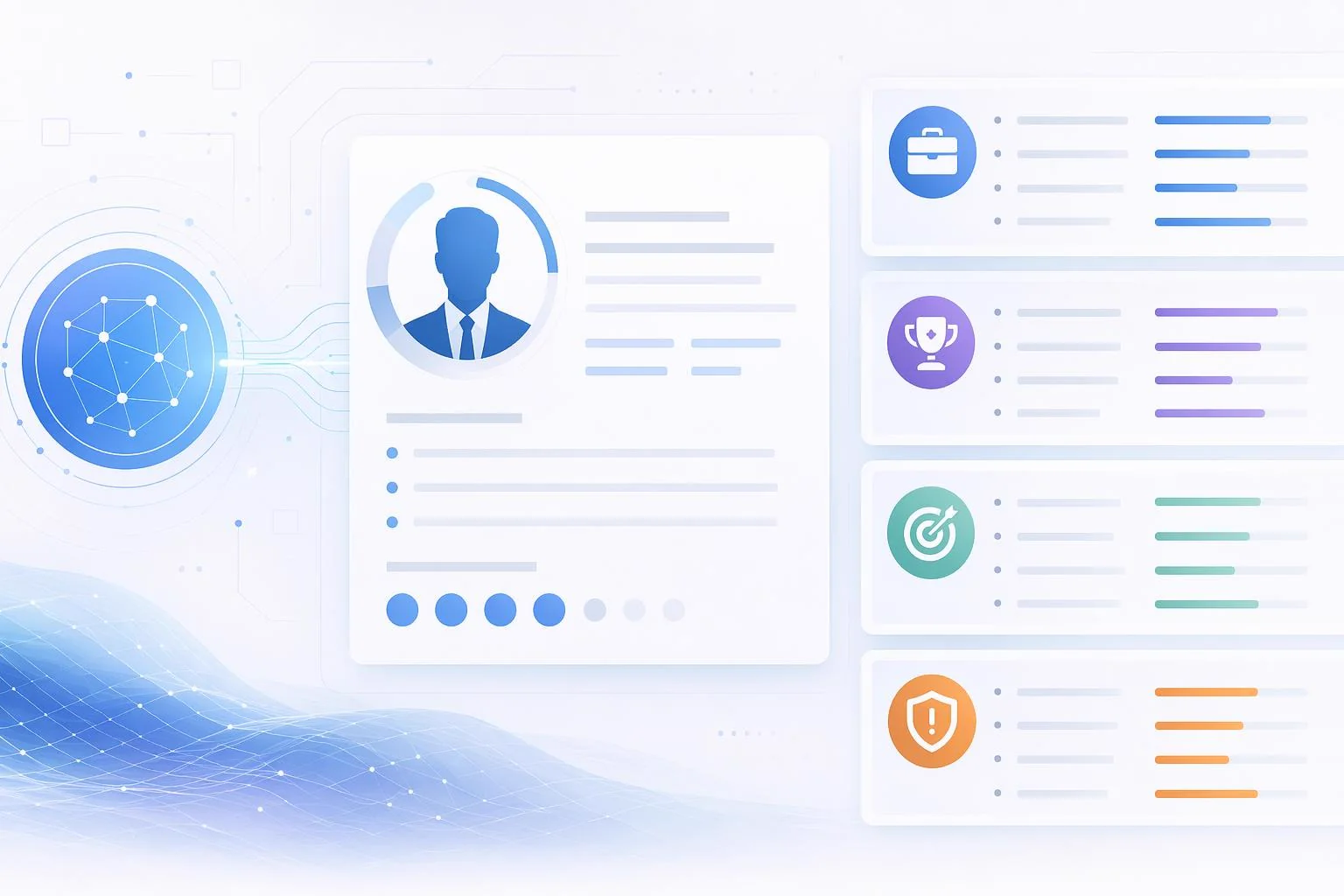
The more complex the role, the more expensive shallow assessment becomes
In highly skilled hiring, a candidate cannot be assessed only "by keywords".
This is where the difference between a superficial "AI recruiter" and a mature AI workflow becomes especially visible. For complex roles, AI in HR should not only process resumes quickly. It should help understand the depth of experience, motivation, and professional reasoning behind the candidate's profile.
Formal signals matter:
- where the person worked;
- which tools they know;
- how many years of experience they list;
- which titles they held;
- which projects they mention.
But other questions matter more: how the person thinks, which decisions they made, what role they actually played in projects, why they changed jobs, how they explain results, and whether their experience is applicable to this specific role.
That is why highly skilled hiring often becomes a bottleneck. There are resumes, applications, and candidates who look formally similar. But it is hard to quickly understand who is truly a fit.
This applies to many roles:
- accountants, where accuracy, responsibility, and process discipline matter;
- marketers, where the team needs to separate real experience from polished wording;
- software developers, where technology names are not enough and engineering reasoning matters;
- engineers, where practice, responsibility, and work with constraints are critical;
- B2B sales managers, where the company needs to assess maturity in complex deals.
In these roles, a hiring mistake is expensive. But a slow process is expensive too: strong candidates do not wait for weeks.
A resume does not answer the main question
A resume is useful. It gives structure, experience, education, skills, employers, industries, and achievements.
But a resume rarely answers the main question: what can the candidate actually do?
The same line can mean very different things.
"Participated in CRM implementation" may mean the candidate led the project, configured processes, trained users, and owned the result. Or it may mean the candidate was a system user and attended several meetings.
"Developed a marketing strategy" may mean independent work with analytics, positioning, channels, and budget. Or it may be a polished phrase for a set of disconnected tasks.
"Worked with large B2B customers" may mean a long enterprise sales cycle, tenders, multiple decision-makers, and complex approvals. Or it may mean handling inbound requests from warm customers.
Without follow-up questions, a resume remains the candidate's statement about themselves. It is important, but it needs to be checked.
Where an AI interview creates the most value
An AI interview is especially useful where the task is not only to collect facts, but to check depth of experience.
For complex roles, the team needs to understand:
| What we check | Why it matters |
|---|---|
| Real role in projects | Separate a participant from the owner of the result |
| Decision logic | Understand professional maturity |
| Depth of competence | See practice, not only knowledge of terms |
| Motivation | Assess whether interest in the role is stable |
| Risks | See mismatches in experience, expectations, or conditions early |
| Communication | Understand how the candidate explains complex decisions |
| Contradictions with the resume | Avoid deciding only by self-presentation |
In manual hiring, this depth usually comes from a good interview. But recruiters and hiring managers do not always have time to speak deeply with every candidate at an early stage.
Neurohiring closes this gap: it conducts an AI interview autonomously, using structured logic and taking into account the resume, chat screening, and role requirements.
This turns AI in recruiting from a contact accelerator into a deep assessment tool where the cost of error is especially high.
Deep assessment starts before the interview
A strong AI interview should not start from a blank page.
If the system does not use the resume, chat screening, and role requirements, it asks questions that are too generic. The candidate feels formality, and the business does not get depth.
In Neurohiring, the AI interview is embedded in one hiring workflow.
Before the interview, the candidate may already have passed:
- red-flag pre-screening;
- resume screening;
- adaptive chat screening;
- clarification of compensation expectations;
- readiness checks for role conditions;
- collection of data on motivation, experience, and constraints.
That is why the AI interview does not waste time repeating the obvious. It goes deeper: clarifies, checks, compares, and collects specifics.
For white-collar and highly skilled roles, this is especially important. Value is created not by the fact that "experience exists", but by how that experience was gained and how applicable it is to the new role.
An AI interview is not a list of questions
The main mistake in automating complex hiring is turning the interview into a form.
For a simple filter, several questions may be enough. For highly skilled talent, that is not enough.
The interview needs dynamics:
- the candidate answers generally, so the system asks for an example;
- the candidate makes a strong claim, so the system asks what supports it;
- the candidate mentions a project, so the system clarifies their personal role;
- the candidate names a result, so the system asks how it was achieved;
- the answer contradicts the resume, so the system records a risk.
In Neurohiring, the AI interview is not built around a fixed script. It adapts to candidate answers, asks thematic blocks, clarifies details, and collects specifics: projects, the person's role, decisions, constraints, results, and conclusions.
That is why this format is closer to a structured interview than to a video questionnaire.
Why this matters for different roles
Accountants and finance specialists
For finance roles, accuracy, responsibility, procedures, reporting, attention to detail, and ability to work within requirements matter.
The question "Have you worked with reporting?" tells almost nothing.
It is much more important to understand:
- which accounting or finance areas the person worked with;
- which complex situations they faced;
- how they check their own work;
- how they act when requirements change;
- where their independent responsibility ends;
- whether they understand the consequences of errors.
An AI interview helps check these nuances before the final meeting with the manager.
Marketers
Marketing has many polished phrases and results that are hard to compare. One candidate talks about strategy, another about performance, a third about brand, a fourth about content or analytics.
Here, the key is not a list of tools, but cause-and-effect logic:
- how the candidate formed hypotheses;
- how they chose channels;
- which metrics they considered meaningful;
- how they separated marketing impact from external factors;
- how they worked with a limited budget;
- what they did when a campaign did not work.
This depth is hard to get from a resume. It needs to be revealed in dialogue.
Software developers and engineers
For technical roles, it is important to separate a list of technologies from real engineering experience.
A candidate may know the names of frameworks, systems, or tools. The question is how they applied them in practice.
An AI interview can clarify:
- which architecture decisions the candidate made;
- where their personal area of responsibility was;
- how they worked with constraints;
- which trade-offs they chose;
- how they diagnosed problems;
- what they would do differently after the project.
This does not replace a final technical interview with the team if one is needed. But it helps understand earlier who is worth bringing to that stage.
B2B sales managers
In B2B sales, resumes often look convincing: large customers, targets, CRM, negotiations, deals.
But assessment requires understanding:
- what the deal cycle looked like;
- who the decision-makers were;
- how the candidate handled complex negotiations;
- whether they worked with tenders;
- how they managed objections;
- how they forecast deal probability;
- how they interacted with presales, product, legal, and finance teams;
- what exactly depended on them.
An AI interview helps separate a mature B2B sales professional from a candidate who was simply near complex sales.
Unified criteria reduce subjectivity
Subjectivity is especially dangerous in highly skilled hiring.
One interviewer may be impressed by a candidate's confidence. Another may see the same confidence as a warning sign. One recruiter may ask more deeply about motivation. Another may spend more time on experience. One manager may remember a strong phrase, another may remember one weak answer.
As a result, candidates become hard to compare.
Neurohiring reduces this problem through unified criteria and calibrated assessment. This does not mean everyone receives identical questions. Questions adapt to context, but the assessment logic remains structured.
In a two-month enterprise pilot with a major telecom company, AI and recruiter assessments matched in 99.1% of cases within a tolerance of ±1 point on a 10-point scale.
This metric matters for trust. It shows that AI assessment can be comparable to expert recruiter logic when it is supported by methodology, calibration, and a correct process.
Depth is needed not only for selection
The business does not need only "fit" or "no fit".
The hiring manager needs to understand why.
After the AI interview, Neurohiring prepares analytics:
- candidate strengths;
- risk areas;
- possible mismatches between the resume and answers;
- a detailed report;
- an interview summary with timestamps;
- materials for finalist comparison.
Timestamps are especially useful. The manager does not need to watch the entire recording to check an important point. They can jump to the relevant fragment and see how the candidate answered a specific question.
Instead of "I think this candidate is strong", the team receives a concrete foundation: answers, examples, assessment, risks, and arguments.
AI should not decide instead of the manager
In complex hiring, it is dangerous to move the final decision to an algorithm.
Neurohiring works differently: AI takes over routine in the early stages, structures assessment, and prepares an evidence base. The final decision remains with people.
For highly skilled roles, this is essential.
Some factors cannot be fully reduced to a score:
- strategic team context;
- manager style;
- current team dynamics;
- cultural fit;
- role development plans;
- the company's readiness to adapt conditions for a strong candidate.
AI can collect data, identify risks, ask follow-up questions, and prepare comparison analytics. But the hiring decision should remain a management decision.
The right role of an AI Hiring Autopilot is not to replace the hiring manager, but to make the manager's decision faster, calmer, and more evidence-based.
How to combine depth and speed
Deep assessment often sounds slow: more interviews, more meetings, more manual work.
But one connected AI workflow can combine depth and speed.
Neurohiring can guide candidates 24/7, run early stages automatically, invite candidates to an AI interview, and collect analytics without waiting for free slots in the recruiter's calendar.
In the Neurohiring operating frame, speed means 3-5 hours from application to an AI interview invitation and 1-2 days to a finalist shortlist with detailed analytics.
For highly skilled hiring, this is especially valuable. The business does not receive a quick list of resumes. It receives a meaningful basis for selection. AI for recruiting helps combine speed and depth instead of forcing a choice between them.
Where deep AI assessment is especially relevant
AI interviews create the most value when at least one factor is present:
- many applications, but little time for first interviews;
- candidates look formally similar in resumes;
- role requirements are complex and multi-layered;
- several strong finalists need to be compared;
- the hiring manager is overloaded;
- early-stage subjectivity needs to be reduced;
- there is a risk of losing candidates because the process is slow;
- assessment needs to be standardized across teams or locations;
- evidence-based analytics is needed for the final decision.
These are typical enterprise hiring scenarios. Especially when a role cannot be filled "by gut feel" and every decision affects the business process, team, and result.
What changes for the recruiter
Deep AI assessment does not devalue the recruiter's work.
On the contrary, it helps the recruiter move from endless first interviews and manual sorting into a stronger role: managing the process, working with finalists, aligning with the business, solving complex cases, and influencing hiring quality.
The recruiter gets:
- less manual routine;
- more structured data;
- clear reasons for candidate discussions;
- the ability to move strong people to the next stage faster;
- lower risk of missing an important signal;
- less dependence on a subjective impression after one conversation.
For the HR team, this is a shift from "we manually process the flow" to "we have a manageable assessment workflow".
What changes for the hiring manager
For the hiring manager, the value is even simpler: fewer early meetings and higher input quality.
Instead of dozens of resumes and scattered comments, the manager receives:
- a finalist shortlist;
- a comparison card;
- analytics for each candidate;
- rationale for recommendations;
- strengths and risks;
- the ability to check key moments by timestamps;
- the ability to ask AI a question about the candidate and receive an answer in seconds.
In the ideal model, the manager joins not to redo first-line selection, but to make the final decision based on prepared analytics.
That is why one of the key Neurohiring metrics is up to 1 hour of hiring manager involvement.
The new standard for complex roles
For a long time, the market lived with a compromise: either fast or deep.
If fast, teams review resumes, run short screening, and hope risks appear later.
If deep, recruiters, experts, and hiring managers spend a lot of time.
The Neurohiring AI Hiring Autopilot offers another approach: early stages can be fast, structured, and meaningful at the same time.
For highly skilled talent, this is especially important. The cost of error is higher, and assessment quality directly affects the business.
Deep assessment should not begin only at the final interview. It should be built into the funnel from the start: from resume analysis and chat screening to AI interviews, analytics, and the finalist shortlist.
This forms the new standard of hiring: not superficial automation for speed, but one AI workflow that helps companies find strong candidates faster and make better-supported decisions.
If a company chooses AI in recruiting for highly skilled roles, it should not look only at the effect of a "fast filter". It should check whether the system reveals candidate experience, records evidence, and prepares a high-quality foundation for the hiring manager's final choice.
What comes next in the series
In the next article, we will look at another important segment: office-operational and low-resume hiring.
We will show how Neurohiring adaptive chat screening works even when the candidate has almost no resume and the application contains only minimum data: contact details, basic availability, a short comment, or brief experience.
This is a separate scenario where the value of an AI hiring autopilot is not in deep resume analysis, but in the ability to collect missing information quickly, correctly, and at scale without using the same script for everyone.