

HR Tech is full of products that promise to make hiring faster.
Some screen resumes. Some message candidates. Some collect video answers. Some help recruiters avoid switching between tabs. Many of them are described with the same language: AI in recruitment, artificial intelligence in HR, AI recruiter.
But the same words can hide very different things: from a simple chatbot to a full candidate assessment workflow.
For HRDs, TA leaders and business stakeholders, automation itself is not the goal. The result matters:
- Are vacancies closing faster?
- Is the team doing less manual work?
- Is candidate quality easier to understand?
- Does the hiring manager get evidence for the final choice?
This is where point tools often hit a ceiling.
A plugin speeds up an action. A chatbot covers part of communication. A video questionnaire collects answers. An ATS tracks statuses. Resume scoring helps sort applications.
But the vacancy can still stay open. Candidates can still drop out between stages. Recruiters can still rebuild the full picture manually. Hiring managers can still receive finalists without a clear answer to the most important question: why these people, and not others?
Speeding up one stage is not the same as managing the whole funnel.
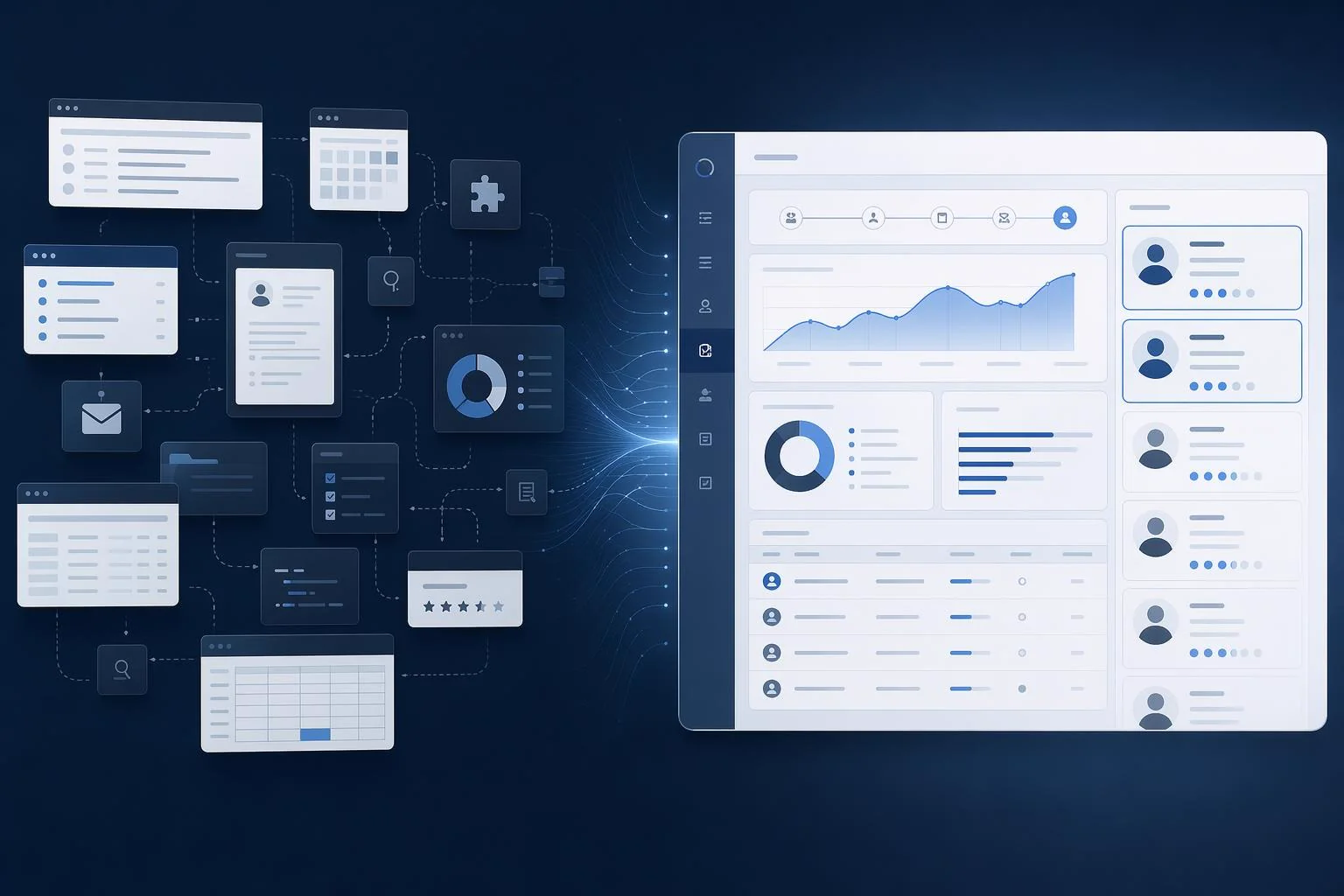
Neurohiring closes this gap. It does not add another fragment on top of the HR stack. It connects the early stages of hiring into one AI-powered workflow.
Why point automation looks logical
At first glance, the logic is simple: find a bottleneck and automate it.
- Too many applications? Add resume scoring.
- Candidates wait too long? Add a chatbot.
- Interviews take too much time? Ask candidates to record video answers.
- Recruiters drown in manual actions? Add an extension or plugin.
This can create a quick local improvement. Something becomes faster, easier, more modern.
But hiring does not work as one button or one action. The result appears between stages.
It is not enough to review a resume. You need to know what happened next.
It is not enough to message a candidate. You need to preserve the meaning of their answers.
It is not enough to run the first contact. You need to pass context into assessment.
It is not enough to choose finalists. You need to explain why they made the shortlist.
When there is no shared information field between stages, automation becomes a set of faster fragments. Everything between them still depends on people doing manual work.
Where a fragmented HR Tech stack breaks
The problem usually does not sound like: "We have no tools."
It sounds like this:
- there are many candidates, but strong ones get lost;
- statuses exist, but analytics do not;
- messages are sent, but context is scattered;
- resumes are scored, but interview questions do not use that assessment;
- video answers are collected, but finalists are still hard to compare;
- services are everywhere, but the recruiter still builds the final picture by hand.
There are usually several gaps.
Gap 1. Data exists, but it is not connected
The resume is in one place. Candidate messages are in another. Recruiter comments are in a third. Interview notes are somewhere else. Hiring manager feedback lives in yet another tool or conversation.
Formally, the data exists. But it does not work as one context.
As a result, the next stage often starts almost from scratch. The candidate answers similar questions again. An important detail does not reach the candidate card. The manager sees a score, but not the evidence behind it.
Gap 2. A stage is automated, but the candidate journey is not
A candidate does not go through a tool. A candidate goes through a process.
When the process is not connected, the journey can look like this:
- first, a resume review;
- then a chat;
- then another set of questions;
- then a video;
- then waiting for a manual decision.
In this model, AI does not always improve candidate experience. Sometimes it simply adds another layer between the person and the decision.
Gap 3. There is speed, but no explainability
You can reject some applications faster. But if the team does not understand why a candidate was recommended or rejected, automation will not earn trust.
Enterprise customers need answers:
- which criteria were used;
- which strengths were found;
- which risks appeared;
- where the candidate confirmed relevant experience;
- where mismatches exist;
- why one finalist is ranked above another.
Without this, AI remains a black box, not a management tool for hiring.
Gap 4. The recruiter still connects everything manually
When tools are not connected, the recruiter becomes the human integration layer.
They move information between systems, copy conclusions, write comments, build comparison tables, remind candidates, send links and explain to the hiring manager what happened at each stage.
Automation exists. But the recruiter still carries the process.
Why an ATS does not solve this problem
An ATS is important. It helps manage vacancies, statuses, candidates, approvals and interaction history.
But an ATS and an AI hiring autopilot solve different problems.
An ATS answers the question: where is the candidate in the process?
Neurohiring answers another question: how do we guide the candidate through early stages, assess them, keep context and prepare an evidence-based finalist shortlist?
These categories do not compete. In a mature workflow, they complement each other.
An ATS tracks. Neurohiring guides.
An ATS stores statuses. Neurohiring creates assessment, analytics and decision support.
An ATS helps manage the process. Neurohiring automates a meaningful part of the hiring funnel.
That is why we do not describe Neurohiring as an ATS replacement. It solves another layer of the problem: from application and pre-screening to a finalist shortlist with detailed analytics.
How a chatbot differs from adaptive chat screening
A recruitment chatbot usually asks a candidate a few questions: salary expectations, schedule, experience, relocation, documents, working conditions.
That can be useful. But it is not enough.
When chat works in isolation, it often does not know what is already known about the candidate. It asks the same questions to everyone, ignores the resume, misses red flags and does not pass context into the next stage.
In Neurohiring, chat screening is part of one workflow. It can use:
- role requirements;
- pre-screening results;
- resume data, when available;
- application information;
- identified risks;
- role-specific context;
- candidate answers in the conversation.
If there is little data, the system can still run adaptive chat screening. In that case, the chat relies on pre-screening logic and critical red flags.
If there is more context, the questions become deeper and more precise.
The main difference is not that "the chat asks questions". The main difference is that chat works inside a shared context and becomes part of candidate assessment.
Why a video questionnaire is not an AI interview
A video questionnaire is usually built around predefined questions. The candidate records answers. The team later watches the recording or receives a short summary.
Sometimes that is convenient. But it is not a full assessment.
An AI interview in Neurohiring is a dynamic conversation. The system uses the resume and chat screening context, asks structured questions, follows up on answers, gets concrete details and creates an analytical report.
For complex roles, this matters. A resume may say that a candidate participated in a project. During an interview, the important questions are different:
- What role did they actually play?
- Which decisions were they responsible for?
- What constraints did they consider?
- How do they explain their actions?
- Where is there real depth, and where is there only surface familiarity?
A video questionnaire records answers. An AI interview helps reveal the candidate's logic.
Why one workflow matters more than a list of features
In hiring, value appears between stages.
The resume should influence chat-screening questions.
Chat screening should influence the AI interview plan.
The AI interview should influence the analytical summary.
The analytics should influence the comparison card.
The comparison card should support the hiring manager's decision.
When these links are broken, the company does not get a hiring system. It gets separate accelerators.
| Approach | What it gives | Where it is limited |
|---|---|---|
| Point tool | Speeds up one stage | Does not own the candidate journey |
| Set of services | Covers several tasks | Leaves context scattered |
| ATS | Tracks statuses and process | Does not assess candidates end-to-end |
| Neurohiring AI Hiring Autopilot | Connects stages into one workflow | Requires clear role setup, criteria and process logic |
How Neurohiring connects the funnel
Neurohiring works as an Enterprise-Grade AI Hiring Autopilot: it guides candidates through early stages 24/7 and keeps one shared context.
One process connects:
- Candidate intake - applications from job boards, sourcing channels, manual uploads and resume imports.
- Pre-screening - red-flag checks and filtering of clearly irrelevant candidates.
- Resume screening - analysis of experience, education, skills and fit against requirements.
- Adaptive chat screening - clarification of key details using what is already known.
- AI interview - dynamic assessment based on the candidate's experience and the role.
- Analytics - strengths, risk areas, mismatches, timestamps and a unified candidate profile.
- Finalist comparison - top candidates, comparison table, recommendations and rationale.
- Final decision - the hiring manager receives evidence and chooses.
This changes the operating model. Recruiters and hiring managers no longer have to hold the entire process together manually.
For the company, this is not "one more feature". It is a shift from a set of accelerators to a system that guides candidates, keeps context and prepares the result for a business decision.
Why this matters for enterprise hiring
In a small team, fragmentation can sometimes be compensated by personal involvement. The recruiter remembers details. The manager responds quickly. There are not too many candidates. The process can live in people's heads.
That does not scale in a large company.
Enterprise hiring needs:
- a consistent assessment standard;
- transparency for HRDs and TA leaders;
- scalability without constant team expansion;
- manageability across teams and business units;
- security and compliance readiness;
- a clear result for the hiring manager;
- evidence, not just speed.
The larger the hiring operation, the more expensive every gap between stages becomes.
If a company hires across many teams, role types and locations, it does not need just another service. It needs one managed workflow.
What changes in metrics
When one stage is automated, you can measure a local improvement: a faster response, faster resume review, faster link delivery.
When one AI workflow is in place, the metrics of the whole funnel change.
For Neurohiring, the core operating frame is:
- 3-5 hours from application to AI interview invitation;
- 1-2 days to a finalist shortlist with detailed analytics;
- up to 1 hour of hiring manager involvement.
In selected enterprise cases, the hiring cycle accelerated by 4-5 times compared with a manual process. One of the best recorded cases moved from application to all stages completed and a candidate selected in 3 hours 57 minutes.
Results like this do not appear because one small step became faster. They appear because the funnel starts working as a connected system.
How to know point automation is no longer enough
There are several signs.
1. Many tools, little transparency
There is an ATS, a chatbot, spreadsheets, plugins, job boards and standalone AI features. But each vacancy still requires manual reconstruction of the full picture.
That means the problem is not a lack of tools. It is the lack of one workflow.
2. Actions are faster, but recruiters are not less overloaded
If individual steps became faster, but recruiters are still overloaded with coordination, rechecking and manual comparison, automation has not reached the operating model level.
3. Managers receive opinions, not evidence
If the final candidate discussion is built around impressions instead of comparison cards, analytics and confirmed facts, the key task is still unsolved.
4. Candidates go through touchpoints, not a journey
If candidates answer similar questions several times, wait between stages and do not understand what happens next, the technology is not connected into one experience.
5. Scaling requires more and more people
If more vacancies almost automatically mean more recruiters, the process is still built around manual work.
What the new standard should include
The new standard of hiring is not a rejection of existing HR systems. And it is not a promise that AI will replace recruiters.
It is a process architecture where:
- the ATS tracks;
- the AI hiring autopilot guides the candidate;
- the recruiter manages process quality;
- the HRD sees metrics and scalability;
- the hiring manager receives finalists with rationale;
- the final decision stays with a human.
In this model, AI does not replace HR. It removes routine, connects data and helps people make decisions faster and with better evidence.
The main point
If a company already has several HR tools, but hiring still feels manual, opaque and dependent on constant coordination, the problem is probably not the lack of one more service.
The problem is that the funnel is not connected into one workflow.
Point automation is useful when you need to speed up a specific action.
But enterprise hiring increasingly needs a different level of solution: one AI-powered workflow that connects application intake, pre-screening, resume screening, chat screening, AI interviews, analytics and finalist shortlists.
That is why Neurohiring is not a chatbot, plugin, video questionnaire or ATS.
It is an enterprise-grade AI hiring autopilot that helps move from disconnected tools to a managed hiring system.
In the next article, we will look at how Neurohiring rebuilds the path from application to finalist, and why speed in hiring appears not in one stage, but in a properly connected funnel.
If your current HR Tech stack speeds up separate actions but does not create a managed result across the funnel, it is worth seeing Neurohiring in a demo and evaluating how one AI workflow can fit into your hiring process.