

Why too many things are called an "AI interview"
The HR tech market uses many similar phrases: "AI interview", "AI in recruiting", "AI in HR", "AI recruiter".
They sound similar. They work differently.
Sometimes an "AI interview" means a video questionnaire: the candidate receives questions, records answers, and the employer reviews the recording later.
Sometimes it means chat screening with a fixed list of questions.
Sometimes it means transcription of a live interview and a short meeting summary.
All these tools can be useful. But they are not the same as a full AI interview.
In enterprise hiring, collecting answers is not enough. The team needs to understand the depth of experience, the candidate's role in projects, decision logic, motivation, strengths, risks, and mismatches. That cannot be done well if the system asks everyone the same questions and does not react to answers.
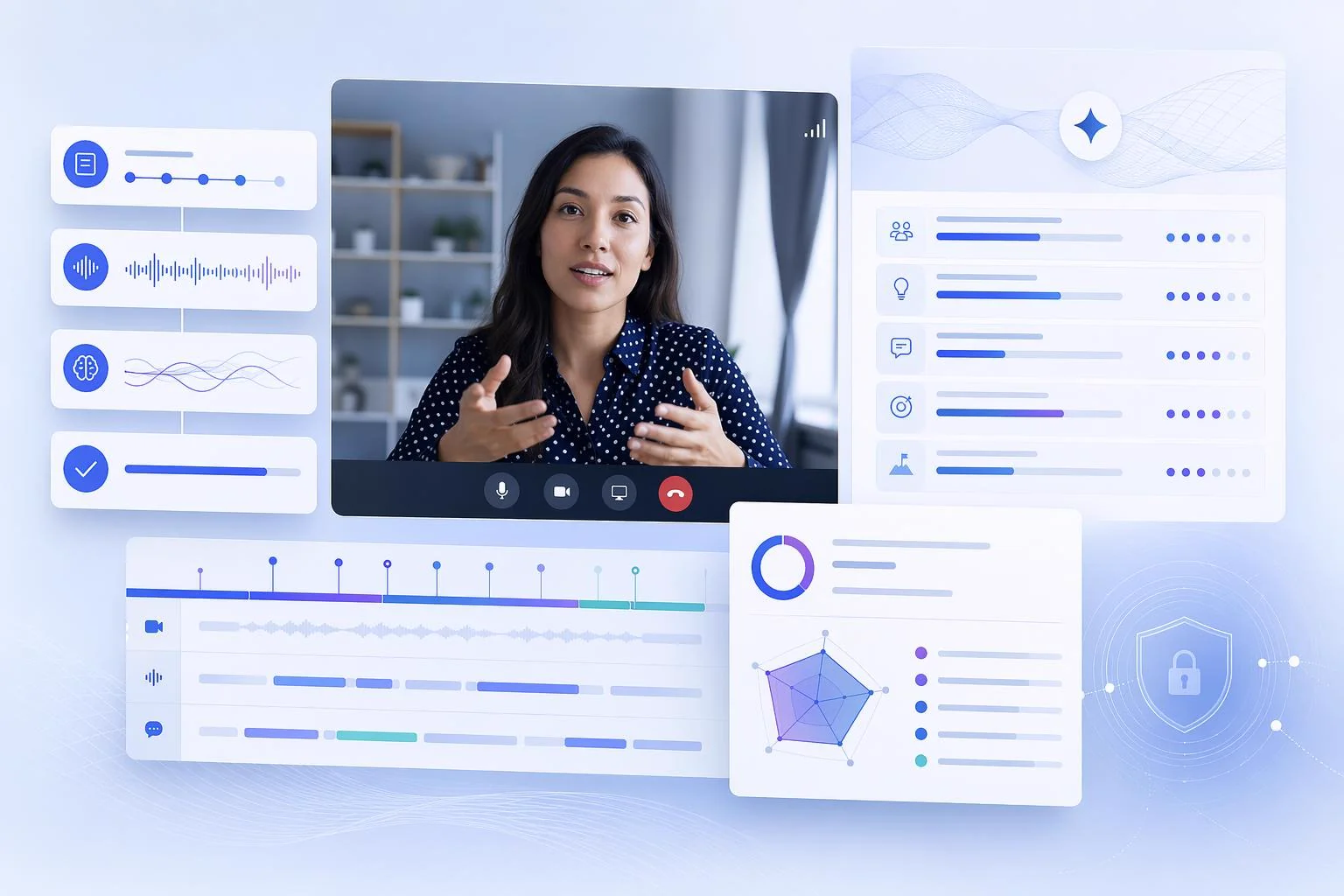
The Neurohiring AI interview works differently. It is a dynamic assessment stage inside one AI Hiring Autopilot. Not a video-answer service. Not a simplified AI recruiter. A part of an enterprise candidate assessment workflow.
A video questionnaire records. An interview checks.
A video questionnaire solves a simple task: collect candidate answers in a convenient format. Sometimes this is faster than scheduling a call. Sometimes it is easier than asking for long written answers.
But a video questionnaire has one major limitation: it does not conduct a dialogue.
If the candidate answers too generally, the questionnaire will not ask for an example. If they mention an important project, it will not clarify their role. If the answer contradicts the resume, there will be no follow-up question. If the candidate avoids the point, the script still moves on.
The employer gets a recording. But not always an evidence base for a decision.
A dynamic AI interview works differently. Its strength is in follow-up questions:
- "What exactly did you do in that project?"
- "What was your area of responsibility?"
- "Why did you choose that approach?"
- "What constraints did you face?"
- "What result did you achieve?"
- "What would you do differently?"
- "How does this connect to the requirements of our role?"
This helps separate real experience from polished wording.
How the AI interview works in Neurohiring
Neurohiring is an Enterprise-Grade AI Hiring Autopilot. The AI interview is not a separate "video feature". It is part of the funnel.
By the time the interview starts, the system can already take into account:
- role requirements;
- red flags;
- pre-screening results;
- resume data;
- resume screening results;
- candidate answers from adaptive chat screening;
- unclear points that need deeper verification.
Based on this, the system builds a personalized interview plan. AI does not ask the same generic question list to everyone. It leads a dialogue based on the role, the candidate, and the data already collected.
The Neurohiring interview can run in video or audio format. It is available 24/7, starts through a unique link, and does not require the candidate to install an app or create an account. If needed, the candidate can reconnect within 12 hours.
This is not just technical convenience. It removes unnecessary friction and helps companies avoid losing candidates because of calendars, apps, and complicated access steps.
What makes an interview dynamic
A dynamic AI interview differs from a template questionnaire not by interface, but by logic.
1. It does not start from zero
If the candidate has already passed resume screening and adaptive chat screening, the system has a picture: experience, expectations, strengths, risks, and unclear points.
The AI interview goes deeper exactly where verification is needed.
2. It asks follow-up questions
A candidate may answer too briefly, use general wording, or mention an important episode in passing. The system can stop and clarify the details.
For complex roles, this is critical: a resume often shows the packaging of experience, not its depth.
3. It checks reasoning
In many roles, it is not enough that a candidate has "worked with a tool". What matters is how the person makes decisions, explains their approach, works with constraints, and takes responsibility for outcomes.
A dynamic interview helps reveal that.
4. It prepares material for analytics immediately
The output is not only a recording. Neurohiring prepares a summary, timestamps, strengths, risk areas, and material for candidate comparison.
5. It connects to the final selection
The results go into comprehensive reassessment, a comparison card, and the finalist shortlist. The final decision remains with people, but people receive a stronger evidence base.
Why a question list is not enough for complex roles
For simple clarifications, a list of questions can work. For example, it can clarify schedule, location, or readiness for specific conditions.
But for qualified roles, this is not enough.
For engineers, software developers, B2B sales managers, marketers, team leads, and other skilled candidates, the key question is not only "does this person have experience?" It is "what kind of experience is it?"
The team needs to understand:
- which tasks the candidate actually worked on;
- how independent their role was;
- which decisions they made;
- what constraints they handled;
- how they explain the result;
- where there are real achievements and where there is general wording;
- how their approach matches the team's expectations.
A fixed questionnaire collects answers, but rarely reaches depth.
In Neurohiring, an AI interview can last 30-90 minutes and work as a full dynamic interview: use the resume and chat screening context, ask thematic blocks, clarify answers, and prepare a detailed summary with timestamps and competency analytics.
The candidate experience must stay simple
An AI interview may be complex inside. For the candidate, it should be simple.
If a candidate has to install an app, create an account, configure access, or search for an inconvenient slot, some people will drop out before the interview even starts. If questions sound mechanical, the candidate opens up less. If the format is unclear, anxiety grows.
Neurohiring AI interviews are available 24/7, run through a unique link, and do not require app installation or registration. The candidate chooses a convenient time instead of waiting for calendars to align.
In Neurohiring trials and pilots, candidates rated AI interviews 4.8 out of 5 in one enterprise pilot and 4.85 out of 5 in another enterprise pilot. Only about 7.1% of candidates refused the AI interview, while around 92.9% accepted the format.
The conclusion is simple: candidates are not against AI. They are against a poor, unclear, inconvenient process.
What recruiters and hiring managers get
In a manual process, a lot of time goes into early interviews. Some of them later turn out to be irrelevant. Results are recorded unevenly: notes, comments, brief impressions, fragments of communication.
Comparing candidates in such a system is difficult.
The Neurohiring AI interview gives teams a more consistent foundation:
- the candidate passes a structured assessment stage;
- the system records answers and key moments;
- a summary with timestamps is created;
- strengths and risk areas are highlighted;
- mismatches between resume and answers become visible;
- the result goes into one candidate profile.
The hiring manager does not need to watch every recording in full. They can work with an analytical summary, timestamps, and a comparison card.
This does not replace the human decision. It removes unnecessary manual work and makes the decision calmer.
Why the interview must be connected to analytics
An interview does not create enough value by itself if the result is hard to use later.
A good conversation can happen. But if conclusions remain in one person's head or in disconnected notes, the process does not scale.
In Neurohiring, the AI interview is immediately connected to analytics:
| What happens | What the team receives |
|---|---|
| The candidate answers questions | Summary and answer structure |
| AI asks follow-up questions | Check of experience depth and reasoning logic |
| Strengths appear | Analytical summary |
| Risks appear | Areas for attention |
| Answers differ from the resume | Recorded mismatches |
| Important moments appear | Timestamps |
| Finalists need to be selected | Finalist comparison |
This turns the AI interview from a conversation recording into a source of evidence for selection.
Which roles benefit most
AI interview depth is especially valuable where the company needs to understand professional thinking, experience, and the ability to explain decisions.
Highly skilled professionals and white-collar roles
For software developers, engineers, marketers, accountants, B2B sales managers, and other skilled roles, it is important to check not only facts from the resume, but the real depth of competence.
A candidate may write that they participated in a major project. In a dialogue, it becomes clearer who they were: a contributor to one workstream, the owner of a solution, or the leader of an area.
Office-operational and blue-collar roles
For operations specialists, dispatchers, machine operators, production operators, and similar roles, an interview can help assess responsibility, accuracy, process understanding, readiness for working conditions, and basic experience.
Here, unnecessary complexity is not needed. Clear and structured assessment is needed.
Roles without a full resume
For no-resume or low-resume roles, the main focus often shifts to pre-screening and adaptive chat screening. But if additional verification is needed, an AI interview can be added as the next stage.
The core principle is the same: assessment depth should match the role and the business task.
Why the 24/7 format changes hiring
Traditional hiring often gets stuck in calendars.
The recruiter looks for a slot. The candidate adjusts. The hiring manager is busy. If the candidate is currently employed, daytime interviews may be inconvenient. If time zones differ, delays grow even more.
A 24/7 AI interview changes the mechanics. The candidate completes the stage at a convenient time, and the team receives a structured result.
Together with other Neurohiring stages, this helps achieve autopilot speed: 3-5 hours from application to an AI interview invitation and 1-2 days to a finalist shortlist with detailed analytics.
Important: speed does not mean superficiality. Speed appears because the funnel works in parallel, structurally, and without manual delays at every step.
How Neurohiring differs from point solutions
A separate video questionnaire collects answers. A separate bot asks questions. A separate tool creates a transcript.
Enterprise hiring needs something else: data that adds up to a decision.
Neurohiring is not a separate video mechanic. It is an enterprise-grade AI hiring autopilot. In it, the AI interview is connected to the whole funnel:
- resume screening helps understand the initial experience;
- adaptive chat screening clarifies expectations and conditions;
- the AI interview checks depth;
- analytics records conclusions;
- finalist comparison helps compare candidates;
- the finalist shortlist gives the hiring manager a basis for selection.
The interview stops being a separate file with a recording. It becomes part of an evidence-based process.
This is the difference between mature AI for recruiting and a point feature that only records or summarizes answers.
How to evaluate AI interview quality
If a company tests an AI interview, it should not stop at the question "does the system ask questions?"
Check what matters:
- Does the system use the resume and previous stages?
- Does it create a personalized interview plan?
- Can it ask follow-up questions?
- Does it check depth of experience, not only facts?
- Does it see mismatches between the resume and answers?
- Does it provide a summary and timestamps?
- Does it help compare candidates?
- Is the format convenient for the candidate?
- Can the candidate complete the stage without unnecessary technical barriers?
- Does the hiring manager understand what the conclusions are based on?
If the system simply records answers from a list, it is a video questionnaire. If it leads a dialogue, clarifies, analyzes, and prepares a basis for a decision, it is a different level of automation.
The new standard: not a recording, but an evidence-based interview
The Neurohiring AI interview does not replace the final human decision. Its task is to make the early and middle stages of the funnel faster, deeper, and more evidence-based.
A good AI interview:
- uses candidate context;
- takes role requirements into account;
- asks main and follow-up questions;
- checks depth of experience;
- records strengths and risks;
- creates a summary with timestamps;
- prepares data for finalist comparison;
- keeps the candidate experience convenient;
- helps the hiring manager make the decision faster and with more confidence.
A video questionnaire collects answers. The Neurohiring AI interview helps understand the candidate and prepare the evidence base for selection.
If a company chooses AI in recruiting for complex roles, it should not look only at the fact that answers are recorded. It should check whether the system can lead a dialogue, clarify answers, connect the result with the resume, and provide clear analytics for people.
What comes next in the series
In the next article, we will look at why hiring needs not just assessment, but evidence: analytics, timestamps, comparison cards, and clear reasons for the final decision.