

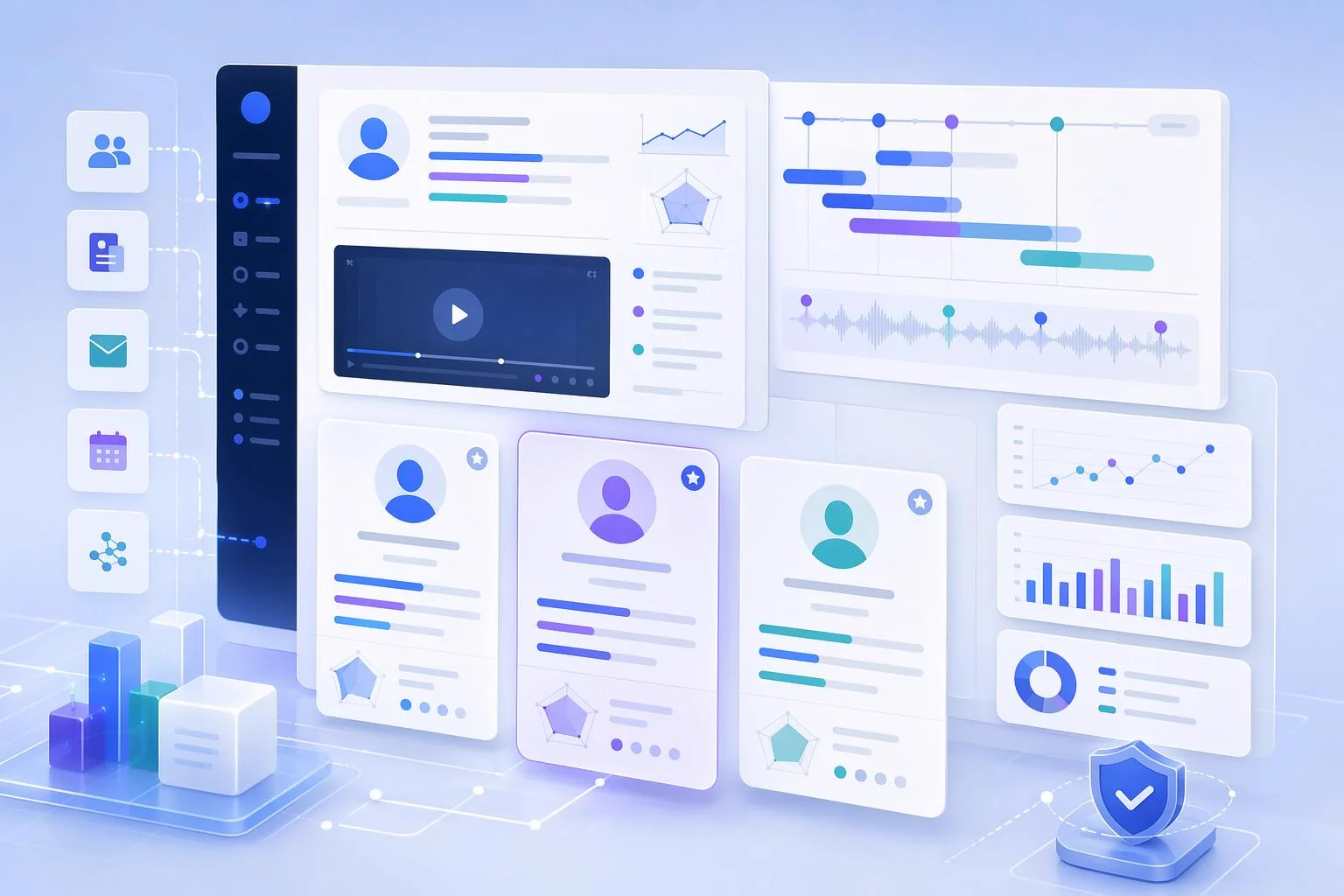
Why a score alone is not enough
In hiring, teams often want a simple answer: is this candidate a fit or not? Even better, they want a score, a ranking, or a short recommendation.
Many tools that call themselves an "AI recruiter" promise exactly that: assess the candidate quickly and produce a conclusion.
But in enterprise hiring, one number is almost never enough.
If a system gives a candidate 8 out of 10, the hiring manager immediately has questions:
- why exactly 8;
- what makes the candidate strong;
- which risks remain;
- what the candidate said during the AI interview;
- where this can be checked;
- how the candidate is stronger or weaker than other finalists;
- which questions should be asked at the final stage;
- whether the conclusion can be trusted.
Without answers, a score remains an opinion. Even if that opinion was generated by AI.
In an enterprise workflow, hiring needs more than assessment. It needs an evidence base. Here, AI in HR should not work as an opinion generator. It should work as a tool for verification, structuring, and candidate comparison.
A score says "how much". Analytics explains "why".
A score helps teams navigate the flow: prioritize strong candidates, filter weak ones, keep borderline profiles visible, and accelerate the early funnel.
But the value appears only when there is an explanation next to the score.
For example:
- the candidate is strong because they worked on similar tasks;
- there is a risk because they have not worked at the required scale;
- motivation looks stable because the candidate explains the transition logically;
- a skill needs verification because it is claimed in the resume but described superficially in answers;
- the candidate fits one team better than another because of the specific experience profile.
This is no longer just scoring. It is analytics that can be discussed, checked, and used.
Neurohiring is built around this logic: not "AI said the candidate is good", but "here are the data, conclusions, risks, strengths, and reasons for the recommendation".
How analytics is embedded in Neurohiring
Neurohiring is an Enterprise-Grade AI Hiring Autopilot. It guides the candidate through the funnel from pre-screening and resume screening to adaptive chat screening, AI interviews, analytics, and the finalist shortlist.
Analytics does not appear "at the end" as a separate report. It collects data from the entire funnel:
- what was known from the application;
- which red flags were checked during pre-screening;
- how the resume matches the role requirements;
- what the candidate clarified in adaptive chat screening;
- how the candidate answered during the AI interview;
- where strengths appeared;
- where risks were found;
- where answers differ from the resume or role expectations.
As a result, recruiters and hiring managers see a complete candidate picture, not fragments of information.
What good hiring analytics should include
Good analytics is not a long retelling of an interview. It should help people make a decision.
In enterprise hiring, five elements matter.
1. Strengths
The system shows where the candidate truly matches the role: experience, competencies, projects, industry context, leadership maturity, motivation, and communication.
These should not be generic compliments. They should be conclusions connected to the role requirements.
2. Risk areas
A risk does not always mean rejection. Sometimes it is a topic for the final interview. Sometimes it is a limitation the team can accept if the rest of the profile is strong.
The important part is to name the risk clearly.
3. Mismatches
If the resume says one thing and the answers show another, the system should record it.
For example, the candidate may mention participation in a project, but the interview reveals that their role was limited. Or the opposite may happen: the resume looks modest, but the conversation uncovers strong experience.
4. Assessment rationale
If a candidate receives a high or medium score, people should understand why.
For an enterprise customer, an opaque black box is not enough. Trust in AI appears when the conclusion can be checked.
5. Recommended next step
Analytics should move the process forward: invite the candidate to the final stage, clarify a topic, compare with other finalists, or stop the funnel.
Why timestamps matter
Timestamps are especially valuable in real work.
A hiring manager cannot always watch the full interview recording. A recruiter may need to show one key fragment quickly. An HR leader may want to verify a specific answer. In a borderline case, the team needs to return to the source, not debate a retelling.
Timestamps help quickly find:
- a story about a relevant project;
- an explanation of motivation;
- an answer to a professional question;
- the place where a mismatch appeared;
- a strong fragment;
- a questionable answer that needs checking.
This turns an AI interview from "a long recording nobody opens" into a working selection tool.
Why timestamps increase trust
AI analytics is easier to trust when it can be checked.
If the system says that the candidate explained project management experience well, the manager can open the relevant fragment. If the system highlights a risk in competency depth, the team can review the answer.
AI does not need to "prove itself" every time. But an enterprise hiring decision requires transparency.
Timestamps make conclusions verifiable. Verifiability creates trust.
Why comparison cards are needed
Even strong analytics for one candidate does not complete the final selection. Usually, the team needs to compare several people.
One candidate has stronger experience. Another has stronger motivation. A third can start sooner. A fourth is weaker on one requirement, but fits the team better. A fifth is more expensive, but can handle a more complex area.
If the data lives across resumes, notes, chats, and recordings, comparison becomes manual assembly.
A comparison card brings finalists into one logic:
| What we compare | Why it matters |
|---|---|
| Relevance to requirements | Understand fit for the role |
| Strengths | See where the candidate can create the most value |
| Risk areas | Discuss limitations in advance |
| Motivation | Estimate offer acceptance and retention potential |
| Conditions and expectations | Check hiring realism |
| Interview outcomes | See depth of experience and answer quality |
| Recommendation | Choose the next step |
In Neurohiring, the comparison card helps teams compare candidates and prepare a finalist shortlist with rationale.
Why analytics should be interactive
In real hiring, one report rarely answers every question.
A hiring manager may ask:
- "Who is stronger in B2B customer work?"
- "Who has more experience at a similar scale?"
- "Who can start sooner?"
- "Why is this candidate higher in the recommendation?"
- "What risks does the second finalist have?"
- "Who should we invite to the final conversation first?"
If analytics is static, the recruiter has to search manually again: resumes, notes, chats, and recordings.
Neurohiring includes interactive analytics: the recruiter or hiring manager can ask AI a question about the candidate and receive an answer based on the collected context.
This turns AI for recruiting from a static report into a working assistant for candidate review.
One candidate profile instead of scattered data
Hiring often becomes unclear because data is scattered.
Part of the communication is in messengers. Part is on job platforms. Part is in recruiter notes. Part is in email. Part is in the interview recording. Part is in manager comments. Part exists only in people's memory.
When the team needs to make a decision, all of this is assembled manually.
Neurohiring brings communication from different channels into one candidate context. The team sees not only the final score, but also the candidate's path through the funnel: which questions were asked, which answers were received, where clarification happened, which risks appeared, and which conclusions were formed.
For an enterprise customer, this matters: the larger the company and the more people involved, the higher the cost of scattered data.
Analytics improves not only selection, but the process
Analytics is useful not only for one hiring decision. It also shows what is happening inside the funnel.
If candidates often ask the same questions, the role description or communication may be missing important information. Neurohiring can provide a summary of candidate questions that remained unanswered. This can be used to improve the company's knowledge base.
If the same risks appear at one stage again and again, the role requirements may need clarification. If strong resumes fail on the same questions, the team may need to review criteria or sourcing channels.
This means analytics works not only for candidate selection, but also for overall hiring quality.
How analytics reduces hiring manager workload
The hiring manager often becomes the bottleneck. They have little time, but they make the key decision.
If they receive "please review these ten candidates", the process slows down. If they receive one candidate without explanation, trust drops. If they receive too many materials without structure, review is delayed.
Evidence-based analytics changes the format.
The manager receives:
- a short finalist summary;
- strengths and risks;
- a comparison card;
- timestamps for key fragments;
- the ability to ask AI a clarifying question;
- a recommendation with explanation.
In the Neurohiring positioning, hiring manager involvement can be reduced to up to 1 hour. Not because the manager is removed from the process, but because they receive a prepared basis for the decision.
Why this matters especially for large companies
In small companies, hiring can sometimes be fast and informal. In an enterprise workflow, it is more complex.
The process may involve a recruiter, HR leader, TA lead, hiring manager, security or compliance stakeholders, a functional leader, and several approvers. Each of them may have different questions about the candidate and the assessment.
That is why conclusions must be:
- structured;
- verifiable;
- connected to role requirements;
- based on data from the whole funnel;
- clear to different stakeholders;
- useful for candidate comparison.
Otherwise, AI looks like one more source of opinion. Neurohiring builds analytics so that the final decision remains with people, while people can see the reasons behind the recommendation.
Where AI ends and the human decision begins
Good AI in hiring should not make the final decision instead of the company.
Neurohiring does not replace the hiring manager. It prepares the foundation:
- fit assessment;
- analytical summary;
- strengths;
- risk areas;
- mismatches;
- timestamps;
- comparison card;
- finalist shortlist;
- recommendation.
After that, people make the decision using business context, team priorities, culture, budget, and other factors.
This is a mature model for enterprise hiring: AI collects, structures, and analyzes data, while people remain responsible for the final choice.
How to evaluate analytics in AI hiring
If a company tests an AI recruiting solution, it should not look only at the interface or the presence of a report.
Check what matters:
- Does the system identify strengths and risks?
- Does it explain the assessment rationale?
- Does it record mismatches between the resume and answers?
- Does it provide an interview summary with timestamps?
- Can the team quickly open a key fragment?
- Can several candidates be compared?
- Is there one candidate profile?
- Can the team ask a clarifying question about the candidate?
- Is the conclusion clear to the hiring manager?
- Does analytics reduce the time needed for final selection?
If a report does not help people make a decision, it is a formality. If analytics accelerates the choice and explains it, it becomes part of the new standard of hiring.
The new standard: not just assessment, but a verifiable foundation
Hiring should not become blind trust in AI. But it also should not remain a world of subjective notes, scattered recordings, and manual comparison.
The new standard sits in the middle.
The Neurohiring AI hiring autopilot collects data across the funnel, analyzes candidates, records strengths and risks, provides timestamps, creates comparison cards, and prepares the finalist shortlist.
The final decision remains with people. But people receive an evidence base, not a stream of raw information.
This is what separates mature AI in hiring from point automation: it does not only assess. It helps explain and verify why a candidate is truly a fit.
If a company chooses AI in recruiting, analytics quality should be evaluated by two questions: does it help the team make a decision faster, and does it increase trust in that decision among all participants?
What comes next in the series
In the next article, we will look at the finalist shortlist: why good AI does not decide instead of people, but prepares the foundation for selection, and how this changes the hiring manager's role in the hiring process.