

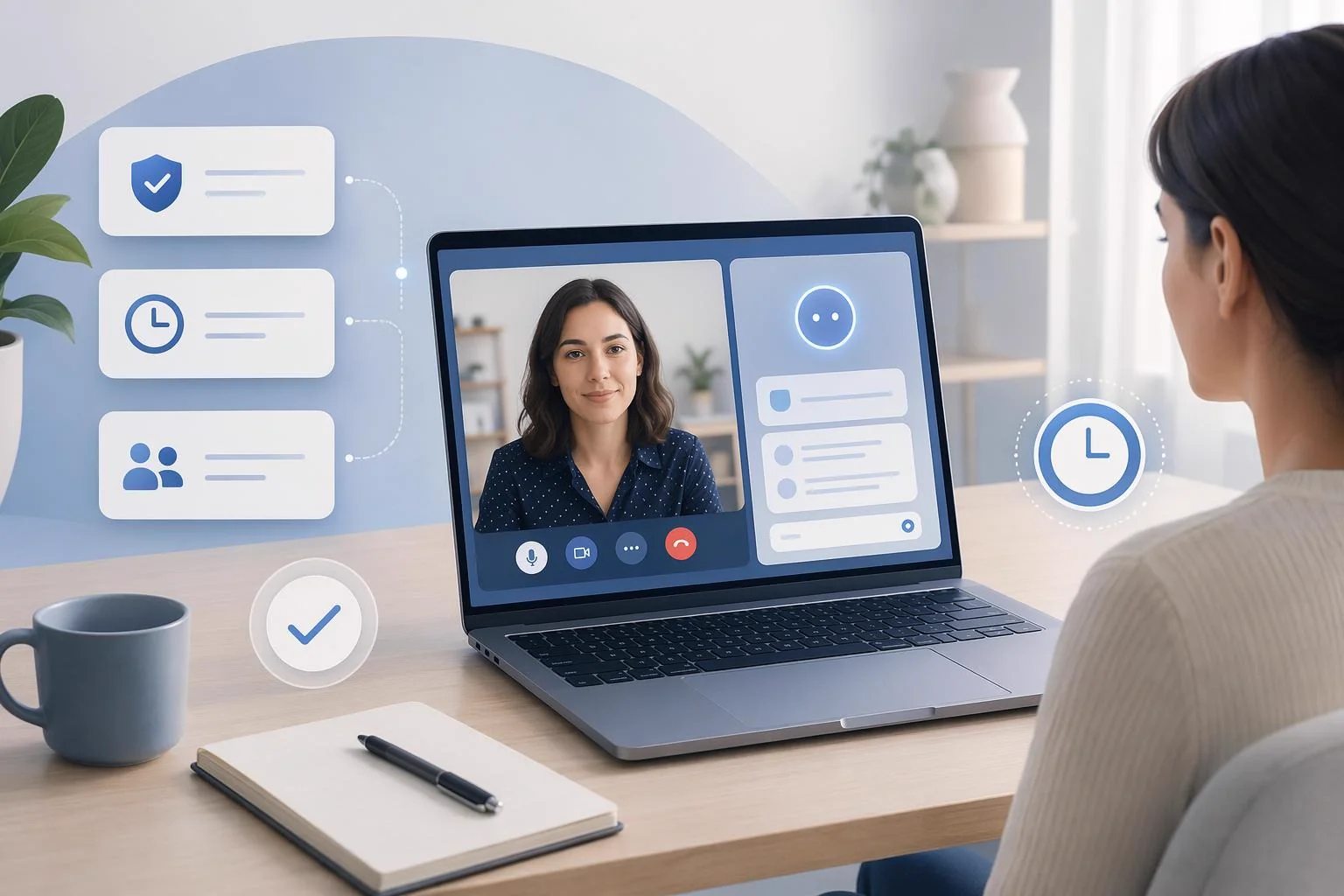
The question is not whether candidates love AI
When companies discuss AI in hiring, one question appears quickly: "Are candidates ready to talk to AI at all?"
The question is understandable. The HR team wants to accelerate the process, but not damage the relationship with people. This is especially important for strong specialists, rare roles, high-volume hiring, or vacancies where employer brand affects conversion.
But the main risk is usually not the technology itself.
Candidates are not against AI when the process:
- saves time;
- asks relevant questions;
- does not make them repeat the same information;
- does not turn selection into an endless form;
- gives a clear next step;
- works at a convenient time;
- does not create the feeling of talking to a wall.
Candidates are against bad experience. That is a different conversation.
For Neurohiring, this is a core principle: AI in HR should not make the candidate journey harder. It should make it faster, clearer, and more respectful.
What candidates actually dislike
Bad candidate experience exists even without AI. It is created not by technology, but by a poorly designed process.
For example:
- the candidate applies and receives no answer for several days;
- the recruiter asks for information already present in the resume;
- different participants interpret the role requirements differently;
- the interview is delayed because of calendars;
- the candidate completes a long questionnaire without understanding why;
- after the interaction, there is no clear result;
- every new stage starts as if nothing was known before.
If a poorly configured AI tool is added to this process, the experience will not improve. It may get worse: automation scales not only the strengths of a process, but also its mistakes.
So the question is not "AI or human".
The better question is: what experience does the candidate receive at each stage of the funnel?
Why bad AI experience is especially visible
Manual hiring has many weaknesses: it is slow, depends on recruiter workload, does not scale well, and often gives different assessment depth.
But a good recruiter has one major strength: they listen to the candidate, clarify, change wording, and understand context.
A bad AI process does not do that. It pushes everyone through the same route.
| Bad AI approach | What the candidate feels |
|---|---|
| One question set for everyone | "Nobody is listening to me" |
| A long form instead of dialogue | "This is bureaucracy, just digital" |
| Repeating resume data | "Why did I send the resume?" |
| No reaction to answers | "The system does not understand what I am saying" |
| Complicated access | "It is easier not to do this" |
| No explanation of the next step | "I do not understand what happens next" |
Point automation can accelerate one fragment, but it does not create a connected process.
Neurohiring works differently: as one AI Hiring Autopilot. Candidate context is preserved between stages, and communication uses already known data. That is why the product is different from a simple AI recruiter or chatbot: it does not just ask questions, it guides the candidate through the logic of the entire funnel.
What Neurohiring practice shows
One persistent myth about AI in hiring is: "Candidates will massively refuse AI interviews."
Practice is calmer than that.
In trials and pilots with enterprise customers, candidates rated AI interviews highly:
- 4.8 out of 5 in one enterprise pilot;
- 4.85 out of 5 in another enterprise pilot.
At the same time, only about 7.1% of candidates refused the AI interview, while around 92.9% accepted the format.
This does not mean that "all candidates love AI". That would be too simple.
It means something else: when implemented well, an AI stage does not have to break conversion. AI for recruiting can become a convenient part of the process if the candidate understands what is happening, does not face unnecessary barriers, and receives a respectful experience.
Good experience starts before the interview
Candidate experience is often discussed only around the interview. But it starts earlier - with the application and the first contact.
Neurohiring guides the candidate through the whole funnel: from pre-screening and resume screening through adaptive chat screening and AI interviews to a finalist shortlist with analytics and rationale.
For the candidate, this means the process should not feel like a set of disconnected touches.
If a person has sent a resume, the system can use its content. If data is limited, Neurohiring can start with pre-screening and red flags, then move to adaptive chat screening. If part of the information is already known, there is no reason to ask for it again.
This matters for different role types:
- for highly skilled professionals and white-collar roles, experience, motivation, depth of competence, and the ability to explain decisions matter;
- for office-operational and blue-collar roles, basic experience, accuracy, responsibility, and readiness for conditions matter;
- for no-resume or low-resume roles, the candidate needs a simple entry point and careful collection of missing information without the feeling of interrogation.
Adaptive chat instead of the same form for everyone
Chat screening is often seen as simple messaging automation. But a "form bot" and adaptive chat screening are not the same thing.
Neurohiring uses the available context:
- resume or application data;
- pre-screening results;
- role-specific red flags;
- role requirements;
- already known candidate information;
- candidate answers in the dialogue.
If the chat follows only red-flag pre-screening, the system asks basic clarifying questions about the role and conditions. If detailed resume screening has already happened, the questions become deeper and more precise.
The candidate should not feel pushed into a universal form.
Good chat screening does more than collect answers. It helps quickly and correctly understand whether it makes sense to move forward.
Tone affects conversion
Candidates evaluate not only the questions, but also the tone.
Even the right question can be asked in a way that makes a person close the dialogue. This is especially true for compensation, relocation, schedule, work authorization, experience in similar roles, or other sensitive topics where legally and contextually relevant.
Neurohiring chat screening is built with careful communication in mind:
- the system adapts to the candidate's communication style;
- sensitive questions are asked carefully and in the right sequence;
- the chat can answer candidate questions based on the role knowledge base;
- the dialogue can happen through familiar communication channels, depending on the implementation;
- richer communication formats can be supported where available;
- the system handles cases where the candidate does not respond, declines the vacancy, or appears as a duplicate.
These are not decorative details. In hiring, they affect conversion.
When communication is clear and relevant, the candidate is more likely to complete the next stage.
An AI interview is not a video questionnaire
Many candidates are cautious about video formats not because of AI, but because they have already seen poor implementations: record an answer to a preset question, fit into a timer, have no chance to clarify, and receive little context.
That is not an interview. That is a video questionnaire.
Neurohiring uses a different approach: the AI interview is built as a dynamic interview. The system does not follow a fixed list of questions. It adapts to candidate answers, uses previous stages, and clarifies specific points.
In real scenarios, an AI interview can:
- rely on the resume and chat screening;
- ask thematic question blocks;
- clarify details from answers;
- check project examples, the candidate's role, and decisions made;
- run a basic technical interview where relevant;
- create a summary with timestamps and analytics.
For the candidate, this is an important difference. They do not complete a "camera monologue". They complete a structured interview where answers influence the next questions.
24/7 is respect for time
One underestimated factor in candidate experience is process availability.
In manual hiring, interviews depend on the calendars of the recruiter, manager, and candidate. Even when everyone is interested, finding a slot can take days.
Neurohiring allows candidates to complete AI interviews 24/7. The candidate chooses a convenient time, enters through a unique link, and does not need to register or install an app. If there is a technical issue or the candidate needs to pause, they can reconnect within 12 hours.
For the company, this accelerates the funnel. For the candidate, it reduces frustration.
This is especially important when a strong candidate is speaking with several employers at the same time. The longer the company delays a clear next step, the higher the risk of losing the person.
Candidate experience affects more than employer brand
Candidate experience is not only about employer image.
Good experience affects business metrics:
- conversion from application to the next stage;
- speed through the funnel;
- the share of candidates who do not lose interest during the process;
- recruiter workload;
- data quality for the final decision;
- candidate readiness to continue communication;
- perception of the company as modern and organized.
If the candidate goes through a clear, fast, and meaningful process, the company wins even before the offer. It shows respect for time, the ability to work with data, and the absence of unnecessary bureaucracy.
For large companies, this is especially important: the hiring process becomes part of the overall impression of the business.
AI should help, not mislead
A good AI process should not hide technology at any cost.
Communication should be natural. Chat should be clear, adaptive, and relevant. The candidate should not feel pushed through a digital form.
But maturity does not mean pretending to be human where trust matters. Maturity means making the AI stage useful, correct, and explainable.
The candidate should understand:
- why the stage is needed;
- how long it will take;
- what happens next;
- how answers will be used;
- that the final decision is not made by a black box without human involvement.
For Neurohiring, the principle is simple: routine goes to AI, the final decision stays with people.
The AI hiring autopilot does not replace the responsibility of the HR team and hiring manager. It prepares the foundation: data, analytics, comparison, strengths, risks, and rationale.
How to evaluate candidate experience in AI hiring
If a company tests an AI recruiting solution, candidate experience should be evaluated not by feelings alone, but by clear signs.
Conversion
How many candidates agree to complete the AI stage? Where do refusals happen? Does the pattern differ by role type?
Candidate rating
How do candidates rate the format after completing it? What do they write in comments? Are there repeated complaints?
Speed
How much time passes from application to the next step? Does waiting time decrease? Does a new delay appear between stages?
Communication quality
Does the system ask relevant questions? Does it avoid repeating known information? Does it understand the role context? Does it handle sensitive questions correctly?
Business-result quality
Does the hiring manager receive clear analytics? Can candidates be compared? Is there enough data to decide who should move forward?
This is why a quick pilot or trial is important not only as an interface test. It shows how the AI hiring autopilot works on a real candidate flow and how people perceive it.
Why one connected workflow is better for the candidate
For the candidate, one connected workflow means fewer repetitions and more logic.
When pre-screening, resume screening, adaptive chat screening, AI interviews, and analytics are connected, the system accumulates context. Each next stage becomes a continuation of the previous one, not a new start.
This matters for the HR team too.
The recruiter sees a complete picture: what was in the resume, what the candidate clarified in chat, how they answered during the interview, where the strengths are, which risks need attention, and why the person did or did not reach the shortlist.
The hiring manager receives an analytical basis for selection, not a subjective retelling.
The candidate gets a process that moves faster and feels more organized.
The new standard: candidates reject bad process, not AI
The debate about whether candidates are ready for AI misses the point.
The better question is whether the company is ready to offer candidates a modern, clear, and respectful process.
If AI works like a long form, candidates will resist.
If AI asks the same questions to everyone, candidates will get irritated.
If AI ignores already known information, candidates will feel unheard.
But if AI helps them move through the process faster, at a convenient time, with relevant questions and clear logic, the attitude changes.
Neurohiring shows that AI hiring stages can be not a barrier, but part of a strong candidate experience. With the right methodology, shared context, and respect for people, the AI hiring autopilot works in the interest of all participants.
The company gets finalists faster.
The recruiter spends less time drowning in routine.
The hiring manager receives an evidence base for the decision.
The candidate goes through a clearer and faster path.
This is how the new standard of hiring is formed: not automation for automation's sake, but one connected process where speed, assessment quality, and respect for the candidate work together.
If a company chooses AI in recruiting, candidate experience should be evaluated as seriously as speed and analytics. A good AI workflow should help not only the employer, but also the candidate move faster and more clearly toward a decision.
What comes next in the series
In the next article, we will look at where AI interviews create the most value in hiring highly skilled professionals and white-collar roles: specialists, managers, engineers, software developers, marketers, accountants, and B2B sales managers.
We will discuss why it is not enough to simply "check the resume" for such roles, and why deep assessment of experience, motivation, and professional reasoning becomes one of the main advantages of the Neurohiring AI hiring autopilot.