

The final decision should not be automatic
Conversations about AI in hiring often fall into two extremes.
The first: AI is only a small recruiter assistant for routine tasks. The second: AI should hire people on its own.
Both frames are weak for enterprise hiring.
If AI helps only with one fragment, it does not change the operating model. If AI takes the final decision away from people, the company faces management, ethical, and business risks.
Hiring is not only about matching a resume to requirements. It is a decision about a person, a team, a role, risks, business priorities, and future work together. Some factors cannot be fully formalized: manager style, team dynamics, urgency, internal plans, and the trade-off between experience and potential.
That is why a mature model looks different: AI does not decide instead of people. AI prepares a high-quality, verifiable, and structured foundation for people.
This is how Neurohiring works. It is not an "AI recruiter" that selects the candidate alone. It is an AI Hiring Autopilot that brings the funnel to finalists and shows why they deserve attention.
The value of an autopilot is getting to finalists
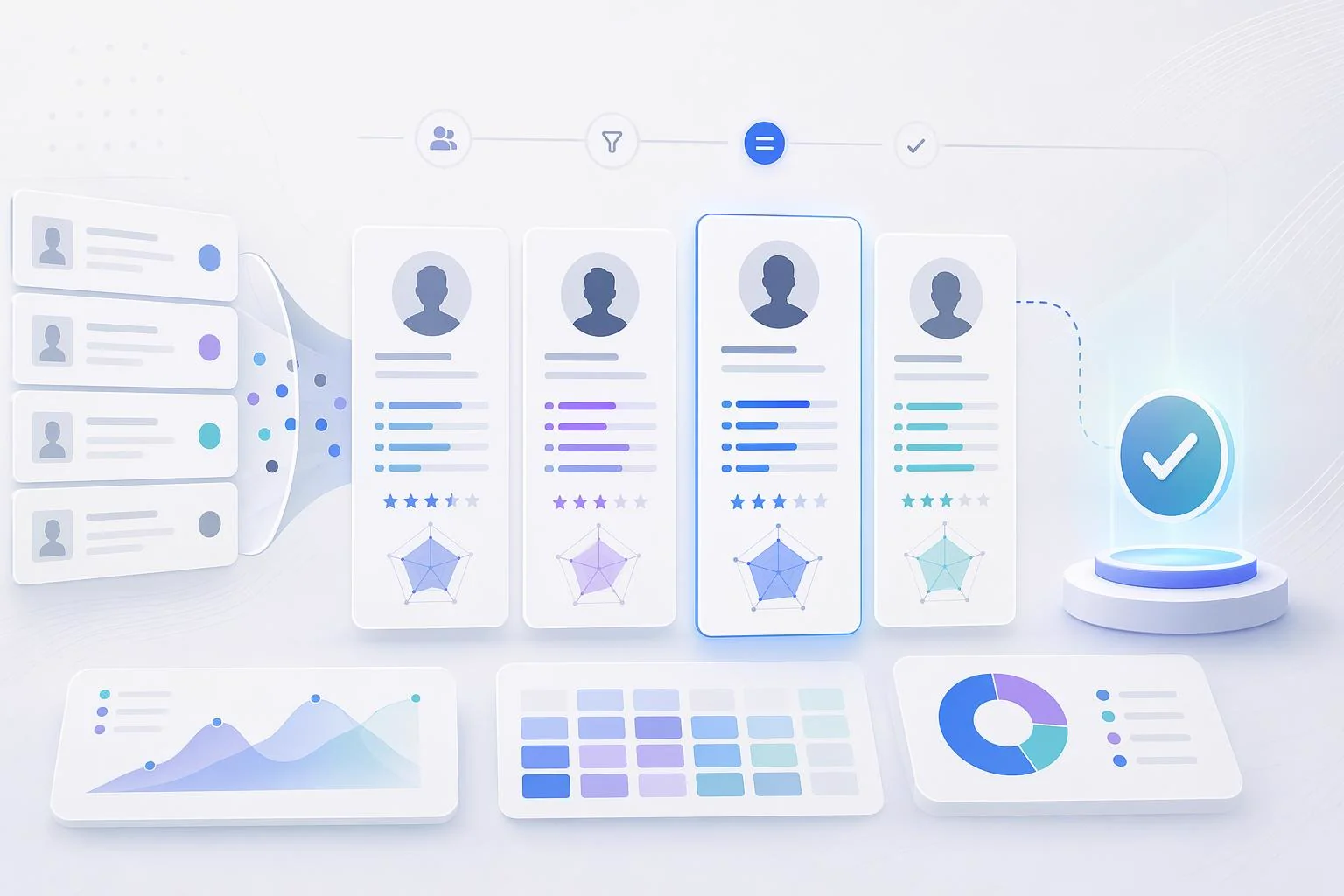
Neurohiring is an Enterprise-Grade AI Hiring Autopilot. It automates the core funnel: from pre-screening and resume screening through adaptive chat screening and AI interviews to a finalist shortlist with analytics and rationale.
This is not a story about "AI hiring by itself".
The task of Neurohiring is to remove manual routine, accelerate early stages, stabilize assessment quality, and prepare finalists who can be discussed substantively instead of being reviewed from scratch.
The final decision remains with the hiring manager. But the manager receives not a stream of raw resumes, but a basis for selection:
- fit assessment;
- analytical summary;
- candidate strengths;
- risk areas;
- mismatches;
- comparison card;
- recommendations;
- the ability to ask AI a clarifying question about the candidate.
People do not disappear from the process. They join where their decision is truly valuable.
For the business, this is a mature use of AI in recruiting: less manual routine, more prepared analytics, and preserved human responsibility.
"Show all candidates" is a poor finish
In manual hiring, the recruiter often sends too many materials to the manager: resumes, notes, comments, links to recordings, and fragments of communication.
Formally, the work is done. But the manager still has to analyze everything again:
- who is stronger;
- who fits the role better;
- where the risks are;
- what has already been checked;
- what still needs clarification;
- why these candidates reached the final stage;
- who should be reviewed first;
- who should be compared with whom.
If there are too many materials, review is postponed. If conclusions are not explained, they are not trusted. If candidates are not compared, the final decision becomes a separate manual project.
A good funnel result is not "we collected candidates for you". A good result is a finalist shortlist with clear comparison and rationale.
What the finalist shortlist means in Neurohiring
A finalist shortlist is not just several candidates with high scores.
In Neurohiring, it is the result of comprehensive reassessment based on all stages:
- pre-screening;
- resume screening;
- adaptive chat screening;
- AI interview;
- analytics;
- strengths;
- risk areas;
- mismatches;
- role requirements.
At the final stage, the system can prepare the top 3 candidates with detailed rationale and a comparison table.
The manager sees not only "who scored higher", but why one candidate looks more suitable than another.
A finalist shortlist is not a ranking
A ranking answers the question "who is higher?" A finalist shortlist answers another question: "who is truly worth discussing?"
These are different tasks.
A candidate may receive a high score but have a risk around conditions. Another may be slightly weaker on formal requirements but fit a specific team better. A third may be ideal by experience but still require a motivation check. A fourth may be strong, but better suited for a neighboring role.
That is why the final recommendation should consider not only the assessment, but also the context.
In Neurohiring, the finalist shortlist is built from the whole funnel, not from one scoring event. The team sees how the candidate looked in the resume, what was clarified in chat, how the AI interview went, which risks appeared, and where strengths were confirmed.
Why a comparison card is needed
When there are several finalists, the manager needs to compare them not "from memory", but through one logic.
A comparison card helps show:
| Criterion | What it gives the manager |
|---|---|
| Fit to requirements | Basic relevance to the role |
| Strengths | Where the candidate can create the most value |
| Risk areas | What to check or accept as a limitation |
| Motivation | How stable the interest in the role looks |
| Conditions and expectations | Realism of hiring and negotiation |
| AI interview results | Depth of experience and answer quality |
| Mismatches | Differences between resume and answers |
| Recommendation | A rational next step |
This is especially important in enterprise hiring, where several people participate in the decision.
The comparison card does not force a choice. It makes the discussion concrete.
Rationale matters more than "AI recommends"
"AI recommends this candidate" is a weak basis for hiring.
In a mature process, the team needs to understand:
- why the candidate reached the final stage;
- which data supports that;
- what has already been checked;
- which questions remain;
- how this candidate differs from other finalists;
- which risks the team accepts if it chooses them.
Rationale reduces distrust in AI and turns it from a black box into a working tool.
In Neurohiring, the recommendation is accompanied by analytics: fit assessment, comparison, strengths, risks, and candidate context.
How the shortlist saves manager time
In a classic process, the hiring manager often joins too early and too broadly. They review many resumes, conduct unnecessary first interviews, return candidates for clarification, and ask the recruiter to collect more data.
This overloads the team and slows hiring down.
The Neurohiring AI hiring autopilot changes the mechanics:
- Early stages run automatically.
- Irrelevant candidates stop earlier.
- Relevant candidates pass assessment and clarification.
- AI interviews collect deeper information.
- Analytics structures conclusions.
- A short list of candidates reaches the final stage.
- The manager chooses based on a prepared picture.
In the Neurohiring positioning, hiring manager involvement can be reduced to up to 1 hour. Not because the manager is "removed" from hiring, but because their time is no longer spent on early-stage routine.
How the recruiter's role changes
The shortlist is important not only for the manager, but also for the recruiter.
When the AI hiring autopilot takes over early stages, the recruiter shifts focus:
- from manual application processing to funnel quality;
- from repetitive clarification to communication with strong candidates;
- from scattered notes to working with analytics;
- from first-line filtering to business stakeholder alignment;
- from searching for information to solving complex cases.
The recruiter does not disappear from the process. The role becomes more expert and managerial.
The business does not need just a candidate flow. It needs a manageable hiring system.
How the shortlist helps avoid losing strong candidates
In a manual funnel, a strong candidate can easily get lost:
- the resume was reviewed too late;
- there was not enough time for clarification;
- the candidate never reached the manager's attention;
- information was scattered;
- strengths were poorly explained;
- the manager chose a more "obvious" profile and missed another candidate's advantage.
A shortlist with analytics reduces this risk.
If a candidate is strong, the system records the reasons: experience, answers, motivation, interview results, risks, and comparison with others. This helps the team avoid missing someone whose resume looked modest, but who appeared stronger in the dialogue.
Final selection should be interactive
Even a good shortlist does not answer every question.
The hiring manager may want to clarify:
- which finalist is stronger in a specific skill;
- who has more experience in a similar industry;
- who can start sooner;
- whose motivation looks more stable;
- what the risk is for finalist number two;
- why candidate one is ranked above candidate three;
- which interview fragment shows the key advantage.
In Neurohiring, the manager can ask AI a question about the candidate and receive an answer in seconds based on the collected context.
The shortlist becomes not a static report, but a working discussion tool.
Sharing with process participants
In enterprise hiring, the decision is rarely made by one person in isolation. A candidate may be reviewed by a functional leader, future manager, HR leader, and other stakeholders.
If data lives in different places, sharing becomes manual assembly: resumes, recordings, notes, links, comments.
In Neurohiring, the team can share a specific candidate or a comparison list with process participants. This helps involve them without unnecessary forwarding of materials.
The shortlist becomes a shared decision point.
The shortlist is the beginning of the final conversation
A shortlist does not mean "the machine has decided everything".
The right frame is different: AI has brought candidates to the point where the final conversation becomes concrete.
Now the team discusses not a stream of resumes, but specific finalists:
- who best solves the business task;
- which risk is acceptable;
- who should be invited to the final live interview;
- who can move toward an offer;
- which questions should be asked before the final decision;
- how to compare a strong but expensive candidate with a more affordable one;
- who may be considered for a neighboring role.
AI prepares the foundation. People make the decision.
How the shortlist accelerates hiring
The funnel becomes faster not only because individual actions are automated. It becomes faster when unnecessary approval cycles disappear.
If the recruiter sends scattered materials to the manager, the manager returns with questions. The recruiter searches for answers. The candidate waits. Competing employers move faster.
If the manager receives a shortlist with analytics, comparison, and rationale, the discussion moves faster from "what do we know?" to "who do we choose and why?"
In Neurohiring positioning, a finalist shortlist with detailed analytics can be ready in 1-2 days, and the path from application to AI interview invitation can take 3-5 hours. In selected enterprise cases, the hiring cycle was accelerated by 4-5x compared with a manual process.
Speed does not come from "AI magic". Every funnel stage works toward the final decision.
Where the shortlist is especially valuable
When the flow is large
If there are many candidates, the manager should not receive the whole flow. The team needs filtering and a short list of people truly worth discussing.
When the role is complex
If the candidate is assessed across several competencies, a resume is not enough. The team needs an interview, analytics, comparison, and explanation.
When several people participate in the decision
If the choice is aligned with multiple stakeholders, they need one shared picture, not scattered opinions.
When the role must be closed quickly
If the role is urgent, delays in final selection are especially expensive. A shortlist helps the team move faster from assessment to decision.
When the company scales hiring
As the number of roles grows, a manual model quickly hits capacity limits. A shortlist with analytics helps scale the process without proportional growth in workload.
How to evaluate shortlist quality
If a company tests an AI hiring solution, it should not only check whether the system can "choose the best".
Check what matters:
- Is it clear why candidates reached the final stage?
- Is there a comparison card?
- Are strengths and risks visible?
- Can conclusions be checked against previous-stage data?
- Are resume screening, chat screening, and AI interview results taken into account?
- Can the manager ask a clarifying question?
- Is it convenient to share a candidate or comparison list?
- Does the shortlist reduce final selection time?
- Does the AI recommendation avoid becoming an opaque order?
- Does the final decision remain with people?
The shortlist should improve decision quality, not replace responsibility.
The new standard: AI prepares the choice, people choose
Enterprise hiring does not need AI that pretends to understand every business nuance better than people.
It needs AI that takes over routine, structures data, reduces subjectivity in early stages, and brings the funnel to finalists.
Neurohiring is built around this model.
The AI hiring autopilot guides candidates through the funnel, analyzes resumes, clarifies data in adaptive chat screening, conducts AI interviews, creates analytics, and prepares a finalist shortlist with rationale.
The final decision remains with people.
This is the mature and honest role of AI in hiring: not to replace responsibility, but to give the business a faster, more precise, and more evidence-based foundation for selection.
If a company chooses AI for recruiting, it should not only evaluate whether the system can "rank" candidates. It is more important to understand whether it can explain the shortlist, compare finalists, and shorten the path to a management decision.
What comes next in the series
In the next article, we will look at candidate experience: why candidates are not against AI, but against a bad process, and how communication quality affects their readiness to complete automated hiring stages.